Walmart is stepping up its game by adding a new payment choice at self-checkout stations in over 4,500 stores across the US. Now, shoppers can use Walmart BNPL provided by Affirm, a service known for its clear and flexible payment plans that let you buy now and pay later.
Affirm’s payment options come with different interest rates, from 0% up to 30%, based on your credit and where you are shopping. You can pick from various repayment schedules, like paying in monthly installments over three, six, or twelve months. This setup is great for folks who want to manage their spending without worrying about hidden fees or penalties for late payments.
Shopping with Affirm at Walmart is incredibly easy. Once you’ve finished scanning your items at the self-checkout, simply choose Affirm as your payment option. Then, just head over to the app or website, provide some information, and make a decision on your payment plan. Once you’ve been approved, scan the barcode that’s generated. You’re all set! It’s a process that enhances your Walmart shopping experience.
Key Takeaways
Walmart Expands Payment Options: With Affirm now available at self-checkout stations in over 4,500 Walmart stores, shoppers have a flexible way to manage their purchases. This move underscores Walmart’s commitment to enhancing the customer experience and catering to diverse payment preferences.
Affirm’s Growing Influence: The collaboration with Walmart amplifies Affirm’s presence in the retail landscape. As the company partners with more major retailers like Amazon and Target, it solidifies its position as a leading ‘Buy Now, Pay Later’ service, appealing to a significant portion of American consumers.
Consumer Demand for BNPL: The rise of Buy Now, Pay Later services reflects a growing consumer preference for flexible payment options. Affirm’s recent study underscores this trend, revealing that a majority of Americans value the ability to use BNPL services, emphasizing its importance in today’s retail environment.
Evolution of BNPL Services: The Buy Now, Pay Later market is expanding rapidly, with projections indicating substantial growth in the coming years. As businesses and consumers alike recognize the benefits of BNPL, it’s clear that this payment model is reshaping the retail landscape, offering a convenient and accessible alternative to traditional payment methods.
Walmart BNPL – Team Up With Affirm For Flexible Payment Options
If you’re getting ready for holiday shopping, there’s some good news for you. Now, at over 4,500 self-checkout Walmart stores, you have the option to pay for your purchases in installments with the BNPL option. Thanks to Walmart’s expanded partnership with Affirm, you can spread out your payments in four to six parts. Pay monthly whether you’re shopping online using the app or visiting Walmart Vision and Auto Centers.
After this collaboration was announced, Affirm’s stock received a boost. This not only helps Affirm expand its customer base but also strengthens its relationship with Walmart. Do you remember back in 2019 when Walmart started offering affirmed pay-over-time options in 4,000 Supercenters across the United States? Well, this new development takes that partnership to heights. You can buy pretty much anything you’d find at Walmart, from clothes and gadgets to toys and more.
Pat Suh, the Senior Vice President of Revenue at Affirm, highlighted some interesting findings. A recent study by Affirm showed that a significant 54% of Americans want the option to use BNPL services when they’re checking out at stores. Even more striking, a whopping 76% of shoppers said they might delay or skip buying altogether if Affirm wasn’t available.
With this in mind, Affirm’s extended partnership with Walmart is no surprise. By offering their straightforward ‘Pay Later’ options at Walmart’s self-checkout stations across the United States, Affirm aims to empower even more shoppers. This move is smart and introduced at the right time, especially with the holiday season around the corner, helping people manage their budgets better while still enjoying their shopping.
If you opt to use Affirm at a self-checkout kiosk, simply open the Affirm app or go to Affirm’s Buy In-Store, Pay Later page on your smartphone. Enter the total amount for your desired items, which should be within the range of $144 to $4,000.
Next, select a pay-over-time plan that suits you, ranging from three to 24 months. Proceed to complete your checkout at the kiosk. Upon approval, you’ll receive a unique barcode. Simply scan this barcode at the self-checkout kiosk to finalize your purchase.
Affirm Focusing On Expanding Partnerships With Leading Retailers In Major Spree
In recent years, Affirm has broadened its reach by offering its buy now, pay later services through collaborations with major retailers. In August 2021, Amazon partnered with Affirm to provide installment payment services for select purchases exceeding $50. Shortly thereafter, Target joined the fray, incorporating both Affirm and Sezzle installment payment options for its customers, enabling Affirm usage for purchases totaling $100 or more.
As Affirm continues to build its network of retail partners, the company is not only focusing on its predominant online presence but is also making strides in attracting customers in physical stores. In October last year, Affirm’s CFO, Michael Linford, highlighted the introduction of the Affirm card. This move aligns with Affirm’s strategy to expand its influence in brick-and-mortar sales.
The Rise and Growth of Buy Now, Pay Later Services
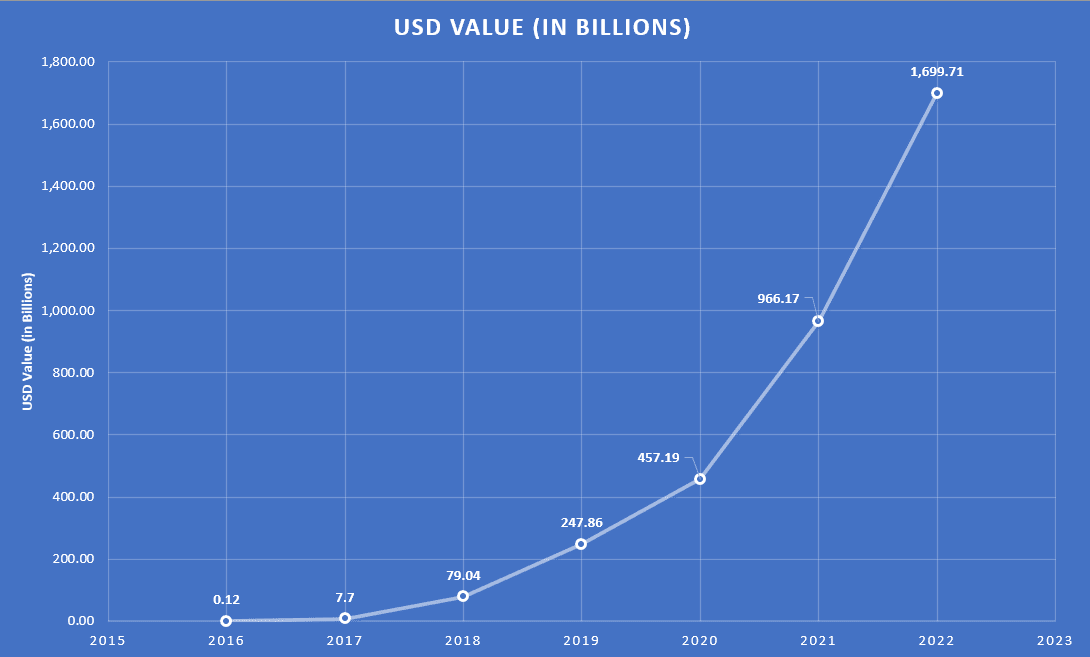
The BNPL trend has come a long way since gaining popularity in 2020. Now, these services are not only gaining traction but also becoming profitable. Experts predict that by 2026, BNPL could make up about a quarter of all online shopping transactions worldwide. That’s a big deal! And by 2023, it is expected to be valued at more than $70 billion in the North American market alone.
So, what’s driving this boom? BNPL services let you split big purchases into smaller, more manageable payments. Plus, some plans offer zero interest, making it even more appealing for consumers. It’s no wonder people are loving the flexibility these services offer.
But it’s not just consumers jumping on the BNPL bandwagon. Businesses are also seeing the benefits, of using these services for everything from day-to-day expenses to major investments. And it’s not just about retail anymore; BNPL options are expanding into areas like healthcare and even grocery shopping. With both traditional banks and new fintech companies entering the scene, the BNPL market is heating up. It’s clear that this payment option is not just a passing trend—it’s here to stay.
About Walmart
Walmart, Inc. is a major player in both wholesale and retail sectors, known for providing a wide range of products and services at consistently low prices. The company operates through three main business units: Walmart International, Walmart US, and Sam’s Club.
Under the Walmart US umbrella, you’ll find familiar brands like Walmart, Walmart, and Walmart Neighborhood Market, along with their online platform walmart.com. The Walmart International division oversees various retail formats such as supermarkets, supercenters, and warehouse clubs, but primarily outside the US. Meanwhile, Sam’s Club focuses on membership-based warehouse stores. Founded in 1945 by Samuel M. Walton and James L. Walton, the company has its headquarters in Bentonville, AR.
About Affirm
Founded in 2012, Affirm Holdings, Inc. is a US-based financial tech company making waves in the “buy now, pay later” (BNPL) section. With a robust presence, Affirm serves millions of consumers and partners with over 200,000 merchants. The company provides flexible payment options for both online and in-person shopping. Whether it’s through an online payment link, a virtual card, or a physical card, Affirm offers multiple avenues for customers to manage their purchases. On the business side, Affirm earns revenue by charging interest to shoppers and service fees to merchants.
When it comes to assessing loans, Affirm takes a comprehensive approach. They consider traditional credit scores, delve into other relevant financial data, and even harness the power of machine learning to make informed decisions.
Conclusion
Walmart’s introduction of Affirm’s BNPL option at self-checkout stations marks a significant step in enhancing the shopping experience for consumers. This partnership not only amplifies Affirm’s presence but also underscores the growing demand for flexible payment solutions.
As the BNPL trend continues to gain momentum, both consumers and businesses stand to benefit from its convenience and adaptability. With Affirm’s extended reach across major retailers and the broader retail landscape embracing this payment model, it’s evident that Buy Now, Pay Later is evolving from a trend to a mainstream financial tool, reshaping the future of commerce.
Online retailer Zulily shutting down its operations to liquidate assets was a surprise to many. Zulily’s shutting down led to the layoffs of numerous employees after attempts to turn the business around fell short.
Founded in 2010 by Mark Vadon and Darrell Cavens in Seattle, the platform has attracted millions of daily visitors looking for unique finds for clothing, home decor, toys, and gifts, all at discounted prices, it announced on its website that it’s working to fulfill all current orders and aims to complete this within the next two weeks. For orders that can’t be fulfilled, Zulily is focused on providing refunds. They’ve also provided a contact for customers who haven’t received their orders or refunds yet.
Key Takeaways
Closure and Job Losses: Zulily, a once-prominent online retailer, is shutting down its operations. This decision has led to the loss of over 800 jobs across three states: 292 in Seattle, 273 in Nevada, and 274 at its fulfillment center in Lockbourne.
Asset Liquidation: The company is in the process of selling off its remaining stock to settle its debts. Douglas Wilson Cos., a San Diego-based firm, will oversee the liquidation process to maximize returns for Zulily’s creditors.
Legal Action Against Amazon: Zulily has filed a lawsuit against Amazon, accusing the tech giant of unfair business practices. Specifically, Zulily alleges that Amazon pressured suppliers to offer less favorable terms to Zulily, thereby undermining its ability to compete effectively.
Community Impact: Zulily, which was once a significant presence in Seattle’s tech community, has faced challenges in recent years. The closure impacts employees and creditors and raises questions about the future of smaller e-commerce platforms in a market dominated by giants like Amazon.
Zulily, the online retail platform, has announced its closure, surprising both its customers and employees. Based in Seattle, the company stated on its website that it’s working to fulfill existing orders and aims to address any outstanding issues, including refunds, on January 22. They’ve also provided a contact for customers with concerns about their orders or refunds.
Once a standout in e-commerce, Zulily is now in the process of selling off its stock to settle debts as it prepares to close its doors. The company began winding down its operations recently after a 13-year stint that once captivated the tech world. However, it struggled to keep up with giants like Amazon and other online shopping platforms. Just before announcing its final sale, Zulily let go of over 800 staff members, with 292 positions in Seattle, 273 in Nevada, and another 274 jobs at its fulfillment center in Lockbourne.
In a statement on its website, Zulily confirmed it’s moving forward with a structured closure. The company has initiated an Assignment for the Benefit of Creditors (ABC), handing over the liquidation process to a third-party trustee. Douglas Wilson Cos., a firm from San Diego, will oversee the winding down and sale of Zulily’s assets, aiming to get the best outcomes for the company’s creditors. It’s worth noting that Douglas Wilson Companies is overseeing the process for Zulily.
Ryan C. Baker, Douglas Wilson Companies’ vice president, emphasized that choosing to wind down Zulily wasn’t taken lightly. Due to the tough business competition, Zulily faced and its financial challenges, immediate action was deemed necessary.
In another statement, Ryan highlighted their aim to handle the Zulily situation efficiently while ensuring the best outcomes for the company’s creditors. Baker mentioned that they’ve assembled a skilled team to manage claims and promptly respond to any queries or worries from both Zulily’s customers and creditors. Understanding the challenges these situations bring, they’re dedicated to being responsive and dependable in their role as the Assignee.
Once a notable presence in Seattle’s tech community, Zulily even sponsored the Seattle Sounders in 2019. Lately, the company gained attention for its vigorous advertising on social media.
Zulily’s move toward liquidation resulted in numerous job cuts across various states this past year. In a significant development last May, Regent, a private equity firm, acquired Zulily from its previous owner, Qurate Retail Group, known for QVC and HSN. This acquisition led to Zulily being separated from QVC, Inc.’s financial arrangements, with an outstanding debt of around $80 million settled by Qurate Retail at the time of sale.
Zulily’s closure follows the recent shutdown of Jane.com. Both struggled to compete with well-funded rivals like Amazon, Shein, and Temu. Just this month, Zulily filed a lawsuit against Amazon, alleging unfair business practices.
Ryan pointed out that the situation unfolded because Zulily had few options left.
Zulily has filed a lawsuit against Amazon, claiming the e-commerce giant used unfair tactics to undermine its business. Specifically, Zulily alleges that Amazon pushed sellers away from Zulily and restricted Zulily’s ability to offer competitive prices. These claims align with the FTC’s broader antitrust lawsuit against Amazon earlier.
The lawsuit alleges that Zulily’s suppliers felt pressured by Amazon’s pricing demands. Suppliers had to raise Zulily’s prices to match Amazon’s rates or stop doing business with Zulily altogether. Within just a year, about half of the suppliers selling on Amazon and Zulily chose to end their association with Zulily due to this pressure.
Zulily argues that its business model is straightforward – it buys products wholesale and sells them to consumers without extra charges. In contrast, Amazon operates a marketplace where retailers sell directly to consumers and pay additional fees for using the platform.
Amazon has refuted these claims from both Zulily and the FTC.
Wilson, from the legal firm handling the case, mentioned they’re reviewing the lawsuit and are committed to keeping it active. He emphasized that dropping the lawsuit isn’t on the table right now.
When Did Things Start To Tumble For Zulily?
Founded in 2010 by Mark Vadon and Darrell Cavens, who previously worked at the online jewelry store Blue Nile, Zulily saw rapid growth. By 2013, the company had attracted 12.6 million active customers and generated $331 million in revenue, a staggering increase of nearly 700% since its inception.
The company went public in 2013 with an initial valuation of $2.6 billion. By 2014, Zulily’s market worth climbed to $7 billion, backed by annual sales of $1 billion. Zulily expanded its workforce at the Nevada location, reaching around 1,000 employees, with plans to add another 600. That same year, the company revealed intentions to launch a new distribution center in Bethlehem, Pennsylvania.
Zulily’s growth momentum began to slow, and In a significant move in 2015, Liberty Interactive-QVC, later known as Qurate, acquired Zulily for an estimated $2.4 billion. Over time, challenges persisted, leading to the closure of its Pennsylvania facility and the unfortunate layoffs of approximately 500 employees in 2022.
Fast forward to 2023, the ownership of Zulily shifted to Regent, a private equity firm.
So, How Can You Reach The Team For Any Refunds Or Your Orders?
Zulily has established a dedicated team to assist customers, vendors, and other concerned parties. You can reach the Zulily ABC hotline at 8882025829, or for international callers, dial (+1) 7472886406. For more details and support, visit https://omniagentsolutions.com/ZulilyABC.
Zulily’s decision to cease operations and liquidate assets underscores mid-sized e-commerce platforms’ challenges in a fiercely competitive market dominated by giants like Amazon. Founded with promise and rapid growth, Zulily’s journey reflects the volatile nature of the online retail landscape.
The closure, affecting over 800 employees and countless customers, also highlights the ripple effects of such business decisions on communities and stakeholders. As the company navigates its liquidation process and legal battles, it is a cautionary tale about the complexities and uncertainties inherent in the e-commerce sector. For those impacted, Zulily has provided dedicated channels for support and inquiries, aiming to mitigate the fallout from its closure.
Salesforce, known for its cloud software, is set to buy Spiff, a company specializing in sales commission tools. This move strengthens Salesforce’s sales offerings, giving users a more robust platform. Established in 2017, Spiff has been a game-changer in automating sales commissions. Spiff offers a user-friendly interface that simplifies the process for businesses to set up automated sales compensation plans. Salesforce acquires Spiff with a focus on expanding its SPM offering in the market.
These plans adjust automatically when team members meet their agreed-upon goals. With built-in compatibility for popular enterprise ERP and CRM systems, Spiff can manage complex commission setups. This includes various conditions that might activate payments. Sales reps also benefit from real-time visibility into their potential earnings.
They’ve helped businesses set up fair and clear commission plans that boost sales team morale and performance. Now, joining forces with Salesforce, Spiff aims to grow even more, bringing added value to Salesforce’s customers. However, The financial terms of the agreement were not publicly disclosed.
Key Takeaways
Strategic Enhancement of Sales Performance Management (SPM): Salesforce’s acquisition of Spiff is a deliberate move to strengthen its Sales Performance Management offerings. By integrating Spiff’s specialized tools for automating sales commissions, Salesforce aims to provide users with a more comprehensive and efficient platform for managing sales strategies and enhancing business growth.
Simplified Compensation Planning: Spiff’s user-friendly interface and capabilities in automated commission calculations offer businesses a simplified approach to setting up and managing complex sales compensation plans. This acquisition promises to bring this ease of use to Salesforce’s Sales Cloud users, enabling them to design fair and transparent commission structures with minimal hassle.
Collaboration and Insights for Revenue Growth: The acquisition aligns with Salesforce’s goal to foster better collaboration between sales, finance, and other departments. With Spiff’s integration, Chief Revenue Officers and teams can expect improved insights into revenue drivers and more effective management of incentive plans, ultimately driving sales performance and growth.
Continuation of Innovation and Flexibility: Spiff’s ongoing commitment to innovation, highlighted by its recent funding rounds and introduction of new features like Spiff Designer, indicates a forward-thinking approach. As part of Salesforce, Spiff’s adaptable and low-code solutions are expected to further enhance Salesforce’s offerings, allowing businesses to tailor the platform to their unique needs more effectively.
Salesforce Acquires Spiff In An Undisclosed Deal To Boost ICM And SPM Solutions
Salesforce, a leading enterprise software company, has revealed its intention to purchase Spiff, a company specializing in innovative ICM software. The financial details of the deal have not been made public.
After the acquisition is finalized, Spiff’s team will become part of Sales Cloud. Their expertise will strengthen Salesforce’s SPM (Sales Performance Management) offerings. This move aims to give Salesforce customers a reliable platform for better visibility, enhanced sales strategies, and accelerated business growth. By integrating Spiff into Salesforce, will also enable Chief Revenue Officers (CROs) to collaborate more effectively with finance and sales teams. This collaboration allows for easier management of intricate incentive plans and provides insights into the key drivers of revenue growth.
Ketan Karkanis, GM at Salesforce, commented that the Spiff bridges the gap between what salespeople desire—clear compensation—and what sales managers seek—integrating compensation planning within CRM to align actions with business goals.
With Spiff, sales reps can see their commission details in real-time, helping them grasp their earnings better. The platform also handles intricate user roles, team setups, approval processes, and document management. Key features include its ability to grow with a business, easy integration options, and detailed analytics, making it straightforward for companies to set up compensation plans.
Both Salesforce and Spiff have a longstanding relationship, with over 70% of Spiff’s customers already using Salesforce’s Sales Cloud. When the acquisition is finalized in the starting months of 2025, Spiff’s team will officially become part of Salesforce.
Jeron Paul, CEO of Spiff, expressed enthusiasm about the company’s future and its role in ICM and SPM. He highlighted Spiff’s ongoing commitment to innovation and looks forward to contributing even more within the Salesforce environment.
Spiff is a flexible platform that lets businesses design their ideal pay structures with minimal coding. By adding Spiff to its portfolio, Salesforce enhances Sales Cloud with this adaptable feature. This flexibility makes it easier for users to tailor the platform to their specific needs, unlike older systems that can be rigid and complex.
While Salesforce offers robust tools, setting them up to fit unique business needs can be time-consuming. Customizing workflows or adding specific features often requires extra effort. However, Salesforce is committed to simplifying these tasks. Acquiring Spiff and refining tools like Salesforce Flow Builder are steps in that direction, aiming to make CRM setup more straightforward for users.
Based in Salt Lake City, Spiff has raised over $110 million since its inception six years ago. Salesforce’s venture capital arm, Salesforce Venture, has also been an investor. Beyond just investment, Spiff has been accessible on the Salesforce AppExchange for quite some time, indicating a deeper collaboration between the two firms.
Earlier this year…
Spiff announced a successful $50 million Round C Series funding. This round was led by Salesforce Ventures, with contributions from Norwest, Lightspeed, Album, and Kickstart Fund, among others. The funding was raised to help Spiff enhance its sales commission tools and address other intricate finance and sales tasks that traditionally relied on spreadsheets.
Additionally, Spiff also revealed its latest feature, Spiff Designer at the same time. This tool aims to simplify commission automation for finance and revenue teams. By combining the user-friendly nature of spreadsheets with advanced automation capabilities, Spiff Designer allows professionals in finance and sales operations to more efficiently manage and create their commission programs.
Salesforce Strengthens Low-Code Focus with Strategic M&A Acquisitions
Salesforce’s acquisition of Spiff fits into its broader strategy of bringing compatible companies into its fold, especially those focused on low-code solutions. This strategy is clear when you look at Salesforce’s recent acquisitions and where it’s investing.
For instance, in September, Salesforce bought Airkit, a platform that uses low-code to create AI-driven customer service tools. Airkit, based in Redwood City, California, was started by Adam Evans and Stephen Ehikian, who previously sold another startup, RelateIQ, to Salesforce for $390 million. Since its launch in 2017, Airkit received funding from various sources, including Salesforce Ventures. By 2020, they had secured $28 million in initial funding and a total of $68 million over six years. Just like Spiff, Airkit was also part of Salesforce’s AppExchange platform.
About Salesforce
Salesforce offers a cloud-based platform designed to craft meaningful customer experiences. Originating as a Software-as-a-Service (SaaS), Salesforce operates on a multi-tenant architecture, offering advantages like seamless API integration, scalability, and cost-effectiveness. It stands out as a top provider of Customer Relationship Management (CRM) solutions and extends its offerings with an Artificial Intelligence (AI) platform for areas like marketing automation, finance, and human resource management.
Whether for a small business or large corporations, Salesforce streamlines operations by providing employees with a unified customer view across various departments. These capabilities enable businesses to leverage cutting-edge technologies, identify potential customers, and enhance overall customer experiences. Currently listed on the NYSE and a part of the S&P 500 index, Salesforce boasts a market capitalization of $258.69 billion, showcasing its rapid growth in the competitive Cloud Computing landscape.
About Spiff
Spiff stands out as a sales compensation platform, streamlining commission calculations and boosting team motivation for enhanced top-line growth. With its user-friendly interface, real-time insights, and seamless integrations, Spiff empowers finance and sales operations teams to manage intricate incentive compensation plans independently. It brings transparency to sales teams, automating and optimizing commission plans to drive motivation among commissioned representatives. Spiff not only alleviates the challenges of commission management for the finance team but also fosters smoother collaboration between finance and sales, ultimately boosting overall sales performance.
Choose Spiff as your sales compensation software to unlock your team’s full potential. Tailored to help you achieve your goals, whether it’s boosting productivity or refining sales processes, Spiff is the solution you need.
Salesforce’s acquisition of Spiff marks a significant stride in its strategy to bolster its Sales Performance Management offerings. This strategic move enhances Salesforce’s capabilities by incorporating Spiff’s expertise in automated sales commission tools. With Spiff’s intuitive interface and robust functionalities, Salesforce customers can anticipate more streamlined processes and better visibility into their sales compensation strategies.
As Spiff’s team becomes an integral part of Salesforce’s Sales Cloud, the synergy between the two companies promises to deliver enhanced value, particularly for Chief Revenue Officers aiming for cohesive collaboration across departments. This acquisition not only signifies Salesforce’s commitment to innovation but also underscores its dedication to providing comprehensive solutions that drive business growth and optimize sales performance.
As real-time payments gain traction across industries, CFOs are weighing the benefits against the potential risks. A significant majority of more than one thousand CFO respondents (68%), have expressed their intention to adopt real-time transaction solutions, also known as instant payments.
The promise of faster transactions, improved cash flow visibility, and streamlined operations is clear, but so are the challenges tied to fraud prevention, integration costs, and internal process changes. In this environment, finance leaders are taking a measured approach—exploring new opportunities while keeping a close eye on security and compliance.
Key Takeaways:
About half of U.S. companies now use instant-payment rails (FedNow or TCH’s RTP), up from 40% in 2023, with roughly 80% expecting to use them by 2026. The FedNow Service (launched July 2023) and the RTP network together now reach most regions – over 1,300 banks and credit unions are live on FedNow, and the RTP network serves 285,000+ businesses monthly.
Both rails have raised transaction limits. FedNow will soon allow $1 million transfers (up from $500K); The Clearing House increased RTP’s cap to $10 million. All real-time systems support ISO 20022, so payments carry rich remittance data (invoices, payer/payee details) for easy reconciliation.
New risk features help manage fraud. FedNow now offers account-velocity controls and “receive-only” modes to limit misuse, and both networks provide 24/7 monitoring. In fact, 42% of RTP transactions occur outside normal banking hours, underscoring round‑the‑clock use.
Today’s CFOs cite cost-cutting and risk management as top goals. Nearly 60% of finance leaders rank reducing payment risk as a priority. Instant payments can boost cash flow by speeding receivables (92% of firms say faster rails improve cash flow) and enable “just-in-time” payables. Many cite lower processing costs (versus wires) and richer data as benefits.
Despite the upside, many CFOs remain careful. Surveys show the cost of upgrading legacy systems is the biggest barrier (over half of businesses see real-time rails as “costly”). Treasury teams still rely on ACH for payroll and wires for large payments, so instant rails are often phased in selectively. A compelling business case is needed to rework established processes.
Other markets continue to make rapid gains. The UK’s Faster Payments (24/7 since 2008) now handles transactions up to £1 million, with volumes 15% higher in 2024. The EU is implementing an “Instant Credit Transfer” rule under PSD3 (effective late 2025) to make euro payments instant.
Rising U.S. Adoption of FedNow and Real-Time Payments
Adoption of real-time rails has accelerated. In late 2024, a major U.S. survey found 51% of firms were already using FedNow or RTP for business payments – a jump from 42% a year earlier. Crucially, 80% of companies plan to be on these instant systems within two years. In practical terms, 285,000+ businesses now send instant payments each month via TCH’s RTP network, which recently surpassed $500 billion in cumulative transaction value.
FedNow, though newer, has also scaled quickly; by April 2025, it counted 1,300+ participating banks and credit unions nationwide (95% of them small/mid-sized). In Q1 2025, FedNow settled about 1.3 million transactions (up 43% year-over-year) – roughly $540 million in value daily. Which simply means, instant payments have gone from niche to mainstream in U.S. corporate finance over just the past two years. This momentum is driven by expanding network reach. When FedNow launched in July 2023, it extended real-time rails to hundreds of banks and credit unions that were not on the RTP network.
The two systems now complement each other, One large U.S. bank reported that clients can send an “instant payment” without worrying which rail will be used – the bank routes it via FedNow or RTP as needed to hit the recipient. In practice, this means more payees (suppliers, payroll providers, etc.) can be reached instantly. As The Clearing House notes, nearly half of RTP activity happens overnight, on weekends or holidays, aligning with how a 24/7 business operates. All told, broader connectivity and availability have pulled more corporate treasury teams into experimenting with these rails.
Since 2023, both FedNow and RTP have rolled out significant enhancements. The Clearing House raised RTP’s single-payment limit from $1 million to $10 million (effective Feb 2025) to accommodate high-value B2B use cases like real estate closings or daily merchant settlements. The Federal Reserve likewise plans to double FedNow’s cap from $500K to $1 million in mid-2024, recognizing that larger supplier payments or urgent payroll top‑ups are needed for big corporations. (Notably, FedNow’s baseline $500K limit was already five times higher than the $100K it launched with in 2023.)
Both rails use the ISO 20022 messaging standard. This means each payment can include detailed invoice and remittance information – far beyond the minimal ACH fields. For example, a real-time corporate payment can carry the supplier’s name plus an itemized invoice breakdown, all instantly visible to the recipient. That data-rich transparency makes reconciliation easier and can reduce exceptions. In short, instant payments now rival wires in amount and exceed them in data, often at a fraction of the cost.
Additionally, instant transactions are irreversible “push” payments, so controlling fraud is critical. FedNow has introduced new built-in safeguards – banks can set velocity limits or account-level thresholds by customer segment (e.g., tiering limits for retail vs. corporate clients), and institutions may choose to be receive-only (able to accept but not send payments) while security is fine-tuned.
The Fed also offers payment inquiry support and optional monitoring; a fintech assessment notes that FedNow was launched with dedicated fraud-prevention tools and inquiry-of-sending features. On the RTP side, participant banks similarly use analytics and screening on their rails. Thus, while no system is impervious, both instant networks are adding controls to address the very bank and treasurer concerns around push-payment fraud. In practice, these upgrades are making real-time payments more versatile.
For example, FedNow now supports low-cost request-for-payment messages (invoices) for free (effective 2025), mirroring TCH’s Request-for-Payment, which streamlines billing and approval. Liquidity management features (instant transfers between Fed accounts) have also been enhanced. Combined with 24/7 availability, these evolving capabilities are closing the feature gap between instant rails and traditional methods, inching them toward ubiquity.
CFO Sentiment and Strategy
Today’s finance chiefs acknowledge the potential of real-time payments but remain deliberate in their approach. A 2024 U.S. Bank survey found that cutting costs and managing risk are top-of-mind priorities for CFOs. In payments specifically, 59% of finance leaders said “decreasing operational risk” is an important initiative, up sharply from past years.
This caution translates into the way treasurers handle new rails. Many firms continue to use the ACH network (batch-based, low-cost) for routine disbursements like payroll or vendor checks, and rely on wires for one-off large payments. Instant payments are often reserved for scenarios that justify the effort, late-stage payables, supply-chain finance, earned-wage access programs, or customer refunds, where speed directly improves business outcomes. Most treasurers agree that instant rails can improve cash management, but they ask if the benefits outweigh the work.
Altering long-established payment processes can be challenging, and a compelling business case is necessary to justify the transition.
For many companies, simply holding onto cash until the last moment using ACH already effectively stretches the float. To change that habit, CFOs need to see a clear ROI, for example, earning early-payment discounts or avoiding short‑term borrowing by using last-minute electronic payments. This balanced stance is echoed on the banking side. A January 2025 report notes 90% of banks agree customers would benefit from instant rails, yet many institutions remain hesitant. Roughly one-third of banks cite legacy core-system limitations and fraud concerns as barriers.
Indeed, a majority of banks and credit unions surveyed called the upfront cost of upgrading the biggest obstacle to offering faster payments. In other words, the ecosystem (both buyers and their banks) is still adapting. For now, many financial institutions have joined FedNow in a “receive only” mode to mitigate risk. CFOs, who must work through these banks, feel that caution, if the company’s bank has not fully embraced sending, can limit immediate use.
However, despite these hesitations, most CFOs recognize that instant payments offer clear financial benefits. The Federal Reserve’s 2024 Business Payments Study found that 92% of firms say faster payments improve cash flow by accelerating receipts and unlocking discounts. Over half of businesses reported instant rails lower transaction costs (versus checks or wires). Real-time confirmation of payment delivery also reduces errors and enables same-day reconciliation, which appeals to the treasury’s efficiency goals.
Many CFOs are therefore building real-time capabilities for key use cases rather than wholesale replacement – for example, sending large vendor payments or making ad-hoc “just-in-time” payables that previously could not clear. In parallel, they continue using instant rails for incoming payments (customers paying by same-day transfer, payroll feeds, or merchant payouts) to gain confidence in the system.
Benefits vs. Challenges for Businesses
Benefits
The chief appeal of instant payments for a company is liquidity management. When a payment clears in seconds, the recipient’s accounts receivable drops immediately, and the payer’s cash outflow is finalized (good funds), allowing finance to optimize cash on hand. Businesses can push out disbursements to the very end of the day, and likewise receive payments without delay, greatly improving working capital.
For example, some employers now use FedNow for off-cycle payroll runs, letting employees tap earned wages instantly while delaying the company’s funding by hours or days. Suppliers receive money faster and with detailed invoice data, which has been shown to improve relations and potentially negotiate better terms. Real-time rails also enhance transparency and accuracy. Unlike ACH entries or checks (where often little more than an ID or invoice number travels with the money), instant transfers can include the supplier’s name and a full breakdown of charges up front.
This two-way messaging (especially under ISO 20022) makes matching payments to invoices almost automatic. In practice, CFOs find that fewer staff hours are wasted chasing missing remittance info. Several studies highlight data as a top advantage, like in a FedPayments Council survey, 56% of businesses using instant payments said they experience lower payment-processing costs and fewer errors.
Finally, there is cost efficiency relative to wires. Typical domestic wire fees (often $15–$30 each) can be dozens of times higher than same-day credit transfer fees, which generally top out at a dollar or two per transaction. For midsize transactions, that difference adds up. As a result, treasurers view real-time credits somewhat like a hybrid of ACH and wires, immediate like a wire, but priced closer to an ACH or commercial card. Over time, large treasuries may even reroute some B2B payments (e.g. supplier draws, claims, rebates) from wires into instant rails to save fees while still meeting their payees’ timelines.
Challenges
These benefits come with caveats. The biggest practical hurdle is integration cost and complexity. Many companies’ ERP and treasury systems were built for batch processing and ACH/file-based uploads. Connecting them to FedNow or RTP’s APIs, or to a bank portal, requires IT investment. As one treasury survey put it, over half of businesses not using instant rails cite “cost and complexity” as the key barrier.
Similarly, smaller firms without a sophisticated treasury function may simply defer adoption until services are turnkey. Also, real-time rails are irreversible, so fraud protection is crucial. CFOs worry about authorized push-payment scams (where an employee is tricked into sending money) or about insufficient time to detect errors. Instant payments networks mitigate this by requiring payers to pre-validate recipients and by including fraud screening at the network level.
For instance, FedNow includes optional filters and the ability to quickly reverse unauthorized transactions under tight timeframes. Banks are also bolstering customer education around confirming payment requests. Nonetheless, many companies ramp up usage gradually while internal controls catch up, or use dedicated fraud-monitoring services as a supplement.
Another issue is that not every counterparty is reachable instantly yet. As of early 2025, roughly 1,300 institutions (out of 9,000 U.S. banks and credit unions) had joined FedNow, and about 400 institutions support RTP. This means a mid-market business may have some suppliers on instant rails, but others are still reliant on ACH. CFOs must therefore maintain dual processes during transition.
Over time, as more banks join and paytechs integrate (many payroll providers, bill-pay vendors, and AR platforms are enabling FedNow/RTP), this “network effect” will ease. But in the near term, CFOs often use instant payments primarily for suppliers and channels that explicitly accept them, while continuing legacy channels elsewhere.
Regulatory and Competitive Side
In the payments industry, competition and regulation are spurring improvements. In the U.S., regulators encourage instant-pay adoption. The Federal Reserve has waived FedNow participation fees for small banks through 2025 and has consulted on beneficial-rule enhancements. The Fed also carefully set FedNow’s initial pricing (e.g., just $0.045 per transfer in 2023) to build volume. On the wire-transfer side, the Federal Reserve’s wire system (Fedwire) and ACH continue alongside, but corporate governance increasingly demands that firms evaluate faster options.
Additionally, fintech providers and payment networks offer alternatives that target similar goals – payment-card networks (Visa Direct, Mastercard Send) and fintech services (Zelle, and business-centric push-to-card) allow faster payouts to vendors and consumers without needing bank details.
Many CFOs consider these alongside FedNow/RTP as part of a suite of “just-in-time” payment tools, especially for disbursements to individuals or international partners. On the legislative front, U.S. authorities are focused on fraud prevention (e.g., encouraging protections for push-pay scams) but have not mandated instant rails for businesses. In contrast, Europe’s regulators are moving more aggressively. A new “Instant Credit Transfer” requirement under PSD3 will mandate euro deposits be available within seconds across the EU (targeting Oct 2025).
Chinese and Indian real-time systems have already demonstrated that ubiquitous instant payments can become a de facto infrastructure. This global momentum puts pressure on the U.S. market to evolve, but U.S. innovation (with dual rails and open banking tools) offers flexibility. For CFOs, this means staying alert to changes. For example, interoperable cross-border schemes (like SWIFT’s GPI for instant transfers) and token-based payment rails may eventually link with domestic real-time networks, expanding reach.
Real-time payments are now common worldwide, and the U.S. trail is closing. The UK’s Faster Payments Service, long a success story, saw transaction volumes jump about 15% in 2024. Faster Payments now allows up to £1,000,000 per transfer, enabling large B2B and real-estate transactions instantly. In continental Europe, the Eurosystem’s TIPS platform (TARGET Instant Payment Settlement) already handles instant euro credit transfers 24/7, and most SEPA member banks support it. The upcoming EU Directive will push all euro-area banks to make instant credit transfers available as a default by late 2025.
In Asia, markets are even further along. For example, India’s UPI system processed 93.2 billion transactions in just H2 2024, demonstrating consumer and merchant comfort with instant pay. China and other countries also have prolific mobile-driven payment rails. While U.S. businesses deal mostly in domestic USD transfers, these global examples show the full potential; once nearly every party is “on network,” instant payments become the norm for nearly all disbursements and receipts. For American CFOs with overseas operations, these developments also signal that cross-border payment delays may become more unusual. Banks and fintechs are working on instant rails for global B2B settlements, and some service providers now link FedNow/RTP flows to foreign instant networks (for example, a U.S. supplier paid in USD could have the funds immediately released to a UK partner via Faster Payments). This “real-time globalization” is still emerging, but it underscores how interconnected payment infrastructures are.
Final Thoughts: The Road Ahead
By 2025, real-time payments will have shifted from a future concept to a core tool for corporate finance teams. Adoption is now essential for timely supply-chain and treasury operations. Still, CFOs and treasurers weigh the benefits of speed and visibility against implementation costs and the need for strong controls.
The next step is deeper integration with financial systems. ERPs and Treasury Management Systems are adding direct connections to FedNow and RTP APIs, making it easier to support new use cases. Banks are also upgrading, moving beyond ACH to offer real-time push payments as client demand grows.
Many companies are starting with targeted use cases, such as automating end-of-month supplier payments or offering instant refunds. ACH and wires will still be used where they make sense, but finance teams are learning to assess real-time payments like any other method.
Real-time payments in the U.S. are at a turning point. CFOs who stay proactive can gain a competitive edge, while waiting too long may mean missed opportunities.
A significant majority of CFOs want to adopt real-time transaction solutions, also known as instant payments, within the next two years. This indicates a substantial increase compared to the adoption rate, which is less than half.
As of September 1st, The Clearing House (TCH), the operator of the RTP Network that has been operational since 2017, reported that around 150,000 businesses are actively utilizing its network. Additionally, in July, the Federal Reserve introduced its instant payment rail called FedNow.
Despite these advancements, it is worth noting that real-time payments are still in their early stages. These solutions enable transfers of funds between consumers and businesses by allowing them to instantly send and receive funds from their bank or credit union accounts at any time of day or year. This ensures that recipients have access to these funds instantly. But CFOs are cautious about real-time payments, let’s see why.
Key Takeaways:
Growing Adoption of Real-Time Transaction Solutions: CFOs are cautious about adopting real-time payments for now but are planning to adopt real-time transaction solutions within the next two years, pointing to an increasing trend in the use of instant payments.
Real-Time Payments Enhance Transparency and Cost Efficiency: Real-time payments offer a transparent view of payment information, providing details like the recipient’s name and a thorough breakdown of the invoice. When compared to wire transfers, instant payments are more economical, often resulting in reduced transaction expenses.
Anticipated Functionality Enhancements: The inclusion of Request for Payment (RfP) in the RTP networks services and its future integration into FеdNows offerings showcase the expected enhancements in functionality. These improvements aim to provide access to transaction details and improved measures against fraud activities.
Improved Cash Flow Management: Real-time payment solutions give businesses control over their payments. This allows for timing and instant confirmation of payments, which helps with managing cash flow and could potentially lead to early payment discounts.
CFOs Are Cautious About Real-Time Payments in a Changing Financial Landscape
In the past, there was a lot of uncertainty when it came to online payments. It was difficult to know for sure if the money reached its intended destination. Now, both parties involved can easily track the payment journey. This is an improvement compared to the ways of delayed settlements and complicated notification processes with traditional ACH and wire payments.
The rise of embedded finance has made things much simpler for buyers. They can now order the inventory they need and settle invoices all on one single platform. Payment orchestration platforms offer Account Payable (AP) services that take away the burden from clients and companies dealing with outbound payments.
Real-time transaction solutions offer CFOs the ability to swiftly settle payments with their suppliers, providing the potential for enhanced efficiency. Despite this capability, many CFOs are exercising caution in adopting these systems within their back offices, assessing whether the benefits ultimately surpass the associated costs.
In July, the Federal Reserve introduced FedNow, an instant payment designed to enable businesses and consumers to transfer money immediately. This initiative seeks to broaden access to rapid payments for a larger network of financial institutions and their clientele. Similarly, TCH, a payment network owned by major financial institutions, initiated a comparable payment system back in 2017. Both services enable instantaneous clearing and settling, operating seamlessly 24/7. In contrast, other payment methods may take longer or may not be available 24/7.
One of the key attractions for CFOs regarding real-time payments is the ability to meticulously manage working capital. By leveraging these systems, companies can delay bill payments until the last possible moment, effectively retaining their cash for an extended period. Additionally, real-time payments can furnish finance chiefs with the assurance of precise settlement and clearance timings for their transactions.
But why is there still hesitation among CFOs about using this as a go-to service? Why CFOs Adopt Cautious Strategy for Leveraging Instant Payments?
The reason why CFOs adopt a cautious strategyabout real-time paymentsis that while some may require this type of service based on the industry, not all B2B sectors may require the swiftness promised by FedNow and other similar services (like RTP by TCH), the potential for enterprises to leverage faster payments as a cash management tool is apparent. Some CFOs opt to hold onto their funds until the eleventh hour, still managing to make timely payments. However, altering long-established payment processes can be challenging, and a compelling business case is necessary to justify the transition effort.
Treasurers typically rely on the ACH system (which is also cheaper compared to instant payments) for batched electronic payments, like employee payroll, and traditional wire transfers for significant or crucial transactions.
Yet, neither system operates round the clock.
Digital payment ecosystems offer enhanced security compared to paper-based checks, eliminating the risk of mail losses. This secure environment incentivizes companies to modernize their payment practices. Suppliers increasingly prefer non-check payment methods, compelling buyers to adapt to these evolving preferences like instant payment (even if they have to pay a little extra).
FedNow and RTP Adoption Trends
A recent survey indicated that currently, 3% of treasurers are utilizing the FedNow payment system, with an additional 39% planning to join in the future. The remaining respondents were either uncertain or had no intentions of utilizing FedNow. The survey, encompassing 310 treasury executives, had almost 80% representation from publicly traded and private U.S. companies, with the rest comprising nonprofits and government agencies.
On the other hand, 12% of treasurers reported using TCH’s RTP network, with an additional 20% expressing their intent to adopt it.
Presently, the FedNow service is connected to over 120 banks and credit unions, while the RTP service by TCH is available at 400 financial institutions. It’s worth noting that there are approximately 9,000 banks and credit unions across the United States.
Reasons CFOs Should Consider Instant Payments
Transparent Information and Data
Information and Data within the ACH file typically include the payment amount, recipient details, and some basic particulars. However, the information obtained post-payment is often more restricted, as it relies on the recipient’s initiative to provide feedback through the network, which many suppliers do not consistently do.
Consequently, reconciling the payment becomes challenging since the payer may lack comprehensive information on the recipient, the exact payment amount, and the timing of fund reception. In contrast, a real-time payment incorporates crucial elements such as the supplier’s name and detailed invoice information, including an itemized breakdown of expenses. Real-time payments enable the transmission of payments along with this comprehensive data, facilitating seamless confirmation without requiring any additional action from the recipient.
Cost Efficiency
When compared to wire transfers, instant payments offer a significantly lower cost while maintaining, if not improving, the same rapidity. Traditional wire transfer charges generally range from $15 to $30, contingent on the financial institution. Instant or real-time payments, depending on the specific bank, can incur costs ranging from 25 cents to $1.
Similar to the use of commercial or procurement cards, incorporating real-time payments for a portion of back-office expenses can prove beneficial. These payments are not only more cost-effective than wire transfers but also offer a heightened value proposition compared to ACH transactions.
Anticipating Enhanced Functionality
TCH recently announced the expanded availability of RfP through the RTP network. This enhancement enables businesses to request payments directly. For instance, payroll providers can leverage RfP to prompt corporate customers to fund payroll on the same day as payday, instead of the customary three to four days prior, leading to improved fund management for employers.
Furthermore, FedNow is set to include RfP in its services, along with additional risk management and operational enhancements focused on bolstering fraud prevention capabilities and ensuring streamlined access to account and transaction information. To leverage the benefits of real-time payments, businesses should proactively engage with their financial institution to determine their participation status in the program.
Currently, around 400 financial institutions are active on the RTP network, with community banks and credit unions constituting 90% of RTP participants. FedNow has boarded 108 financial institutions thus far.
Enhanced Control for Cash Flow
RTP provides businesses with the capability to manage the timing of their outgoing payments accurately, ensuring a better grasp of their cash flow, a critical aspect for small and mid-sized enterprises.
Additionally, RTP enables businesses to obtain instant confirmation of each payment’s receipt, facilitating improved cash flow management and the potential to leverage early payment discounts.
Conclusion
The “digital” finance sector is experiencing a notable shift toward the adoption of real-time transaction solutions, as CFOs adopt a cautious strategy for leveraging instant payments within their operations. While the availability and advantages of real-time payments, such as enhanced transparency, cost efficiency, and improved cash flow management, are becoming increasingly evident, some finance leaders remain cautious in fully adopting these systems.
The cautious approach is driven by several factors, including industry-specific requirements, established payment processes, and cost considerations. Despite the benefits of real-time payments, CFOs are carefully evaluating the potential impacts on their current financial landscapes, assessing whether the benefits outweigh the associated costs and complexities of transitioning to these new systems.
As both the Federal Reserve’s FеdNow and TCH’s RTP Network continue to expand their services and functionalities, the potential for enhanced financial control and streamlined payment processes becomes more apparent with more and more people adopting this solution despite the current payment environment where CFOs Are Cautious About Real-Time Payments With the anticipation of additional enhancements and functionalities, businesses arе encouraged to actively engage with their financial institutions to explore the opportunities and benefits of integrating real-time payment solutions into their operations.
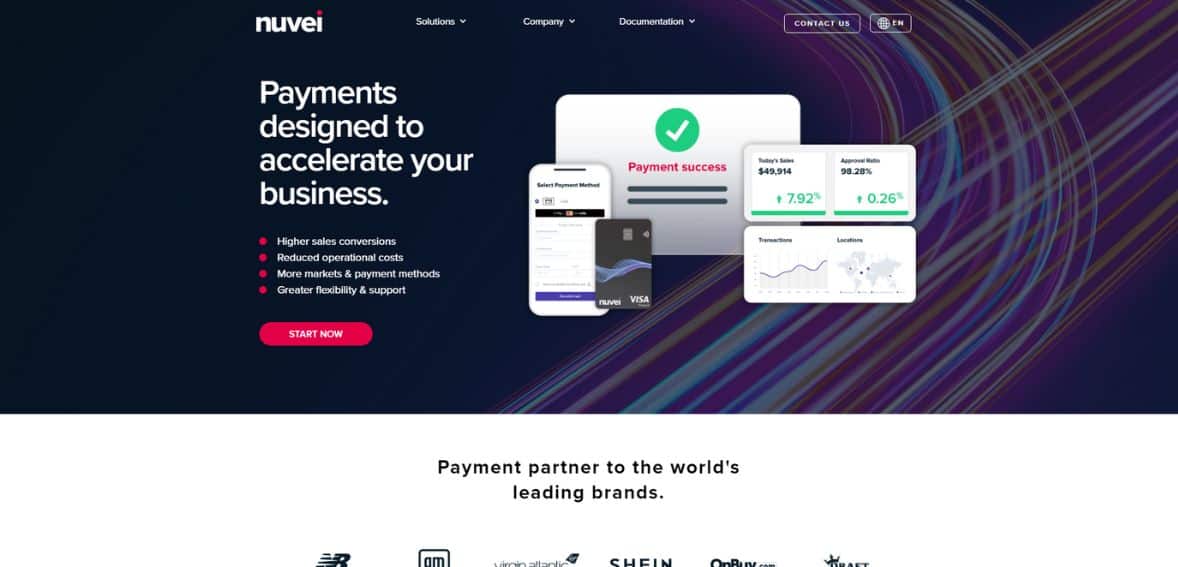
Pay with Bank Transfer, a division of American Express, recently revealed that they have chosen Nuvei Corporation, a known fintech company, to be their first authorized acquirer responsible for promoting and delivering the innovative payment method made possible by Open Banking.
As Nuvei Partners with American Express to enable effortless A2A payments, this forward-thinking payment solution allows consumers to effortlessly conduct transactions directly from their banks, eliminating the need to put in the card attributes or undergo additional authentication procedures. PwBt provides vendors with a seamless payment experience that includes instant fund reconciliation and attractive processing charges. Nuvei will actively promote PwBt to both existing and new merchants in the UK, helping them seamlessly integrate the Open Banking approach into their e-commerce platforms.
PwBt Selects Nuvei as First Acquirer for Open Banking Solution: Nuvei Partners with American Express to promote and distribute its innovative Open Banking-powered payment method.
Seamless Integration into Nuvei’s Checkout Process: Nuvei offers its customers an effortless way to integrate PwBt into their checkout process. This can be done by utilizing Nuvei’s customizable payment solution, which allows for an overview of all payment data from each customer transaction. Additionally, it simplifies payment operations, making them more efficient and streamlined.
Enhanced Benefits for Merchants and Consumers: As Nuvei Partners with American Express, this collaboration aims to provide its merchant partners with efficient and secure payment alternatives, promoting increased conversion rates and reduced cart abandonment. PwBt’s expansion is set to contribute to the broader adoption of Open Banking solutions, fostering trust and comprehension among consumers.
Open Banking’s Empowering Potential: Open Banking technology enables individuals to have control over their management and opens up possibilities for innovative payment solutions, like PwBt, which enhances user experience with its security and seamless operation.
Background
In a press release issued in 2019, American Express announced its plan to introduce a real-time financial transaction product for consumers in the UK. This product – PwBt – was designed to allow people to make payments for goods and services. The PwBt service is designed specifically for individuals who have bank accounts, regardless of whether or not they have an American Express card. American Express has partnered with eCommerce merchants from different industries, including well-known names like Hays Travel and Thai Airways.
By taking advantage of the opportunities presented by open banking regulations, the PwBt feature enables sellers to receive payments from customers who are connected to leading banks in the UK. Buyers can conveniently check their account balances and make payments online using this service. American Express recognized the potential offered by open banking and got in line to help businesses with a new, efficient, and secure way to accept online payments from their customers.
The whole structure of open banking empowers individuals with greater control over their financial management. The regulations implemented by the EU at the time facilitated the sharing of data from multiple banks, paving the way for innovative payment solutions such as PwBt. This solution recently expanded its way to a Canadian giant as Nuvei Partners with American Express to Enable Effortless A2A Payments.
Nuvei Partners with American Express to Expand PwBt’s Seamless Open Banking-Powered Solutions
PwBt provides a secure method for paying your American Express bill through a direct transfer from your bank account. It’s a user-friendly process that takes just a few simple steps, without the need for any account setup. Additionally, since your bank manages the payment entirely, you benefit from top-tier bank-level security, with none of your payment details stored by American Express.
Nuvei customers will have the opportunity to seamlessly integrate PwBt directly into their online checkout process using their existing link to Nuvei technology. Leveraging Nuvei’s adaptable and full-stack tailor-made payments solution, online businesses can optimize their checkouts and streamline their backend payment operations through a unified connection, facilitating smoother interactions and providing a consolidated picture of all payment data from every customer transaction.
The CEO of Nuvei, Philip Fayer expressed pride in extending the availability of PwBt to their merchant partners, enabling them to meet the increasing customer demand for efficient and secure payment alternatives.
He added that their goal is to facilitate closer connections between their clients and their customers through flexible payment options, regardless of location or preferred payment method. Backed by American Express but accessible to anyone with a bank account, they recognize that PwBt surpasses expectations by providing a secure and seamless service that is inclusive and user-friendly. They are excited to collaborate in extending these advantages to a wider customer base.
Holly Coventry, the Vice President, emphasized that in today’s digitally-driven environment, consumers seek straightforward and secure payment solutions. Merchants who understand this trend are experiencing increased conversion rates and reduced instances of cart abandonment.
The Nuvei partnership with American Expresswill expand the reach of PwBt to more merchants, addressing these concerns and offering additional benefits such as immediate reconciliation and appealing processing fees. This expansion will contribute to the broader adoption of Open Banking solutions, as consumers will gradually build trust and comprehend the advantages with more frequent exposure to this payment option.
All of Nuvei’s partners selling to customers in the UK now have the opportunity to seamlessly integrate (PwBt) instantly. The technology, backed by American Express but accessible to anyone with a UK bank account, enables customers to enjoy the effortless payment process while benefiting from American Express’s robust bank-level security measures.
About American Express
American Express serves as a global service company, providing a diverse array of products and services, including charge and credit card products, expense management solutions, consumer and business travel services, as well as stored value products like traveler’s cheques and other prepaid options. Additionally, the company offers network services, merchant acquisition and processing, servicing and settlement, point-of-sale systems, marketing and information solutions for merchants, and fee-based services, encompassing market and trend analyses, consulting services, fraud prevention, and the development of tailored customer loyalty and rewards programs.
The “Pay with the Bank Transfer” feature by American Express enables consumers to make direct online or in-store payments from their bank accounts. Leveraging the capabilities of open banking, this service provides financial and processing advantages to merchants while offering customers a simple, swift, and secure payment method.
About Nuvei
Nuvei operates as a financial service company, offering clients a range of payment technology solutions. Through Nuvei, businesses can access various payout options, along with banking, card issuing, fraud management, and risk management services. Leveraging Nuvei’s adaptable, expandable, and customizable technology, businesses can embrace next-generation payments, offer diverse payout choices, and tap into banking and card issuance opportunities.
By linking businesses to their customers across more than 200 markets, with localized acquisition in over 47 markets, 634 distinct payment methods, and 150 currencies, Nuvei equips customers and partners with the technology and insights necessary to thrive both locally and globally through a single integration.
Conclusion
The collaboration between Nuvei Corporation and American Express to facilitate seamless Account-to-Account (A2A) payments through the Pay with Bank Transfer (PwBt) solution marks a significant advancement in Open Banking-powered transactions. By leveraging Nuvei’s adaptable technology and American Express’s secure banking features, this partnership aims to provide a user-friendly and secure payment experience for consumers while aiding merchants in streamlining their checkout processes and enhancing transaction efficiency.
With an emphasis on enhancing financial control for individuals and delivering simplified, secure payment solutions for businesses, the integration of Open Banking technology presents an innovative and progressive approach within the fintech industry. As Nuvei actively promotes PwBt to a wider audience of merchants in the UK, the collaboration is expected to further accelerate the adoption of Open Banking solutions, enabling increased consumer trust and understanding of the benefits associated with this cutting-edge payment method.
Following a robust quarterly performance, Block stock surged on strong earnings and upgraded outlook, with an increase of up to 17% during after-hours trading. The payment company, led by Jack Dorsey, has updated its adjusted profit forecast to show confidence in its ability to withstand the harsh economy’s impact on consumer spending. This positive revision aligns with the performance observed in the sector, which closely reflects consumer spending patterns.
Block now expects to achieve adjusted core earnings ranging from $1.66 billion to $1.68 billion for the year, surpassing their estimate of $1.50 billion. Additionally, the company aims to achieve profitability based on operating income by 2024. Amrita Ahuja, the finance chief, has disclosed plans to reduce the workforce by year’s end as part of a comprehensive cost-saving program implementation.
Stock Surge Following Upgraded Forecast: Block Stock Surges on Strong Earnings and Upgraded Outlook, with shares climbing as much as 17% in early trading, buoyed by an improved forecast for the entire year’s adjusted EBITDA, signaling investor confidence in the company’s financial health and prospects.
Exceeding Financial Expectations: Block has surpassed the expectations set by Wall Street in Q3 2023. Their adjusted earnings per share (EPS) of $0.55 exceeded consensus estimates, resulting in a surge in Block shares price after their impressive earnings beat and increased full-year guidance. This strong performance aligns with their revenue growth trend, as their net revenue has increased by 24%. Moreover, their adjusted EBITDA has significantly surpassed expectations.
Strategic Cost-Saving Initiatives: To enhance efficiency and profitability, Block is implementing a cost-saving program that includes measures like downsizing the workforce and automating processes. Their goal is to achieve profitability on an operating income basis by 2024.
Robust Growth Across Platforms: Blocks Cash App and Square segments have experienced robust growth year over year. The monthly active accounts for Cash App have seen an increase, while Squares revenue has grown by 12%. This noteworthy growth across platforms further supports Block’s raised earnings expectations and ambitious targets for the future.
Block Stock Surges: Soaring Shares and EBITDA Outshine Estimates With Strong Outlook
Block stock surged, climbing as high as 17% during early trading, following the company’s upward revision of its adjusted EBITDA projection for the year. In the third quarter, Block reported a significant rise in EPS to $0.55 compared to $0.42 in the previous year, surpassing the expected value of $0.47. The company’s net revenue reached $5.62 billion, showing a growth of 24% YOY.
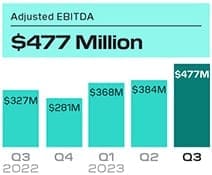
Adjusted EBITDA exceeded expectations at $477.5 million, surpassing the estimated value of $373.8 million, while the total payment volume increased by 10% annually and reached $60.08 billion. Cash App stood out as a competitor with an account activity of $55 million for transactions, marking a 1.9% increase from the previous quarter.
Additionally, Block revised its adjusted EBITDA projection for the year to be around $1.67 billion. The company expects significant growth in adjusted EBITDA to reach approximately $2.4 billion by 2024. Furthermore, Block announced a stock buyback program of $1 billion.
Ahuja mentioned that they have identified areas where they expect to find cost savings, such as real estate, process improvements through automation, and discretionary spending.
With consumer spending in the US maintaining a generally positive trend, analysts anticipate a rise in sales during the crucial holiday shopping season, supported by retailers offering substantial discounts on various products to attract buyers. Furthermore, Block has now projected a gross profit for 2023 ranging from approximately $7.44 to around $7.46 billion.
As the Block stock surges on strong earnings, the expectations for 2024 are high, with the company expecting a significant enhancement in adjusted operating income margin compared to 2023. In its shareholder letter, the company stated that its outlook does not consider any additional macroeconomic deterioration that could affect its results.
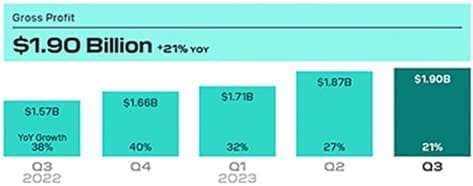
During the Q3 results, net revenue experienced a 24% YOY growth, escalating from $4.52 billion to around $5.62 billion. Bitcoin revenue surged from $1.76 billion to $2.42 billion YOY. Gross profit increased by 21% compared to the same period last year, rising from $1.57 billion to $1.9 billion.
Adjusted EBITDA stood at $477 million, in contrast to $327 million in the year prior. Block observed particularly robust growth in its payment platform, Cash App, and its POS options from Square.
Cash App revenue reached $3.58 billion, marking a 34% YOY growth, while Square revenue increased by 12% YOY to $1.98 billion. Jack Dorsey remarked that they have been relatively quiet recently due to their intense focus.
Key Revenue Details
Transaction Segment: The company’s transaction revenues reached $1.66 billion, reflecting a 9.3% increase from the previous year. However, this figure was slightly below the expected $1.68 billion.
Strong Square Ecosystem: Within the transaction revenues, the robust Square ecosystem contributed $1.54 billion, marking a 10% growth from the prior year.
Subscription and Services: Revenues from this category amounted to $1.49 billion, indicating a significant 25.3% surge year over year, surpassing the expected $1.46 billion. The solid performance of the Square ecosystem played a role, contributing $402 million to subscription and service revenues, up 21% from the previous year.
Hardware Segment: The company’s business generated $42.3 million in revenues, showing a slight decline of 2.4% from the previous year, missing the projected $45.9 million.
Bitcoin: Revenues from the Bitcoin category totaled $2.42 billion, representing a substantial 37.5% increase from the previous year.
These figures demonstrate the company’s varied revenue streams and its continued growth in different segments.
Block’s Q3 Earnings – Balance Sheet And Operation Details
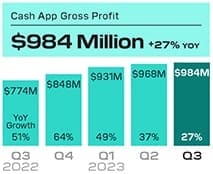
For the third quarter of 2023, the company saw its gross profit increase by 21.1% from last year, reaching $1.898 billion. However, the gross margin saw a slight decrease of 0.9% from the previous year, ending at 33.8%. Breaking it down, the Cash App was a standout, with its gross profit rising to $984 million, which is a 27% boost from the previous year. Similarly, Square’s earnings were up, with a gross profit of $899 million, marking a 15% increase from the year before.
When we look at the adjusted EBITDA, there’s a notable rise to $477.5 million, which is a 45.9% jump from last year. This is while keeping in mind that the non-GAAP operating expenses also climbed by 14.4%, reaching $1.44 billion.
There’s also good news regarding operating income. It saw a significant climb to $89.8 million, a substantial increase from the $32.2 million reported in the quarter last year. Turning our attention to the balance sheet, as of September 30, 2023, there’s a healthy cash and equivalents balance of $5.1 billion, up from $4.7 billion at the end of June. The short-term investments also saw an uptick, standing at $1.16 billion, compared to $1.12 billion in the previous quarter.
The long-term debt has remained more or less the same, with a slight increase to $4.118 billion from $4.114 billion in the previous quarter.
About Block
Block, Inc. concentrates on building comprehensive ecosystems tailored to specific customer groups. Operating across two primary segments, namely Cash App and Square, the company provides a range of services designed to meet the needs of businesses and individual consumers. Under the Square segment, Block enables businesses or sellers to process card payments, offering a suite of products and services that support their operational growth. This segment combines hardware, financial, and software services, creating user-friendly products and services.
On the other hand, the Cash App segment offers a variety of financial tools and services, empowering consumers to effectively manage their finances. With a focus on enhancing financial management, Cash App facilitates money transfers, savings, spending, investments, and receipt management. Additionally, Block’s TIDAL platform serves as a global hub for musicians and their fans, providing engaging content and experiences to foster stronger connections between artists and their followers.
The company also engages in the Bitcoin ecosystem through Spiral, an independent team dedicated to contributing to the open-source development of Bitcoin technology.
Conclusion
The company’s strategic adjustments to its earnings forecast, coupled with cost-saving measures and a focus on operational profitability, have cemented investor confidence.
The strong growth across both Cash App and Square segments is a testament to the company’s robust business model and its ability to adapt and thrive in a volatile economic environment. As Block continues to diversify its revenue streams and enhance its operational margins, it stands as a compelling example of resilience and forward-thinking in the fintech sector. The upward trajectory in its financials, backed by a comprehensive ecosystem of products and services, positions Block to not only weather potential economic downturns but also to seize new opportunities for growth and innovation.
Unlike many new corporate leaders, PayPal New CEO, Alex Chriss, has not hesitated to make significant directional changes early in his tenure. In the Q3 earnings call. Chriss, who took over as CEO after Dan Schulman on September 27th, emphasized his focus on achieving growth.
This marks a departure from Schulman’s emphasis on PayPal’s checkout service. Initially, this shift caused a decrease in investor confidence and a decline in the company’s stock value.
Key Takeaways:
New CEO’s Strategic Shift: Alex Chriss highlighted the importance of focusing on growth and moving away from the checkout service that Dan Schulman previously had priority on. Chriss’s leadership signifies a change in strategy aiming for an effective and growing organization.
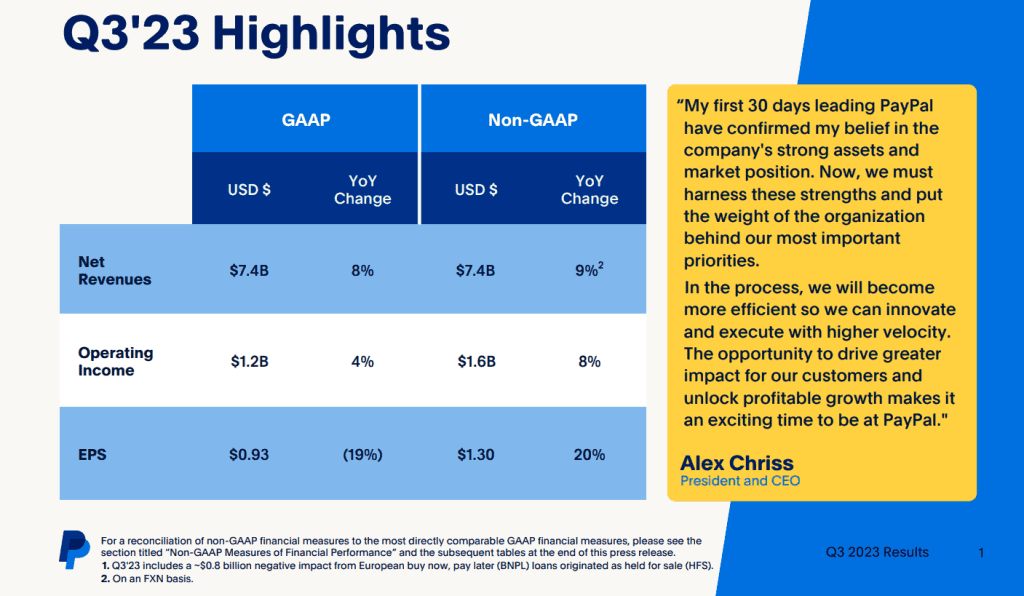
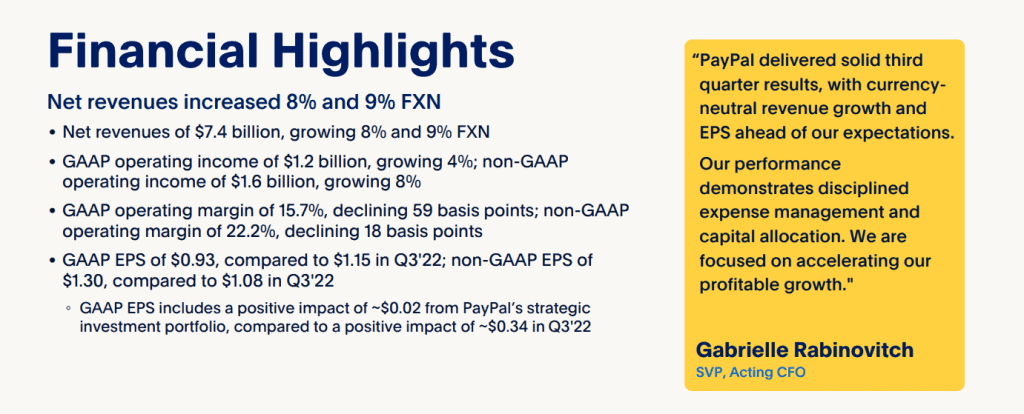
Resilient Q3 Performance: Despite facing difficulties in the market and experiencing heightened competition, PayPal displayed a strong performance in Q3 of 2023. Some notable achievements during this period include a 15% rise in payment volume, an 8% increase in revenues, and a 20% growth in EPS. Moreover, the company exhibited good operating cash flow and free cash flow throughout this timeframe.
Strategic Overhaul: As part of its revamp, PayPal made notable changes to its operations, like divesting its logistics branch, Happy Returns to UPS. The company’s goal is to make operations more efficient and provide experiences for customers by implementing automation and enhancing the checkout process. Moreover, PayPal plans to utilize AI technology to engage consumers and improve its range of business solutions.
Financial Overview and Company Profile: PayPal provides an overview of its situation, including information about its cash holdings, investments, and debts. Additionally, the company demonstrates its dedication to rewarding shareholders through stock repurchases. Moreover, PayPal’s mission revolves around stimulating empowerment and focusing more on economic participation through its inclusive digital payment platform that serves millions of active account holders worldwide.
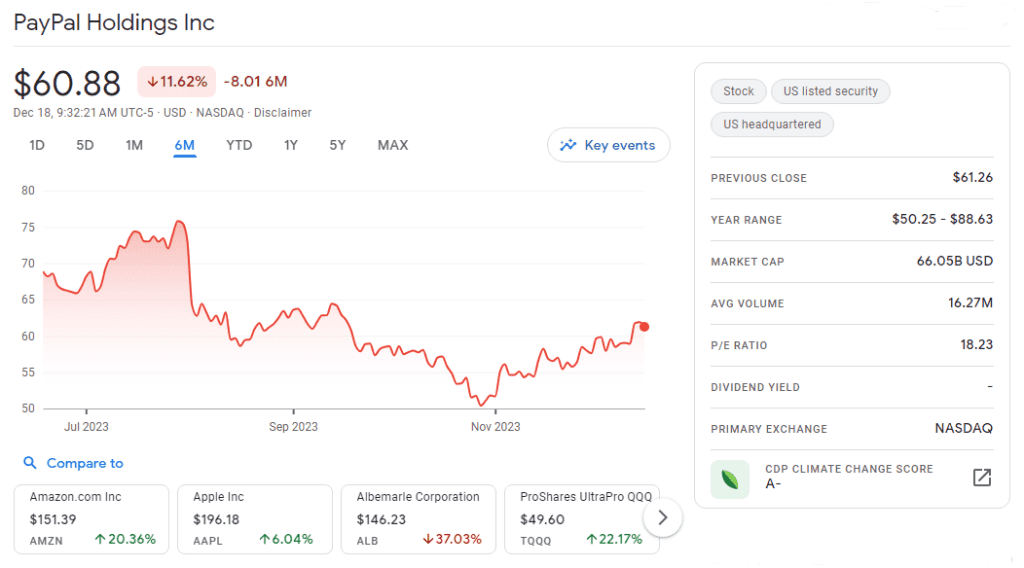
PayPal Stock Price On 12-18-2023 (11:00 am) ( Source Google Finance)
PayPal New CEO, Alex Chriss: Background
PayPal’s New CEO, Alex Chriss assumed the position of CEO on September 27, replacing Dan Schulman when PayPal was head-on with various challenges in the fintech industry. The company has faced a decrease in its stock value due to decreasing investor interest in fintech companies, tough competition from Apple, and slower growth in its branded checkout business over the past few years.
Given Chriss’s extensive experience at Intuit, he is expected to lead PayPal’s recovery. However, analysts on Wall Street caution that reviving the company might take a long time and extensive efforts.
The year 2023 proved difficult for PayPal, as its stock mostly traded at low levels compared to the long-term average. While this made the stock more affordable, potential investors were still worried about uncertainties in the economy and reduced consumer spending. However, there was a positive market response to the plans of PayPal’s new CEO, Alex Chriss. He aimed to streamline the company’s resources towards its growth priorities to create a leaner, more efficient, and effective organization. Overall, market observers hold a confident view of the stock’s long-term prospects.
Regarding growth, one of the primary hurdles facing the company is intense competition. The market dynamics have significantly changed since PayPal’s separation from eBay approximately eight years ago, with consumers now having alternative options, such as Apple Pay, that provide a fast and convenient checkout experience. The payment systems of Amazon and Google continue to gain traction, posing challenges for PayPal, which heavily relies on e-commerce for revenue generation. It is essential to note that the termination of PayPal’s operating agreement with eBay a few years ago has impeded its growth.
PayPal’s Third Quarter 2023 Earnings Reflect Resilience Amidst Market Challenges
Following a more-than-expected third-quarter report, PayPal experienced a much-needed upturn in its stock value, which had been struggling since its peak in 2021. Despite its position as a leading figure in the payments sector, PayPal has faced challenges in sustaining its growth momentum during the pandemic surge, leading to ongoing struggles in its stock performance.
Speaking about it, Alex Chriss, acknowledged the obstacles ahead, highlighting the competitive pressures from firms like Block (formerly Square) and Stripe, as well as traditional financial service providers such as Fiserv and FIS. To address these challenges and improve financial performance, PayPal aims to streamline certain aspects of its operations. Chriss emphasized the need to address the company’s high-cost structure, which has been impeding its agility and clarity of focus.
On November 1, 2023, PayPal disclosed its third quarter of 2023 earnings, showcasing a robust performance with notable growth in both revenue and EPS. The company’s Overall payment volume reached $387.7 billion, marking a 15% increase and a 13% growth on an FX-neutral basis. Notably, net revenues stood at $7.4 billion, demonstrating an 8% growth and a 9% FX-neutral increase. The GAAP operating income saw a 4% rise, amounting to $1.2 billion, while the operating income (excluding GAAP) showed an 8% increase, reaching $1.6 billion.
GAAP EPS was reported at $0.93, compared to $1.15 in the third quarter of 2022, whereas the EPS for non-GAAP showed an impressive 20% growth, totaling $1.30 compared to $1.08 in the prior year. Additionally, the company recorded a significant operating cash flow of $1.3 billion and a free cash flow of $1.1 billion.
PayPal’s Strategic Overhaul – Enhancing Consumer Experience and Streamlining Operations
PayPal recently divested its logistics arm, Happy Returns, to UPS, as part of its strategy to streamline operations and focus on its core payments model. CEO Chriss emphasized the need to address duplication and manual work, intending to invest in automation for improved efficiency.
During his initial month in the role, Chriss engaged with various stakeholders to outline a plan that aims to revolutionize product development and reporting practices. This plan, to be unveiled in the upcoming earnings call, involves a comprehensive overhaul of the consumer experience, centering on a seamless checkout process that adds value to each transaction.
For consumers, PayPal intends to leverage its rich database to power a sophisticated shopping recommendation engine and enhance incentive marketing using AI technology. In the business segment, the company plans to accelerate the advancement of PayPal Complete Payments, an offering tailored for digital merchants. Utilizing consumer data for refining checkout form autofill is also a focus.
PayPal’s New CEO also highlighted the potential of generative AI in fostering meaningful connections between consumers and merchants, ensuring responsible use of this technology. The company anticipates recruiting seasoned professionals to reinforce its talent pool in the upcoming months, recognizing the need for enhanced execution speed in driving growth and delivering on its promising outlook.
Jamie Miller has been appointed as the new CFO of PayPal to aid the company under its new expense management approach led by the new leader, Alex Chriss. Previously serving as the global CFO at EY, Miller brings a wealth of experience from her previous roles at General Electric and Cargill. She takes over from Gabrielle Rabinovitch, who has been serving as acting CFO during the transition period. In Q3, PayPal’s net income saw a 23% decline, settling down to around $1.02 billion YOY, with the company’s Q4 performance falling slightly below expectations till now, as noted by Rabinovitch.
Expanding Service Offerings to Braintree Customers
In a bid to cater to larger companies associated with Braintree, Chriss intends to broaden the range of services offered. Describing Braintree’s position as a foothold for future growth, Chriss emphasized the company’s commitment to addressing additional customer needs, including fraud management, payouts, chargeback automation, and Forex services.
According to William Blair, the company’s long-term prospects remain substantial, particularly as it has transitioned from a traditional checkout button to a comprehensive E2E solutions platform for both consumers and merchants. While it’s still early, the company’s sharp focus on leveraging its wealth of data for enhanced operational efficiency is encouraging for the future, as management emphasizes its commitment to pursuing profitable growth.
While acknowledging the dedication of PayPal’s current employees, Chriss also expressed the intention to bring in new talent to help achieve his objectives. In the meantime, he is diligently working to gain a comprehensive understanding of the company, with plans to present a more detailed strategy to analysts during the upcoming earnings call in February.
Key Highlights Of Q3 Results 2023
PayPal exhibited a robust performance in the third quarter of 2023, marked by an 8% increase in net revenues, which grew to 9% on an FX-neutral basis. The company saw a 4% rise in GAAP operating earnings, amounting to $1.2 billion, and an 8% increase in operating income (non-GAAP), reaching $1.6 billion. The GAAP EPS was $0.93, down from $1.15 in the third quarter of the prior year, while the EPS for non-GAAP stood at $1.30, demonstrating a 20% growth YOY.
As of September 30, 2023, PayPal’s cash equivalents and investments amounted to $15.4 billion, with a total debt of $10.6 billion. During the third quarter of 2023, the company bought back approximately 23 million common stocks, delivering $1.4 billion in returns to stockholders.
The company generated $1.3 billion in cash flow from operations and $1.1 billion in free cash flow during the quarter. These figures include a $0.8 billion of adverse impact from European BNPL loans originated as HFS in the period.
About PayPal
PayPal offers a secure and efficient way to send money, pay and create online invoices, and establish a merchant account. With a core belief in the transformative power of accessible financial services, PayPal is dedicated to democratizing financial opportunities and empowering individuals and businesses to participate and thrive in the global economy. Their inclusive digital payment platform empowers 277 million active account holders to transact with confidence, whether online, through a mobile device, an app, or in person.
Through a blend of innovative technology and strategic partnerships, PayPal continuously develops improved methods for managing and transferring funds, providing users with flexibility and options for sending, receiving, and paying. Operating in over 200 markets globally, the PayPal ecosystem, encompassing Venmo, Xoom, and Braintree, facilitates transactions in more than 100 currencies, allowing users to withdraw funds in 56 currencies and hold balances in their PayPal accounts in 25 currencies.
Conclusion
PayPal’s New CEO, Alex Chriss, left an indelible mark by charting a clear course for the company’s future. Departing from the previous strategy, Chriss outlined his vision for prioritizing profitable growth, setting the stage for a more efficient and agile organization. Despite market challenges, PayPal’s robust third-quarter performance, including notable increases in overall payment volume and net revenues, showcased the company’s resilience and enduring potential.
Moreover, the strategic overhaul, evidenced by the divestment of Happy Returns and a commitment to streamline operations, underscores Chriss’s dedication to optimizing consumer experiences and refining business offerings through advanced AI technologies. With the appointment of Jamie Miller as CFO, PayPal is poised to fortify its financial management and steer the company’s trajectory toward sustained growth.
As PayPal continues to empower millions of users worldwide through its secure and accessible financial services, Chriss’s leadership, coupled with the company’s continued dedication to innovation and strategic partnerships, bodes well for its continued success and enduring prominence in the global digital payment landscape.
Unlike many new corporate leaders, PayPal New CEO, Alex Chriss, has not hesitated to make significant directional changes early in his tenure. In the Q3 earnings call. Chriss, who took over as CEO after Dan Schulman on September 27th, emphasized his focus on achieving growth.
This marks a departure from Schulman’s emphasis on PayPal’s checkout service. Initially, this shift caused a decrease in investor confidence and a decline in the company’s stock value.
Key Takeaways:
New CEO’s Strategic Shift: Alex Chriss highlighted the importance of focusing on growth and moving away from the checkout service that Dan Schulman previously had priority on. Chriss’s leadership signifies a change in strategy aiming for an effective and growing organization.
Resilient Q3 Performance: Despite facing difficulties in the market and experiencing heightened competition, PayPal displayed a strong performance in Q3 of 2023. Some notable achievements during this period include a 15% rise in payment volume, an 8% increase in revenues, and a 20% growth in EPS. Moreover, the company exhibited good operating cash flow and free cash flow throughout this timeframe.
Strategic Overhaul: As part of its revamp, PayPal made notable changes to its operations, like divesting its logistics branch, Happy Returns to UPS. The company’s goal is to make operations more efficient and provide experiences for customers by implementing automation and enhancing the checkout process. Moreover, PayPal plans to utilize AI technology to engage consumers and improve its range of business solutions.
Financial Overview and Company Profile: PayPal provides an overview of its situation, including information about its cash holdings, investments, and debts. Additionally, the company demonstrates its dedication to rewarding shareholders through stock repurchases. Moreover, PayPal’s mission revolves around stimulating empowerment and focusing more on economic participation through its inclusive digital payment platform that serves millions of active account holders worldwide.
PayPal Stock Price On 12-18-2023 (11:00 am) ( Source Google Finance)
PayPal New CEO, Alex Chriss: Background
PayPal’s New CEO, Alex Chriss assumed the position of CEO on September 27, replacing Dan Schulman when PayPal was head-on with various challenges in the fintech industry. The company has faced a decrease in its stock value due to decreasing investor interest in fintech companies, tough competition from Apple, and slower growth in its branded checkout business over the past few years.
Given Chriss’s extensive experience at Intuit, he is expected to lead PayPal’s recovery. However, analysts on Wall Street caution that reviving the company might take a long time and extensive efforts.
The year 2023 proved difficult for PayPal, as its stock mostly traded at low levels compared to the long-term average. While this made the stock more affordable, potential investors were still worried about uncertainties in the economy and reduced consumer spending. However, there was a positive market response to the plans of PayPal’s new CEO, Alex Chriss. He aimed to streamline the company’s resources towards its growth priorities to create a leaner, more efficient, and effective organization. Overall, market observers hold a confident view of the stock’s long-term prospects.
Regarding growth, one of the primary hurdles facing the company is intense competition. The market dynamics have significantly changed since PayPal’s separation from eBay approximately eight years ago, with consumers now having alternative options, such as Apple Pay, that provide a fast and convenient checkout experience. The payment systems of Amazon and Google continue to gain traction, posing challenges for PayPal, which heavily relies on e-commerce for revenue generation. It is essential to note that the termination of PayPal’s operating agreement with eBay a few years ago has impeded its growth.
PayPal’s Third Quarter 2023 Earnings Reflect Resilience Amidst Market Challenges
Following a more-than-expected third-quarter report, PayPal experienced a much-needed upturn in its stock value, which had been struggling since its peak in 2021. Despite its position as a leading figure in the payments sector, PayPal has faced challenges in sustaining its growth momentum during the pandemic surge, leading to ongoing struggles in its stock performance.
Speaking about it, Alex Chriss, acknowledged the obstacles ahead, highlighting the competitive pressures from firms like Block (formerly Square) and Stripe, as well as traditional financial service providers such as Fiserv and FIS. To address these challenges and improve financial performance, PayPal aims to streamline certain aspects of its operations. Chriss emphasized the need to address the company’s high-cost structure, which has been impeding its agility and clarity of focus.
On November 1, 2023, PayPal disclosed its third quarter of 2023 earnings, showcasing a robust performance with notable growth in both revenue and EPS. The company’s Overall payment volume reached $387.7 billion, marking a 15% increase and a 13% growth on an FX-neutral basis. Notably, net revenues stood at $7.4 billion, demonstrating an 8% growth and a 9% FX-neutral increase. The GAAP operating income saw a 4% rise, amounting to $1.2 billion, while the operating income (excluding GAAP) showed an 8% increase, reaching $1.6 billion.
GAAP EPS was reported at $0.93, compared to $1.15 in the third quarter of 2022, whereas the EPS for non-GAAP showed an impressive 20% growth, totaling $1.30 compared to $1.08 in the prior year. Additionally, the company recorded a significant operating cash flow of $1.3 billion and a free cash flow of $1.1 billion.
PayPal’s Strategic Overhaul – Enhancing Consumer Experience and Streamlining Operations
PayPal recently divested its logistics arm, Happy Returns, to UPS, as part of its strategy to streamline operations and focus on its core payments model. CEO Chriss emphasized the need to address duplication and manual work, intending to invest in automation for improved efficiency.
During his initial month in the role, Chriss engaged with various stakeholders to outline a plan that aims to revolutionize product development and reporting practices. This plan, to be unveiled in the upcoming earnings call, involves a comprehensive overhaul of the consumer experience, centering on a seamless checkout process that adds value to each transaction.
For consumers, PayPal intends to leverage its rich database to power a sophisticated shopping recommendation engine and enhance incentive marketing using AI technology. In the business segment, the company plans to accelerate the advancement of PayPal Complete Payments, an offering tailored for digital merchants. Utilizing consumer data for refining checkout form autofill is also a focus.
PayPal’s New CEO also highlighted the potential of generative AI in fostering meaningful connections between consumers and merchants, ensuring responsible use of this technology. The company anticipates recruiting seasoned professionals to reinforce its talent pool in the upcoming months, recognizing the need for enhanced execution speed in driving growth and delivering on its promising outlook.
Jamie Miller has been appointed as the new CFO of PayPal to aid the company under its new expense management approach led by the new leader, Alex Chriss. Previously serving as the global CFO at EY, Miller brings a wealth of experience from her previous roles at General Electric and Cargill. She takes over from Gabrielle Rabinovitch, who has been serving as acting CFO during the transition period. In Q3, PayPal’s net income saw a 23% decline, settling down to around $1.02 billion YOY, with the company’s Q4 performance falling slightly below expectations till now, as noted by Rabinovitch.
Expanding Service Offerings to Braintree Customers
In a bid to cater to larger companies associated with Braintree, Chriss intends to broaden the range of services offered. Describing Braintree’s position as a foothold for future growth, Chriss emphasized the company’s commitment to addressing additional customer needs, including fraud management, payouts, chargeback automation, and Forex services.
According to William Blair, the company’s long-term prospects remain substantial, particularly as it has transitioned from a traditional checkout button to a comprehensive E2E solutions platform for both consumers and merchants. While it’s still early, the company’s sharp focus on leveraging its wealth of data for enhanced operational efficiency is encouraging for the future, as management emphasizes its commitment to pursuing profitable growth.
While acknowledging the dedication of PayPal’s current employees, Chriss also expressed the intention to bring in new talent to help achieve his objectives. In the meantime, he is diligently working to gain a comprehensive understanding of the company, with plans to present a more detailed strategy to analysts during the upcoming earnings call in February.
Key Highlights Of Q3 Results 2023
PayPal exhibited a robust performance in the third quarter of 2023, marked by an 8% increase in net revenues, which grew to 9% on an FX-neutral basis. The company saw a 4% rise in GAAP operating earnings, amounting to $1.2 billion, and an 8% increase in operating income (non-GAAP), reaching $1.6 billion. The GAAP EPS was $0.93, down from $1.15 in the third quarter of the prior year, while the EPS for non-GAAP stood at $1.30, demonstrating a 20% growth YOY.
As of September 30, 2023, PayPal’s cash equivalents and investments amounted to $15.4 billion, with a total debt of $10.6 billion. During the third quarter of 2023, the company bought back approximately 23 million common stocks, delivering $1.4 billion in returns to stockholders.
The company generated $1.3 billion in cash flow from operations and $1.1 billion in free cash flow during the quarter. These figures include a $0.8 billion of adverse impact from European BNPL loans originated as HFS in the period.
About PayPal
PayPal offers a secure and efficient way to send money, pay and create online invoices, and establish a merchant account. With a core belief in the transformative power of accessible financial services, PayPal is dedicated to democratizing financial opportunities and empowering individuals and businesses to participate and thrive in the global economy. Their inclusive digital payment platform empowers 277 million active account holders to transact with confidence, whether online, through a mobile device, an app, or in person.
Through a blend of innovative technology and strategic partnerships, PayPal continuously develops improved methods for managing and transferring funds, providing users with flexibility and options for sending, receiving, and paying. Operating in over 200 markets globally, the PayPal ecosystem, encompassing Venmo, Xoom, and Braintree, facilitates transactions in more than 100 currencies, allowing users to withdraw funds in 56 currencies and hold balances in their PayPal accounts in 25 currencies.
Conclusion
PayPal’s New CEO, Alex Chriss, left an indelible mark by charting a clear course for the company’s future. Departing from the previous strategy, Chriss outlined his vision for prioritizing profitable growth, setting the stage for a more efficient and agile organization. Despite market challenges, PayPal’s robust third-quarter performance, including notable increases in overall payment volume and net revenues, showcased the company’s resilience and enduring potential.
Moreover, the strategic overhaul, evidenced by the divestment of Happy Returns and a commitment to streamline operations, underscores Chriss’s dedication to optimizing consumer experiences and refining business offerings through advanced AI technologies. With the appointment of Jamie Miller as CFO, PayPal is poised to fortify its financial management and steer the company’s trajectory toward sustained growth.
As PayPal continues to empower millions of users worldwide through its secure and accessible financial services, Chriss’s leadership, coupled with the company’s continued dedication to innovation and strategic partnerships, bodes well for its continued success and enduring prominence in the global digital payment landscape.
The recent news of Citigroup layoffs has startled the financial sector. Jane Fraser, the CEO, is spearheading this initiative to streamline operations and improve the bank’s stock performance. A comprehensive restructuring plan is currently underway, with a focus on simplifying the bank operations and giving Fraser oversight. This “reorganization” involves removing a layer of management and reducing leadership roles. While the exact number of job cuts and their financial impact are still uncertain, Fraser remains steadfast in her decision, stating that it aligns with the interests of shareholders.
Fraser’s strategic overhaul is part of her efforts to boost profits and address regulatory concerns. With Citigroup’s stock performance trailing behind its competitors, there is pressure to deliver results. Fraser’s decisive actions demonstrate her commitment to reshape the bank and steer it towards success. The workforce restructuring at Citigroup primarily targets support and technology departments.
Citigroup’s “Project Bora Bora”: Citigroup’s restructuring initiative, known as “Project Bora Bora”, has raised concerns among employees. Led by CEO Jane Fraser, the plan includes job reductions in divisions, particularly in support and technology roles.
Strategic Reorganization Focus: The strategic reorganization aims to streamline the bank operations by removing management layers and reducing leadership positions. This effort is focused on improving efficiency and enhancing the organization’s performance.
Support for Affected Employees: To assist employees during this transition, Citigroup has introduced severance packages that include extended healthcare coverage and job search support. These measures are designed to help those impacted by the Layoffs at Citi.
About Citigroup: Citigroup is a financial services company that operates across segments, serving diverse customer accounts and offering a wide range of banking and financial services worldwide.
Citigroup CEO Jane Fraser’s restructuring initiative, referred to as “Project Bora Bora “, is causing concerns as it aims to reduce the workforce by 10% across various vital divisions. This announcement has raised worries among the employees. The final count of CitiMortgage layoffs, which is expected to include executives facing cuts too (other than the 10%), particularly those in roles with overlapping responsibilities and operations staff supporting divested or restructured businesses, will be determined in the upcoming weeks.
Following the announcement of management changes on September 13th, Citigroup has reportedly started the process of laying off employees, primarily affecting support staff in risk and compliance management. Additionally, there is a risk of job loss for technology personnel involved in overlapping functions.
Conversations about potential layoffs Citi is already in progress, with individual discussions about departures underway. Executives in charge of revenue-generating operations have held meetings to clarify the changes and reassure their teams that the restructuring is aimed at reducing bureaucracy and prioritizing activities that generate more profits, as mentioned in the report. It’s worth noting that Citigroup currently has around 240,000 employees.
While the number of job reductions is uncertain, the main focus is on support and technology departments. In a memo to staff, Fraser emphasized that these departures will allow producers and dealmakers to focus more on clients and achieving outcomes. Fraser expressed determination for the bank to reach its potential, highlighting the bold decisions being made to fulfill commitments to all stakeholders.
The addition of new division heads, including Andrew Morton, Shahmir Khaliq, Gonzalo Luchetti, Andy Sieg, and Peter Babej, strengthens Citigroup’s restructuring efforts. These leaders will play a vital role in decision-making concerning the second and third tiers of management, contributing to the bank’s shift towards a more effective operational structure.
She has acknowledged that the main driving force for layoffs is the need to simplify the bank’s functioning. Fraser hopes to create a more effective and adaptable decision-making process by getting rid of a level of management and rearranging the organizational structure. This is a calculated move that will enable Citigroup to respond quickly to changes in the market, increase productivity, and eventually increase shareholder returns.
What Are The Affected Locations?
The bank continues to address a 2020 consent order from regulators, which requires the resolution of several “longstanding deficiencies” in its internal controls. The company’s official note emphasized that streamlining the organization would further support the implementation of its transformation, which stands as the firm’s top priority.
In recent years, Citigroup has made significant technology investments to enhance risk controls and compliance, aiming to comply with the consent order, as stated by a source. However, the company still retains numerous employees with overlapping roles and redundant technology systems.
The layoffs will have a significant effect across all of the regions where Citigroup has operations. Although precise information has not been made public, it is expected that the changes will result in fewer regional leadership positions outside of North America. The objective of this stage is to simplify processes and concentrate decision-making. Citigroup aims to enhance coordination, productivity, and consistency of the bank’s worldwide strategy through the consolidation of executive positions.
The job reductions form a component of a more comprehensive effort in organizational restructuring initiated by Jane Fraser. Citigroup wants to become a more agile and effective company by streamlining the bank’s processes, eliminating unnecessary management tiers, and reorganizing decision-making. Although the precise quantity of employment reductions and the economic consequences are still unknown, these modifications are per Fraser’s plan to simplify the bank and increase value for investors.
Severance For Those Affected
The company has implemented measures to support employees affected by the Citigroup layoffs 2023. The business has presented severance packages to facilitate the financial challenges during this transition. Benefits, including outplacement services, increased healthcare coverage, and assistance with job searching, may be included in these packages. Although it may not completely offset the impact of job loss, these efforts aim to offer some assistance and stability to those impacted.
Anticipated Job Cut Timeline
While an exact timeline has not been revealed, Citigroup has indicated that the job cuts will be rolled out gradually over an extended period. This phased approach aims to ensure a smoother transition and minimize any disruption to the bank’s day-to-day operations.
It is essential to recognize that while some job reductions may occur swiftly, others may take more time to execute, especially in cases where there are legal or regulatory obligations that require attention. Citigroup is dedicated to managing the process responsibly and ensuring that affected employees receive appropriate support and assistance throughout the transition period.
Market Reaction and Investor Outlook
Following the revelation of the reorganization plan and relatedCiti layoffs in 2023, there was a little uptick in Citigroup’s stock price. Shortly after the announcement, the price of the stock increased by 2% to $42.35 per share. The early reaction of the market suggests that investors could perceive the restructuring efforts as a constructive measure aimed at augmenting the bank’s efficiency and earnings.
It is important to remember, though, that Citigroup’s shares have already experienced difficulties as a result of a number of issues, such as increased interest rates and more stringent financial regulations during the previous year. From its peak in late 2021, the company’s share price has dropped significantly—by 46%. Even though the market’s initial response to the news of the reorganization is positive, it is still too early to tell how the bank’s stock will do in the long run.
About Citigroup
Citigroup Inc. is a diverse financial services company, serving approximately 200 million customer accounts across nearly 160 jurisdictions and countries. Its operations are structured into the following segments:
Institutional Clients
Global Consumer
Corporate and Other
The Global Consumer Banking segment offers standard banking assistance to retail consumers, including commercial banking, retail banking, Citi cards, Retail services, and retail banking.
The Institutional Clients Group segment serves institutional, corporate, clients with high net worth, and public sector entities globally, providing a comprehensive range of banking services and products. This segment includes equity and fixed-income trading, prime brokerage, foreign exchange, research, derivative services, investment banking, corporate lending, private banking, advisory services, trade finance, securities services, and cash management.
The Corporate and Other segment covers unallocated costs of global staff functions, various corporate expenses, global operations, and technology expenses, Corporate Treasury, specific North America and international legacy consumer loan portfolios, other legacy assets, and discontinued operations. Citigroup Inc., which was established in 1812, has its headquarters in New York.
Conclusion
The recent wave of Layoffs at Citi under CEO Jane Fraser’s guidance has stirred the financial sector. The emphasis on simplifying the organization, eliminating redundant rolls, and centralizing decision-making signals Fraser’s commitment to enhancing the bank’s efficiency and profitability. While the exact scale and scope of the job cuts remain unclear, the move reflects a determined effort to align the bank’s operations with the evolving market landscape and meet shareholder expectations.
As Citigroup continues its efforts to transform and optimize its global presence, the company remains dedicated to supporting its affected employees through severance packages and other assistance measures. As it progresses through this phase of change, Citigroup’s overarching goal remains focused on delivering sustainable value and maintaining its position as a leading global financial services provider.