

How Can Merchants Claim Their Share of the Visa-Mastercard Interchange Settlement?

How Can Merchants Claim Their Share of the Visa-Mastercard Interchange Settlement?

Mastercard and Visa recently reached a settlement in a lawsuit where they were accused of imposing excessive fees on business owners. This legal case, known as the Payment Card Interchange Fee and Merchant Discount Antitrust Litigation, has been an ongoing issue in the United States and has culminated in a substantial $5.54 billion settlement involving Visa, Mastercard, and various financial institutions. The deadline for submitting claims to Visa Mastercard Interchange Settlement is set for May 31, 2024. The settlement aims to resolve allegations of anti-competitive behavior, specifically accusations of fixing interchange fees charged to merchants for accepting payment cards.

An Overview of the Visa-Mastercard Interchange Settlement

This lawsuit primarily concerns the interchange fees charged to merchants who accepted Mastercard or Visa credit or debit cards between January 1, 2004, and January 25, 2019. It also examines the rules that Mastercard and Visa enforced on these merchants. The merchants contend that Mastercard, Visa, and their respective member banks unlawfully established these fees. Additionally, they argue that both companies imposed restrictive rules that prevented merchants from directing customers toward alternative payment methods.

These rules included prohibitions on surcharges and discounts and mandatory acceptance of all cards, which shielded Mastercard and Visa from competitive pressures to reduce their fees. The lawsuit further alleges that Mastercard and Visa conspired on some contentious business practices and continued these practices even after both companies were restructured to become publicly owned corporations. Merchants claim that such actions led to them paying excessively high interchange fees.

start your claim now

They suggest that with Mastercard and Visa conduct, the interchange fees would exist and would have been higher. Conversely, they maintain their innocence, arguing that their business practices are lawful, a result of independent competition, and beneficial to merchants and consumers.

The lawsuit against Mastercard and Visa has been ongoing for over 18 years since it was initiated by Robins Kaplan, who served as co-lead counsel. Representing over 10 million US merchants, the legal team advanced an innovative argument that the interchange fee structure and the accompanying rules set by Mastercard and Visa stifled competition. This foundational lawsuit set the stage for the subsequent consolidated case, eventually leading to a significant settlement.

A settlement was reached in 2012 but later overturned on appeal. In 2018, a renegotiated settlement of $6.2 billion was achieved and received final approval in December 2019. The Second Circuit Court of Appeals reviewed this settlement in March 2022 and, by March 2023, after extensive legal proceedings, approved a monetary agreement. This means the Court has not determined whether either party was correct or any laws were broken. Instead, both parties have agreed to settle the dispute to avoid the expenses and uncertainties of a trial and any subsequent appeals.

image 5

Under this agreement, approximately $5.54 billion was allocated to be distributed among the merchants who accepted Mastercard and Visa between January 1, 2004, and January 25, 2019. In January 2024, claim forms for this settlement began to be distributed, with a filing deadline set for May 31, 2024. To help merchants navigate the claims process and maximize their recoveries, Host Merchant Services, North America’s most trusted merchant account provider, has partnered with Certificate Clearing.

What Does It Mean to You?

The settlement between Mastercard Visa and U.S. merchants in March 2024 could benefit merchants by reducing costs and enhancing payment processing methods. The agreement suggests reducing interchange feesβ€”fees that merchants incur to process credit card paymentsβ€”by 0.04 percentage points for three years from the current average of around 2%. Additionally, the settlement grants merchants greater control over their payment processing, allowing them to direct payments toward preferred networks or specific types of credit cards. Merchants could also impose surcharges on cards with higher transaction fees, potentially increasing the cost of using premium cards.

This significant legal settlement permits qualifying businesses to claim their portion of fees paid between January 1, 2004, and January 25, 2019. It is important to note that companies that are no longer operational may still qualify for compensation if they were active during this period.

If you believe you are eligible, you must file your claim for the $5.54 billion Mastercard and Visa settlement by May 31, 2024. Administrators distributed claim forms in December 2023 and January 2024.

What Is the Eligibility for the Mastercard and Visa Interchange Settlement?
Visa-Mastercard Interchange Settlement

Specific merchants who meet these requirements may be eligible for reimbursement through the MasterCard and Visa settlement:

  1. Business Eligibility:

This settlement covered businesses, sole proprietorships, partnerships, and specific non-profit organizations that accepted cards bearing the Mastercard or Visa brands.

  1. Transaction Period:

The qualifying companies had to have taken Mastercard or Visa-branded credit cards between January 1, 2004, and January 25, 2019.

  1. Card Brands:

The settlement did not cover private card networks or other payment networks, only Mastercard and Visa-branded cards.

  1. Geographic Requirement:

The cards must have been accepted within the US.

  1. Exclusions:

Certain entities were not eligible for the settlement, including:

  • The plaintiffs were previously dismissed from the lawsuit.
  • Financial institutions or Banks that issued Mastercard or Visa cards or accepted transactions throughout the specified period.
  • Government Entity.
  • MasterCard, Visa, related institutions, and affiliates are named defendants in this action.
  1. Transaction Volume:

There is no minimum number of transactions needed to be eligible. Any company that accepts the designated cards within the allotted time frame may be eligible.

  1. Damage Requirement:

Merchants didn’t need to demonstrate they had been adversely affected by interchange fees to qualify for the settlement.

How Can You Claim Your Settlement?

To claim your settlement, you have two options: either submit a valid and timely claim via the court-authorized website or wait until you receive a settlement notice.

Alternatively, you can expedite the process by collaborating with Host Merchant Services. We offer an extensive approach that continues even after the settlement period. Host Merchant Services have teamed up with Certificate Clearing Corporation (CCC), which has successfully filed over 13 million claims and secured over $2 billion for class members across numerous settlements. CCC specializes in class action settlements that offer cash or transferable coupon payouts.

Furthermore, through Host Merchant Services and Certificate Clearing Corporation, you can monetize claims for early cash payouts in the $5.54 billion Visa-Mastercard class action settlement. CCC actively bids to purchase claims, potentially increasing the value of an award or providing immediate financial benefit. To accelerate this process, you can complete the form here by filling in simple details:

Conclusion

The Mastercard and Visa interchange settlement represents a significant milestone for merchants, promising relief from the burden of excessive swipe fees and offering avenues for financial recovery. This legal resolution, stemming from years of litigation and negotiation, marks a turning point in the relationship between major credit card companies and businesses. This settlement empowers merchants to assert greater control over their payment processing costs and methods by addressing allegations of anti-competitive behavior and providing avenues for compensation.

With the claim deadline fast approaching, eligible merchants must seize this opportunity and submit their claims promptly. Whether navigating the claims process independently or seeking assistance from trusted partners like Host Merchant Services and Certificate Clearing Corporation, merchants stand to benefit from this landmark settlement, ushering in a new era of fairness and transparency in payment processing.

recommended article Learn more about the Visa MasterCard Class Action Settlement.

recommended article Official court order website

Frequently Asked Questions

  1. Who is eligible to claim part of the settlement?

    Businesses in the United States that accepted Visa and MasterCard payments from January 1, 2004, to January 25, 2019, can participate. This includes various businesses like grocers, retailers, and restaurants.

  2. What constitutes a valid claim?

    Eligible merchants who didn’t opt out of the settlement class must submit a valid claim. The claim should accurately reflect Mastercard and Visa transactions during the eligible period and include all required documentation per the settlement guidelines.

  3. When will merchants receive their payments?

    Payments are expected after the claim deadline on May 31, 2024. The exact timing depends on claim reviews and court approvals, so a payment date must be made.

Dollar General to Open 800 New Stores in 2024

Dollar General to Open 800 New Stores in 2024

In February, Dollar General celebrated the opening of its 20,000th store in southeastern Texas, marking a significant milestone. Looking ahead, the retailer is aiming for further expansion. For the fiscal year 2024, Dollar General has outlined plans for roughly 2,385 real estate projects. These include opening about 800 new stores (which also includes around 30 pOpshelf locations and 15 new outlets in Mexico), in addition to 1,500 store renovations and 85 store relocations.

Key Takeaways
  • Dollar General’s plan to open 800 new stores in 2024, alongside renovating 1,500 existing locations and relocating 85 stores, reflects its ambitious real estate strategy. This significant expansion signifies the company’s commitment to growth amidst market challenges, including inflation and shifting consumer spending habits.
  • Dollar General’s emphasis on managing physical retail assets amidst inflation and evolving consumer behavior underscores its adaptability and strategic approach to staying relevant in the retail landscape. Despite facing challenges such as rising operating costs, the company remains focused on steady growth and navigating through market fluctuations.
  • Chief Financial Officer Kelly Dilts highlighted the ongoing impact of inflation on Dollar General’s customers, who are making trade-offs directly at the shelves. This observation emphasizes the importance of understanding consumer behavior in response to economic factors and adjusting business strategies accordingly to maintain profitability.
  • With a total of 20,000 stores, Dollar General has a larger presence than many of its competitors, including Walmart, Target, and Dollar Tree. This extensive reach, combined with initiatives like store renovations and new openings, positions Dollar General to maintain its market share and competitive edge within the retail sector.

Dollar General’s 800 New Stores – Expansive Real Estate Strategy

Dollar General's 800 New Stores - Expansive Real Estate Strategy

Image source

During a March earnings call, Dollar General announced plans to undertake 2,385 real estate-related projects throughout the year. This ambitious plan includes the opening of 800 new stores, remodeling of 1,500 existing locations, and relocating 85 stores.

A comparison is helpful to understand the scale of Dollar General’s operations: Just five statesβ€”Florida, Georgia, North Carolina, Pennsylvania, and Texasβ€”host over 5,800 Dollar General stores, surpassing competitors like Target and Walmart stores in the US.

Amid ongoing inflation and shifts in discretionary spending, Dollar General is intensifying its real estate strategy. Managing physical retail assets has become increasingly crucial, and the company continues to achieve steady growth in its store count, navigating through changing market trends.

Chief Financial Officer Kelly Dilts noted in a post-earnings call that inflation continues to affect their customers, who are making trade-offs directly at the shelves. She expects that the impact on sales mix will continue to pose a challenge to gross margin throughout 2024.

shop by category

The company has not sustained the robust growth rates we’ve previously seen, and its profitability has significantly declined due to rising operating costs. However, as reported in Q3, the opening of over 260 new stores contributed to a 2.4% increase in Dollar General’s sales, reaching nearly $10 billion, despite a 1.3% drop in comparable store sales.

During the Q4 results announcement, Todd Vasos noted that customers have been experiencing the effects of inflation for the past two years, leading them to make trade-offs while shopping. This trend is evident in the ongoing sales pressure within discretionary categories and the increased growth and market share of private brand sales.

Dollar General opened 987 new locations, renovated 2,007, and moved 129 shops in the previous year. Vasos states that up to 15 sites in Mexico and 30 pOpshelf-format stores would be opened this year as part of the expansion ambitions. He explained that pOpshelf primarily sells non-consumable goods, making it more susceptible to the challenges of a weaker discretionary sales climate.

If the company successfully implements its plan to renovate 1,500 existing stores, relocate 85 others, and create 800 new ones, it should experience an increase in margins and possibly even a recovery in profitability.

Dollar General has managed to increase revenue through the expansion of new stores and, more critically, through growth in same-store sales. Same-store sales growth is crucial for retailers as it reflects the success of existing stores, indicates the attraction of new customers, and suggests that more spending is occurring within these stores. This is often seen as a key indicator of long-term growth potential for retailers. Despite recent challenges, Dollar General has kept pace with major competitors in terms of same-store sales growth rate.

This performance is significant as it indicates that Dollar General is not losing customers to nearby competitors, allowing it to maintain a stable market share of 2.31% within the retail sector.

The inaugural Dollar General store debuted in Springfield, Kentucky, almost 70 years ago in 1955. The company operates under several brands, including DGX, DG Market, and pOpshelf in the U.S., and Mi SΓΊper Dollar General in Mexico. With a total of 20,000 stores, Dollar General boasts a larger presence than many of its competitors. For comparison, Dollar Tree, which also encompasses Family Dollar, operates approximately 16,600 stores. Walmart has around 5,200 stores, Target nearly 2,000, and Five Below, which targets teens and tweens, has more than 1,500 stores.

Dollar General warehouse

About Dollar General

Dollar General Corporation is a discount retail chain that operates in the southern, southwestern, midwestern, and eastern United States. The company offers a variety of merchandise, including consumables such as paper products, cleaning supplies, packaged food, and perishables like dairy and frozen foods. Its inventory also includes snacks, health and beauty products, pet supplies, and tobacco products.

Additionally, Dollar General provides seasonal items, home goods, apparel for all ages, and basic essentials like kitchenware, small electronics, and office supplies. Founded in 1939 in Goodlettsville, Tennessee, the company was originally known as J.L. Turner & Son, Inc., before it was rebranded to Dollar General Corporation in 1968.

Conclusion

Dollar General’s aggressive expansion plans for 2024 signify its commitment to growth and adaptability in the dynamic retail landscape. With a strategic focus on real estate, the company aims to open 800 new stores, remodel 1,500 existing locations, and relocate 85 stores. Despite facing challenges like inflation and shifting consumer preferences, Dollar General remains resilient, leveraging its extensive network of over 20,000 stores to maintain a competitive edge.

The company’s ability to sustain revenue growth through new store openings and same-store sales improvement underscores its solid position in the retail sector. As Dollar General continues to evolve and expand its footprint, it reaffirms its status as a dominant player in the industry.

American Express Q1 2024 Report

American Express Reports an 11% Increase in Q1 2024 Revenue

American Express’s robust financial performance in Q1 2024, marked by an 11% year-over-year increase in revenue to $15.8 billion and a 39% rise in EPS to $3.33, was primarily driven by strong spending growth from international cardholders and successful new card acquisitions. Here is a complete analysis of the American Express Q1 2024 report.

Despite a softer spending trend among US small and medium-sized enterprises (SMEs), American Express has projected a revenue growth rate of 9% to 11% and an EPS range between $12.65 and $13.15.

The strong quarterly results were maintained by increased net interest income and growth in the customer base of Millennials and Gen-Z. However, rising customer engagement and compensation expenses partially offset these gains.

American Express Q1 2024 Report Key Takeaways
  • Robust Financial Growth: American Express achieved an 11% revenue increase, totaling $15.8 billion in Q1 2024, driven by strong international spending and successful new card acquisitions, alongside a notable 39% rise in EPS.
  • Increased Profits and Strong Performance Metrics: Profits soared by 34% to $2.44 billion in Q1, surpassing expectations. EPS hit $3.33, with revenue reaching $15.8 billion, reflecting robust growth in cardholder spending.
  • Segmental Performance Highlights: Notable growth was observed across segments, with the US Consumer Services segment seeing a 43% income increase. Although Commercial and International Services slightly missed estimates, Global Merchant Services saw a 15% increase in pre-tax net income.
  • Strategic Outlook and Confidence in Future Growth: American Express reaffirmed its full-year guidance, projecting revenue growth of 9% to 11% and an EPS range of $12.65 to $13.15 for 2024. This reflects confidence in strategic initiatives to attract high-quality customers and engage younger demographics, ensuring continued growth in Card Member spending.

American Express Reports 34% Increase in First-Quarter Profits

american express

Credit card giant American Express reported a 34% increase in first-quarter profits, driven by higher spending from cardholders and an increase in customers maintaining balances on their cards. The New York-based company announced a profit of $2.44 billion in the first three months of the year, surpassing Wall Street’s expectations.

The results exceeded expectations, with EPS reaching $3.33 and revenue hitting $15.8 billion, an 11% year-over-year (YOY) increase. Higher net interest revenue and more cardholder spending were the main drivers of this growth. Increased consumer spending drove network volumes to $419 billion in the first quarter, a 5% YOY rise. The total interest income rose 31% from the prior year to $5.8 billion.Β  On the other hand, consolidated provisions for credit losses increased to $1.3 billion from $1.1 billion in the previous year due to a decrease in net reserve build of $320 million to $148 million, which was partly offset by higher net write-offs.

At $11.4 billion, consolidated expenses rose 3% year over year. Increased cardholder spending, utilization of travel-related benefits, and marketing expenditures were the primary causes of this increase in customer engagement costs. A $196 million advantage from improved models for projecting future redemptions of membership rewards somewhat mitigated this. Millennials and Gen Z consumers acquired more than 60% of new customer accounts.

Chairman and CEO Stephen Squeri noted that 2024 has begun on a strong note. The company’s first-quarter results reflected positive trends seen in recent years, including an 11% increase in revenue and a 39% increase in EPS compared to the previous year.

She went on to say that they have significantly increased engagement among premium consumers as a result of their continuous investments in value propositions, marketing, brand, and technological capabilities. When adjusted for foreign exchange, the total amount spent by card members climbed by 7%, with US consumer card members spending 8% more than they did a year ago, and the International Card Services section spending rose by 13%.

She also emphasized that the business still draws in high-spending, high-quality credit clients. The number of new card acquisitions increased to 3.4 million during the quarter, with over 70% of new accounts coming from fee-based products. Around 60% of newly opened consumer accounts worldwide are attributed to Gen Z and Millennial demand, which is still high. The business continues to have the strongest credit metrics in its class.

Segmental Performances Overview

segmental growth
  • US Consumer Service:

In the Q1 report, the US Consumer Services segment reported a pre-tax income of $1.6 billion, marking a 43% increase compared to last year. This exceeded expectations of $1.3 billion. Total revenues, net of interest expenses, grew 14% YOY, reaching $7.5 billion, driven by higher net interest income and increased Card Member spending.

  • Commercial Services:

This segment recorded a pre-tax income of $878 million, up 39% YOY but falling short of estimates by 6.1%. Total revenues net of interest expenses amounted to $3.8 billion, showing an 8% increase from the previous year due to growth in net interest income. The figure surpassed the consensus estimate of $3.7 billion.

  • International Card Services:

This segment’s pre-tax income increased by 33% YOY to $252 million. Total revenues net of interest expenses rose 8% to $2.7 billion, missing the consensus estimate of $2.8 billion. The growth can be attributed to increased Card Member spending and rising card fee revenues.

  • Global Merchant and Network Services:

This segment saw a pre-tax net income of $1 billion in the first quarter, marking a 15% increase year over year and surpassing estimates of $958 million. Total revenues net of interest expenses rose 7% year over year to $1.9 billion due to growth in merchant-related revenues.

What Lies Ahead for American Express?

American Express’s Q1 2024 results demonstrate its ability to sustain solid financial performance amidst a changing regulatory landscape. Key metrics for investors to monitor include net income growth, total revenue, and credit loss provisions, alongside the company’s ability to manage expenses and maintain a robust capital position.

Furthermore, the impact of regulatory changes, particularly related to AML/CFT laws and credit card late fees, is crucial to watch. The sale of Accertify and ongoing investments in customer acquisition and engagement will also significantly influence American Express’s performance in the upcoming quarters.

American Express has reiterated its full-year 2024 outlook, forecasting revenue growth between 9% and 11%, with earnings per share anticipated to fall between $12.65 and $13.15.

This demonstrates the company’s faith in its business plan and highlights its ability to keep up the momentum with smart marketing, technology, and value-adding initiatives. The company’s effective approach to drawing in high-caliber clients and interacting with younger audiences is anticipated to spur further expansion in Card Member expenditure, giving the stakeholders hope for the company’s future.

About American Express

About American Express

Image source

American Express Company, with its subsidiaries, functions as an integrated payments provider across a diverse global market, including the United States, the Middle East, Africa, Europe, Australia, the Asia Pacific, Latin America, New Zealand, the Caribbean, Canada, and beyond. Its operations are divided into four key segments: Commercial Services, US Consumer Services, Global Merchant and Network Services, and International Card Services. The company offers a variety of products and services, such as credit cards, charge cards, banking, and other payment and financing options.

In addition, it provides merchants with a comprehensive suite of services, including acquisition, processing, servicing, settlement, point-of-sale marketing, information products and services, fraud prevention services, and the design and implementation of customer loyalty programs. Furthermore, it operates Centurion Lounges in airports worldwide. American Express markets its products to consumers, mid-sized companies, and large corporations through mobile and online applications, direct mail, customer referral programs, affiliate marketing, third-party providers, business partners, in-house sales teams, and direct response advertising. The company, established in 1850, is headquartered in New York.

Conclusion

American Express’s strong performance in the first quarter of 2024 demonstrates its resilience and strategic capabilities in navigating dynamic market conditions. The company’s revenue has increased by 11%, and earnings per share have substantially risen, surpassing expectations. This growth has been fueled by greater spending from international cardholders and successful new card acquisitions. Despite ongoing challenges such as softer spending trends among US SMEs, the company remains confident in sustaining growth momentum, as evidenced by the reaffirmation of its full-year guidance.

The company’s quarterly results showed strong growth, mainly due to an increase in net interest income and an expanding customer base, with a particular focus on Millennials and Gen Z. However, the rise in customer engagement and compensation expenses needs to be carefully considered for ongoing optimization. Going forward, investors should keep a close eye on key metrics, regulatory impacts, and strategic initiatives to determine the company’s direction. American Express’s dedication to strategic investments and attracting high-quality customers position it for continued success in the constantly evolving payments landscape.

1 4

Fiserv Reports Q1 2024 Financial Results

Fiserv Inc., a global leader in payment and financial services technology solutions, has unveiled its highly anticipated financial results for the first quarter of 2024. The company’s adjusted earnings per share (EPS) have surged impressively by 19% year over year (YOY), reaching a substantial $1.88. This significant growth underscores Fiserv’s robust performance and sets a promising tone for its future financial outlook. Here is a complete analysis of Finserv’s Q1 2024 financial results.

The quarter witnessed a robust organic revenue growth of 20%, which was in line with expectations. This stellar performance has prompted Fiserv to revise its adjusted EPS outlook for the year to $8.60 to $8.75, and it anticipates an adjusted operating margin expansion of at least 125 basis points in 2024. As Fiserv approaches its 40th anniversary and its 5th year since merging with First Data, the company is steadfast in its confidence about its growth trajectory and its ability to achieve its 2026 targets.

Carat by Fiserv

Image source: Carat

Finserv’s Q1 2024 Financial Results: Key Takeaways
  • Substantial Revenue Growth and Margin Expansion: Fiserv’s Q1 2024 financial report showcases robust performance, with a 20% organic revenue growth and a significant expansion in operating margins, exemplified by a 180 basis points improvement to 35.8%. This growth is attributed to efficient operations, innovative product offerings, and cross-selling strategies across diverse customer segments.
  • Segment-wise Performance: The report focuses on the performance of Fiserv’s different segments. The Merchant Solutions segment has shown a remarkable 36% increase in revenue and a 440 basis point rise in operating margin. In comparison, the Financial Solutions segment has experienced a 5% revenue growth and a 160 basis point improvement in operating margin. This highlights the company’s ability to effectively cater to various market needs.
  • Adjusted EPS Increase and Financial Operations: Fiserv’s Q1 2024 adjusted earnings per share increased by 19% to $1.88, clearly indicating the company’s robust financial health and operational efficiency. Despite a decline in free cash flow compared to the previous year, Fiserv’s proactive financial management and investment strategies, such as share repurchases and debt issuances, demonstrate the company’s commitment to maintaining its financial stability and ensuring a secure investment environment for stakeholders.
  • Looking Ahead: Fiserv has raised its adjusted EPS outlook for the year to a range of $8.60 to $8.75, projecting an organic revenue growth rate of 15% to 17% for 2024. This upward revision and positive outlook indicate the company’s strong belief in its growth trajectory. Fiserv’s steadfast commitment to sustainable expansion, operational excellence, and client focus further solidifies its position as a leading player in the payment and financial services technology solutions industry.

Fiserv’s First Quarter 2024 Performance Highlights Robust Revenue Growth and Margin Expansion

Fiserv Inc., a global provider of payment and financial services technology solutions, released its financial results for the first quarter of 2024 on Tuesday. The company reported a 7% increase in GAAP revenue and a 20% increase in organic revenue compared to the same quarter last year.

GAAP EPS reached $1.24 in Q1 of 2024, a 39% increase YOY. The GAAP operating margin was 24.2% in this quarter, compared to 20.5% in the same period in 2023. The Merchant Solutions segment achieved a GAAP operating margin of 34.1%, while the Financial Solutions segment achieved 44.1%, compared to 29.7% and 42.4% in the same period last year, respectively. Net cash provided by operating activities was $831 million in the first quarter of 2024, compared to $1.13 billion in the previous year’s Q1.

Fiserv

According to Frank Bisignano, the chairman, president, and CEO of Fiserv, the company has maintained robust revenue growth and margin expansion and is expected to continue to do so through 2024. In the first quarter, the company’s adjusted earnings per share increased by 19%. Bisignano emphasized that the company has achieved this by improving efficiency, providing innovative products and services, and cross-selling to its diverse and elite customer base, all while executing a solid business model.

As mentioned, in Q1 2024, Fiserv reported a 7% increase in adjusted revenue – reaching $4.54 billion compared to last year. Organic revenue growth for the quarter stood at 20%, driven by a significant 36% increase in the Merchant Solutions segment and a 5% increase in the Financial Solutions segment.

Adjusted EPS rose by 19% to $1.88 compared to the previous year’s quarter. The adjusted operating margin improved by 180 basis points to 35.8%, with Merchant Solutions seeing an increase of 440 basis points to 34.1% and Financial Solutions rising by 160 basis points to 44.1%. Free cash flow for the quarter was $454 million, a decline from $861 million in the previous year. The company repurchased 10.2 million shares of common stock for $1.5 billion and issued $2.0 billion in 3-year, 7-year, and 10-year senior notes with a weighted average interest rate of 5.313%.

Fiserv’s Strong Performance and Growth Outlook Highlight Commitment to Sustainable Expansion

Fiserv projects organic revenue growth of 15% to 17% for 2024 and raises its adjusted EPS outlook to $8.60 to $8.75, representing a 14% to 16% increase.

Bisignano reiterated Fiserv’s commitment to a virtuous cycle of investment, revenue growth, operating leverage, capital return, and reinvestment for further expansion. This cycle is fortified by a steadfast focus on clients, operational excellence, and maintaining a strong balance sheet. The company’s strong first-quarter results and proven model have led it to raise their adjusted EPS outlook for the full year, underscoring Fiserv’s commitment to sustainable expansion.

About Fiserv

About Fiserv

Established in 1984, Fiserv is a global leader in payments and financial technology, providing services to thousands of financial institutions and millions of businesses across more than 100 countries. Their clientele spans banks, credit unions, thrifts, leasing and finance companies, securities broker-dealers, and retailers.

Fiserv’s innovative and excellence-driven approach includes digital banking solutions, account processing, network services, card issuer processing, payments, merchant acquiring, e-commerce, and the Clover cloud-based POS solution. Fiserv is listed on both the FORTUNE 500 and S&P 500 Index and has been recognized by FORTUNE as one of the World’s Most Admired Companies.

Conclusion

Fiserv’s first-quarter performance for 2024 underscores its robust growth trajectory and commitment to sustainable expansion. The company’s financial prowess is evident, with a 7% increase in GAAP revenue and a notable 20% surge in organic revenue, alongside a substantial rise in GAAP EPS and operating margins. CEO Frank Bisignano’s emphasis on efficiency, innovation, and customer-centric strategies has propelled Fiserv’s success.

Looking ahead, Fiserv anticipates continued growth, with projected organic revenue growth of 15% to 17% for the year and an adjusted EPS outlook of $8.60 to $8.75. By prioritizing investment, operational excellence, and maintaining a strong balance sheet, Fiserv remains poised for sustained expansion. As it approaches its 40th anniversary, Fiserv’s position as a global leader in payments and financial technology is firmly established, reflecting its status as one of the world’s most admired companies.

Stripe Will Unbundle Payments from Other Software

Stripe Will Unbundle Payments from Other Software

Stripe, a prominent payment processing industry player, has made a game-changing announcement. In a recent decision, Stripe will unbundle payments from other software from its more comprehensive financial services stack. Previously, businesses were required to use Stripe for payments to access its different services. This move simplifies the process for merchants, enabling them to integrate Stripe’s financial services seamlessly.

Stripe’s innovative approach now empowers businesses to leverage its billing, tax, and other financial services without the obligation of processing payments exclusively with Stripe. This newfound flexibility opens up possibilities, allowing merchants to combine Stripe’s products with other payment providers like PayPal Holdings Inc. or Adyen NV. This broadens their options and has the potential to enhance their financial operations.

Stripe Issue Charge Card for Small Businesses
Key Takeaways
  • Unbundling Payment Services: Stripe’s decision to separate its payments service from its broader financial services stack is a strategic move aimed at simplifying merchant access. This allows businesses to integrate Stripe’s financial services more seamlessly without the obligation of exclusively processing payments with Stripe.
  • Enhanced Merchant Access and Modularity: By refocusing its strategy, Stripe aims to offer greater flexibility to merchants, enabling them to leverage its suite of services alongside other payment providers like PayPal and Adyen. This shift towards modularity extends Stripe’s reach to larger organizations, simplifying the adoption of its services.
  • Innovative Product Updates: Stripe’s announcement of new AI tools, expanded payment methods, and enhancements to its embedded finance offerings underscores its commitment to innovation. These updates cater to evolving market demands and aim to streamline operations, enhance customer experiences, and drive business growth.
  • Continuous Commitment to Innovation: Stripe’s unbundling of payment services reflects its commitment to driving innovation in the fintech industry. As it evolves its platform and expands its offerings, Stripe reaffirms its position as a leader, providing businesses with cutting-edge tools and services to navigate the complexities of the payment landscape.

Stripe Will Unbundle Payments from Other Software: Focus On Merchant Access and Modularity Enhancement

Stripe plans to split its payment services from its broader financial services technology stack. This strategic decision aims to make it easier for merchants to access and use its services. As a leader in the fintech industry, Stripe has recently been valued at $65 billion and has processed around $1 trillion in payment volume over the past year. However, with growing competition from companies like PayPal and Adyen, Stripe is adjusting its approach to stay ahead.

This move by Stripe also allows other companies to use other payment providers while still accessing Stripe’s comprehensive suite of services, including risk and verification services, fraud, in-person payments, billing and invoicing, financial account data, and more. This shift is aimed at attracting large-scale organizations, offering them greater flexibility.

What is the Difference Between Stripe and Merchant Accounts

CPO Will Gaybrick emphasized that this move extends Stripe’s modularity to its core, enabling seamless integration of all Stripe products with third-party processors. Co-founder John Collison added that as Stripe began serving larger customers, these organizations faced more constraints, and the new approach simplified the adoption of the best aspects of Stripe.

In addition to other product updates, Stripe announced that American Express has joined its enhanced issuer network. Established in 2023, this network comprises partnerships with US card issuers, including Discover Financial Services and Capital One Financial Corp., to reduce fraud and improve business payment authorization rates.

Alongside Stripe, it has also announced a new suite of AI tools. These announcements are part of Stripe’s mission to boost the internet’s GDP, aligning with the evolving needs of businesses and merchants worldwide. Among Stripe’s goals for 2024 is to support its clients and partners in navigating the complexities of the payment market with these new tools, leveraging AI for sustained growth. Additionally, it aims to make its platform more modular to accommodate its users’ diverse requirements better.

These pivotal updates were unveiled at Sessions, Stripe’s highly anticipated developer event in San Francisco. At the event, Stripe announced plans to introduce over 50 new features on its platform, adding to the impressive tally of over 250 announcements made thus far this year. Stripe is also doubling the number of supported payment methods to 100, including popular options like Revolut Pay, Twint, and Amazon Pay. In response to market trends, Stripe is integrating AI technology into its fraud detection services with the launch of “Radar Assistant,” which allows users to create new fraud prevention rules using natural language commands, streamlining the process and improving efficiency.

The company is also strengthening its embedded finance offerings, branded as Stripe Connect, with several upgrades, bringing the total number of tools to 17. These enhancements include adding Stripe Capital and offering loans to customers to meet the growing demand for embedded financial services. Furthermore, although late, Stripe is coming with new usage-based billing, allowing customers to create customized billing models tailored to their specific needs. This move aligns with evolving market demands for more sophisticated subscription and billing products, positioning Stripe to compete more effectively.

This comprehensive rollout underscores Stripe’s unwavering commitment to innovation. It relentlessly provides businesses with cutting-edge tools and services to streamline operations, enhance customer experiences, and drive growth in an ever-evolving landscape.

About Stripe

Stripe

Image source

Stripe provides a payments platform designed to streamline payment infrastructure, coupled with a comprehensive suite of ancillary enablements and financial services, including fraud management, analytics, and SMB lending. Businesses of all sizes, from emerging startups to established public companies like Facebook and Salesforce, leverage Stripe’s software to manage online payments and run complex global operations.

The company integrates economic infrastructure with applications supporting new business models, such as crowdfunding, marketplaces, fraud prevention, and analytics. Stripe also navigates global regulatory uncertainty and collaborates closely with internet leaders like Google, Apple, Tencent, Alipay, X, and Facebook to introduce new capabilities.

Conclusion

Stripe’s decision to unbundle its payment services marks a significant shift in the fintech industry. By separating payments from its broader financial services stack, Stripe aims to simplify access for merchants, allowing them to integrate its services more seamlessly. This move not only enhances flexibility for businesses but also opens up opportunities for them to combine Stripe’s offerings with other payment providers.

With a focus on modularity and customer needs, Stripe continues to innovate, offering a comprehensive suite of tools and services to empower businesses to navigate the complexities of the payment landscape. As Stripe evolves its platform and expands its offerings, it reaffirms its commitment to driving growth and innovation, cementing its position as a leader in the industry.

FedNow Pricing: Fed Sets Pricing for Instant Payments

FedNow Pricing: Fed Sets Pricing for Instant Payments

The new instant payment rail from the Federal Reserve, FedNow, allows bank payments to settle instantly. A trial program for the system, which involved rigorous testing and feedback collection from a diverse group of participants, was started in January 2021. With 41 banks and 15 service providers, the system was formally launched in July 2023, a testament to the successful trial completion and the system’s readiness for full-scale implementation.

Compared to regular bank payments like ACH, which took one to three business days to settle and were viewed as possible “market breakers,” FedNow transfers have an advantage. Recent reports, however, suggest that the Federal Reserve has no plans to cause market disruptions. The FedNow pricing for instant payments has been set. This pricing matches the rival RTP network to prevent upsetting the market.

Key Takeaways
  • Strategic Market Balancing: The Federal Reserve’s meticulous approach to pricing FedNow instant payments reflects its unwavering commitment to market stability. By aligning fees with those of competitors, particularly the RTP network, the Fed aims to foster innovation without disrupting the financial ecosystem, ensuring a seamless transition to real-time payment solutions.
  • Driving Adoption: The Fed’s innovative pricing model for FedNow, including fee waivers and discounts, is designed to stimulate rapid adoption by financial institutions. By offering incentives such as waived fees for initial periods and discounts on transaction costs, the Fed encourages broader participation, accelerating the integration of real-time payment capabilities across the industry.
  • Ensuring Cost Recovery and Investment: FedNow’s fee structure reflects the Federal Reserve’s dual objectives of cost recovery and continued investment in infrastructure and security. The Fed aims to cover operational expenses while advancing payment security and resilience, safeguarding the financial system’s integrity through fees like the monthly participation fee and liquidity management transfer fee.
  • Addressing Adoption Challenges: Despite the advantages of real-time payments, cost considerations present significant challenges to adoption. The higher fees associated with FedNow, particularly for continuous availability, pose dilemmas for institutions and end-users. Balancing the benefits of instant settlements with associated costs remains a key consideration for businesses and consumers evaluating payment solutions in an evolving financial landscape.

FedNow Pricing: Understanding the Model and Market Impact

FedNow Pricing: Understanding  the Model and Market Impact

Image source

Speed and convenience are key factors driving US consumers to adopt new fintech tools, and newer, more efficient payment options, such as peer-to-peer payment (P2P) apps and autopay, have emerged to meet these preferences. FedNow is the latest payment rail to offer greater speed, convenience, and choice, expanding its reach since its launch and quickly gaining popularity. Immediate payments, a key feature of FedNow, refer to transactions that are processed and settled in real-time, providing users with instant access to their funds and enhancing their financial flexibility.

Before FedNow launched, there were worries that it would upend the industry and greatly affect P2P payment services. As a second mover, the Federal Reserve set prices for the new immediate payments system to equal those of the competing RTP network in an effort to avoid upsetting the market.

Daniel Baum
Image source

The Senior Vice President of the Federal Reserve Bank of Atlanta, Daniel Baum, a key figure in the development and implementation of FedNow, has admitted that they do not have any data to support their pricing. In response, they have devised a plan to avoid being the second mover in the market, a strategy that underscores the Fed’s commitment to responsible and informed decision-making.

The Fed launched the FedNow Service in July 2023 with a pricing structure intended to promote financial institutions’ quick adoption. A $25 monthly service cost per routing transit number (RTN) account was waived, along with a waiver of all fees for 2023 and discounts on the $0.045 consumer credit transfer charge (sending fee) for the first 2,500 transfers made each month. A $25 monthly participation cost, a $1 managing liquidity transaction fee, a $0.01 request for the payment cost, and a $0.045 return consumer credit transfer fee (for rejected or declined payments) are all included in the price schedule for 2024.

These modifications show the Fed’s attempts to encourage the broad use of immediate payments while modifying the fee schedule to guarantee cost recovery, ongoing investment in infrastructure modernization, and advancements in payment security and resilience.

FedNow’s pricing includes the Private Sector Adjustment Factor, a component that considers potential profit margins and tax liabilities if a private company were to provide the same services. By incorporating this factor, the Fed ensures that it does not undercut its private rivals. However, this also means that the system’s pricing may not be as competitive as it could be, potentially affecting its attractiveness to certain market players.

The amount of this fee is determined by the number and kind of transactions that FedNow processes annually. The cost of Federal Reserve services includes these imputed charges, a term that refers to the estimated value of services provided by the Federal Reserve, which investments in security measures, regulatory compliance, and real-time technologies must cover. Due to their potential lack of resources compared to larger banks, smaller institutions may find it more difficult to make these investments and may, therefore, need to use third-party solutions to handle these requirements.

Since FedNow’s introduction last year, some 700 financial institutions have signed up, compared to only 35. Still, this falls well short of the 10,000 credit unions and banks that are potentially eligible to join the system. The Federal Reserve is actively watching the adoption rate.

Challenges of Cost and Fees with FedNow Adoption

The associated costs and fees are a significant challenge for many companies considering FedNow. While these fees are comparable to competitors like TCH’s RTP Network, they are somewhat higher than those of services that don’t operate 24/7β€”indicating a premium for FedNow’s round-the-clock availability.

This continuous availability, a key feature of FedNow, adds to the overall cost, posing issues for companies contemplating FedNow adoption. The participating institutions must decide to either absorb these costs or pass them on to their customers. While the round-the-clock availability enhances customer convenience and can be a significant selling point for the system, it also increases the operational costs for the participating institutions, potentially affecting the system’s adoption and pricing dynamics.

It isn’t easy to pass the expenses on to the end user because some clients can only utilize the service if they require 24/7, instantaneous payment processing. On the other hand, it is only feasible to absorb the additional expenditures if there is sufficient demand from clients, enabling the business to draw in new clients or enhance operations through this product offering. This highlights the potential benefits and drawbacks of the ‘continuous availability’ feature, a key aspect of FedNow’s value proposition.

Most companies and customers do not need their accounts settled right away, especially if a premium is involved. If the functionality helps them and is included at no additional cost, they could be more likely to select a solution that offers it.

About FedNow

About FedNow

Image source

The FedNow Service, developed by the Federal Reserve, enables instant payments for individuals and businesses. The service is available to all depository institutions in the United States, including banks and credit unions of all sizes. Launched on July 20, 2023, by 2024, hundreds of financial institutions were utilizing it.

FedNow operates continuously, offering 24/7/365 processing with integrated clearing functionality. It allows financial institutions to provide end-to-end instant payment services to their customers and accommodates a variety of instant payments, including account-to-account (A2A) transfers and bill payments.

Conclusion

FedNow’s introduction as the Federal Reserve’s instant payment rail represents a significant advancement in the financial landscape, offering speed, convenience, and choice to users. Despite initial concerns about market disruption, the Fed’s pricing strategy aligns with competitors like the RTP network, aiming to foster adoption without destabilizing the industry.

The pricing model, including fee waivers and adjustments, reflects a balance between encouraging participation and ensuring cost recovery for infrastructure investments and security measures. However, challenges persist, particularly regarding costs and fees, which may deter some businesses from immediate adoption. Balancing the benefits of continuous availability with associated expenses remains crucial as FedNow seeks broader acceptance in the financial sector. With ongoing monitoring and adaptation, FedNow promises to transform payment systems while addressing institutions’ and consumers’ needs and concerns.

Square Enables Offline Payments on its Devices

Square Enables Offline Payments on its Devices

Square has supported offline payments for ten years, starting with the ‘Offline Mode’ feature introduced for its original Square Reader for Magstripe in 2014. By 2022, this functionality had been extended to include Square Register and Square Terminal, giving around half of Square’s sellers offline coverage. Now, Square enables offline payments on all its devices. This will prove beneficial in scenarios such as internet outages, card network issues, or operating in remote locations with limited connectivity.

Square has made a significant stride by extending offline payments across its entire hardware lineup, including the Square Stand and the Square Reader for contactless and chip. This game-changing move allows nearly 90% of Square hardware sellers to process offline payments, ensuring their business operations remain uninterrupted despite technological disruptions or remote locations. This is particularly beneficial for industries such as retail, food and beverages, entertainment, and more, where uninterrupted payment processing is crucial for business operations.

Key Takeaways
  • Enhanced Connectivity: Square’s introduction of offline payments across its entire hardware lineup ensures continuous commerce connectivity for sellers, regardless of their location or technological disruptions.
  • Reliability and Continuity: This move enhances Square’s reliability, providing coverage for sellers in rare cases of service disruptions and ensuring business continuity for those operating in areas with limited mobile coverage or facing technical issues.
  • Seamless Experience for Consumers: Despite offline payments being activated, consumers experience no disruption in their purchase journey. They can continue using their preferred payment methods, including mobile wallets in the US, without altering their purchase experience, ensuring their satisfaction and loyalty.
  • Commitment to Transparency and Improvement: Cyndy Lobb, Head of Trust Platform at Square, emphasizes the company’s unwavering commitment to transparency, accountability, and continuous improvement. By prioritizing the needs of sellers during incidents and investing in offline payments, Square aligns with the values of businesses that partner with them, ensuring trust and reliability in their services and making the audience feel secure and valued.

Square Enables Offline Payments

Square Enables Offline Payments

Square now offers offline payments across all its hardware devices, providing continuous commerce connectivity to sellers everywhere. Sellers can keep their business running smoothly, even in remote areas or during a technology disruption.

Offline payments enhance Square’s reliability, covering sellers in rare cases of a service disruption. They also ensure continuity for those outside mobile coverage areas, facing technical issues like internet provider or card network outages. To enable the offline payments feature, sellers can navigate to their Square settings and toggle the ‘Offline Payments’ option. Alternatively, the Square point-of-sale (POS) system can automatically detect a connectivity issue and activate the feature. Once activated, the seller has 24 hours to reconnect to the internet to upload and process the payments.

The offline payment process is seamless for consumers and does not alter their purchase experience. A banner alerts sellers when offline payments are active, but customers can continue using their preferred payment methods, including mobile wallets in the US.

Cyndy Lobb

Cyndy Lobb, Head of Trust Platform at Square, highlights that investments in offline payments reflect Square’s commitment to transparency, accountability, and continuous improvement. While no tech company can guarantee 100% uptime, Square prioritizes the needs of its sellers during incidents to minimize disruption and preserve trust. This investment underscores Square’s dedication to reliability, aligning with the values of businesses that partner with them.

Image source

Square is also strengthening its platform by enhancing its technological and communication systems. This aims to prevent disruptions and streamline information sharing, helping sellers quickly identify and resolve issues.

Square software now provides in-product alerts that instantly notify the sellers about any service disruptions and their resolution. This helps the sellers to make necessary arrangements for offline payments if required. Additionally, sellers can sign up through the Square Dashboard, a comprehensive management tool, to receive real-time notifications via emails and texts about service disruptions, even if they don’t directly impact payments. The IsSquareUp.com hub, which is redesigned, provides clearer updates and information about service disruptions, ensuring sellers stay informed.

These enhancements contribute to a more resilient and reliable platform for all Square users. Square’s recent expansion is a direct response to the outages in 2023, which were significant disruptions that left many sellers unable to take payments. The introduction of offline payments is a proactive measure to ensure business continuity if a service disruption of a similar magnitude reoccurs.

About Square

square POS for golf course

Square, a subsidiary of Block Inc. (formerly Square Inc.), is a fintech company that offers comprehensive payment processing and point-of-sale (POS) solutions. The company provides a range of services, including payment, analytics and reporting, customer engagement tools, payroll, bill payments management, employee scheduling, recruitment, and promotional activities.

Square, founded in 2009 by Jack Dorsey and Jim McKelvey, has become synonymous with revolutionizing how small businesses handle transactions. With its iconic white card reader that attaches to smartphones and tablets, Square democratized payment processing, allowing even the smallest of merchants to accept credit card payments easily. Beyond its hardware, Square offers a suite of financial services tailored to small businesses, including point-of-sale software, invoicing tools, payroll services, and business loans, making it a one-stop solution for entrepreneurs.

One of Square’s key strengths is its user-friendly interface and intuitive design. Whether managing inventory, analyzing sales data, or processing payments, Square’s software is known for its simplicity and ease of use. This accessibility has empowered countless small businesses, from food trucks to pop-up shops, to manage their operations and focus on growth efficiently. Additionally, Square’s transparent pricing model, with no monthly fees and competitive transaction rates, appeals to businesses of all sizes, providing cost-effective solutions without hidden charges.

Square has also made significant strides in expanding its ecosystem beyond payment processing. With acquisitions like Caviar for food delivery and Cash App for peer-to-peer payments, Square has diversified its offerings to cater to a broader range of customer needs. This ecosystem approach enhances Square’s value proposition and strengthens its position as a leading player in the financial technology industry. As Square continues to innovate and evolve, it remains committed to empowering small businesses and driving economic growth.

Block also offers hardware products such as chip readers, contactless readers, and magstripe readers. The company serves various industries, including retail, food and beverages, entertainment and leisure, home and repair, health and fitness, and beauty and personal care. Block’s operations span Europe, the Asia-Pacific region, and North America. The company is headquartered in San Francisco, California.

Conclusion

Square’s implementation of offline payments across its entire hardware lineup marks a significant milestone in ensuring uninterrupted business operations for sellers. With this feature, nearly 90% of Square hardware sellers can process payments without relying on continuous internet connectivity.

This move enhances sellers’ connectivity and underscores Square’s commitment to reliability and transparency. By providing a seamless experience for consumers and prioritizing the needs of its sellers during incidents, Square is fostering trust and reliability in its services. Additionally, Square’s ongoing enhancements to its platform and communication systems further strengthen its resilience, ensuring sellers can navigate any technological disruptions. As Square continues to evolve, its dedication to empowering businesses across diverse industries remains steadfast.

What Are Neobanks?

What Are Neobanks?

Customers increasingly seek digital banking solutions as the digital revolution reshapes the finance sector. Traditional banks and Fintech companies are working on upgrading their systems to cater to these evolving needs, while neobanks are generating digital bridges to provide comprehensive financial services, particularly in underserved regions.

However, key questions arise: What are neobanks? What unique features do they offer? What are the advantages and disadvantages of utilizing neobank services? Stay tuned as we address these fundamental questions about neobanks.

What Are Neobanks?

Essentially, it’s a type of fintech company that operates exclusively through mobile apps or websites, offering various financial services like savings and checking accounts, budgeting tools, and cash advances. Neobanks are particularly attractive to customers seeking flexibility, convenience, and transparency in their banking experience.

One key advantage of neobanks is their cost structure. Without the burden of maintaining physical branches, they can afford to offer lower fees and higher interest rates on savings accounts. Moreover, their apps and websites are often designed with user-friendly interfaces, providing a smoother customer experience.

neobanks market size

Source: Fortune Business Insights

It’s worth noting that most neobanks aren’t technically classified as banks themselves, as they lack the official charter from regulatory bodies like the Office of the Comptroller of the Currency. Instead, they partner with chartered banks to facilitate the delivery of their services and ensure that deposits are insured by the Federal Deposit Insurance Corporation (FDIC).

How Do Neobanks Work?

While neobanks work fundamentally differently from traditional banks, they provide a similar variety of financial services. Typically, these digital banks collaborate with well-established, chartered banks that offer essential banking functions, such as loan issuance, deposit management, and regulatory compliance.

With this basic framework in place, neobanks create a digital platform through websites and mobile apps, enabling them to offer banking services only online. Customers no longer need to use physical branches because they may open accounts straight through the Neobank website or app.

The neobank oversees the user interface and customer service functions, while a partner bank handles the underlying banking operations. Customers can access services such as checking accounts, savings accounts, debit cards, loans, and ATM access through Neobank’s platform. The partner bank’s systems process transactions, including deposits, withdrawals, and transfers initiated via the app.

Neobanks operate digitally and have fewer overhead costs, so they can offer advantages such as cheaper fees, greater interest rates, budgeting tools, and rapid access to services. In a standard neobank arrangement, the neobank and its partner bank split income from interest, interchange fees, and other sources.

How Are Neobanks Different from Traditional Banks?

How Are Neobanks Different from Traditional Banks?

Neobanks and traditional banks represent two distinct types of financial institutions, each with its own features and approaches to banking services. Neobanks, also known as digital or challenger banks, are entirely digital entities that operate primarily through mobile apps and online platforms. They are technology-driven and offer services such as checking and savings accounts, loans, and debit cards, all accessible digitally.

Traditional banks, on the other hand, are well-established institutions with physical branches. They have a long history of serving customers in person and offer a wide range of services, from checking and savings accounts to loans, investment products, and financial advice. Many traditional banks have also embraced digital transformation by offering online and mobile banking services.

It’s also worth noting that neobanks often partner with traditional banks to utilize their established infrastructure and ensure regulatory compliance. This partnership enables neobanks to focus on their digital platforms and customer service while the traditional banks handle backend operations.

Types of Neobanks

Types of Neobanks

Front-end Neobank:

A front-end neobank doesn’t have its own banking license. Instead, it partners with a traditional financial institution, leveraging their balance sheets to operate. This setup allows it to offer banking services to its customers despite lacking a standalone banking license.

Digital Banking Units:

These are digital entities affiliated with established banks. Operating as an independent digital bank requires a virtual banking license. Once a digital bank accumulates enough capital to secure its investors’ deposits, it can apply for a full banking license.

Full-stack Digital Banks (Licensed):

Full-stack digital banks hold regulatory approval and provide a comprehensive range of services. They issue deposits, offer loans, and manage their balance sheets and brand. These banks operate increasingly digitally, avoiding the costs associated with physical branch networks.

Benefits of Neobanks

  • Quick Loan Processing:

Opening an account with a neobank is akin to signing up for any website. Neobanks that offer loans do so with minimal paperwork. They circumvent the rigid structures found in traditional banks, instead verifying your credit score from multiple data sources. This enables quick loan approval, showing you the amount and interest rate within minutes.

  • Convenience:

A key advantage of neobanks is the ease of getting started. It’s as simple as downloading an app and signing up. They often leverage AI-assisted tools for online verification, utilizing data from partner banks to streamline customer onboarding. This digitized process greatly simplifies getting started with a neobank.

Additionally, neobanks integrate seamlessly with smart devices. They support payments through wearables and smartwatches and are compatible with Samsung Pay, Google Pay, Apple Pay, and others.

  • Money Transfer Services

Neobanks provides money transfer services, allowing users to send and receive funds domestically and internationally conveniently. These services encompass peer-to-peer (P2P) transfers, wire transfers, and foreign remittances, offering users flexibility in managing their finances across borders.

  • Easy International Payments:

Traditional bank debit cards typically have restrictions on international payments, necessitating an upgrade or special request to enable this feature. Neobanks, however, make international transactions seamless. They allow easy foreign currency purchases and may offer no international transaction fees. Additionally, many neobanks allow holding accounts in multiple currencies.

  • Low Costs:

Neobanks offer cost-effective solutions, with many services being free of charge. They eliminate fees for services like debit cards, ATM usage, and text message alerts and often don’t charge monthly fees for maintaining an account.

  • Excellent User Experience:

Neobanks replace clunky Internet banking websites with modern, responsive apps. These apps provide a familiar Internet user experience, making banking straightforward.

Neobanks also enable instant transactions and allow users to view all account and transaction details in one place. Some even provide spending insights and allow users to set up savings goals, improving financial management. Personalization options also add flexibility, offering a more tailored experience compared to traditional banking apps.

  • Budgeting Tools

Neobanks commonly integrate budgeting and savings tools directly into their mobile apps or online platforms. These tools empower users to track expenses, categorize spending, set financial goals, and establish targeted savings plans.

How Exactly Does Neobanks Make Money?

How Exactly Does Neobanks Make Money?

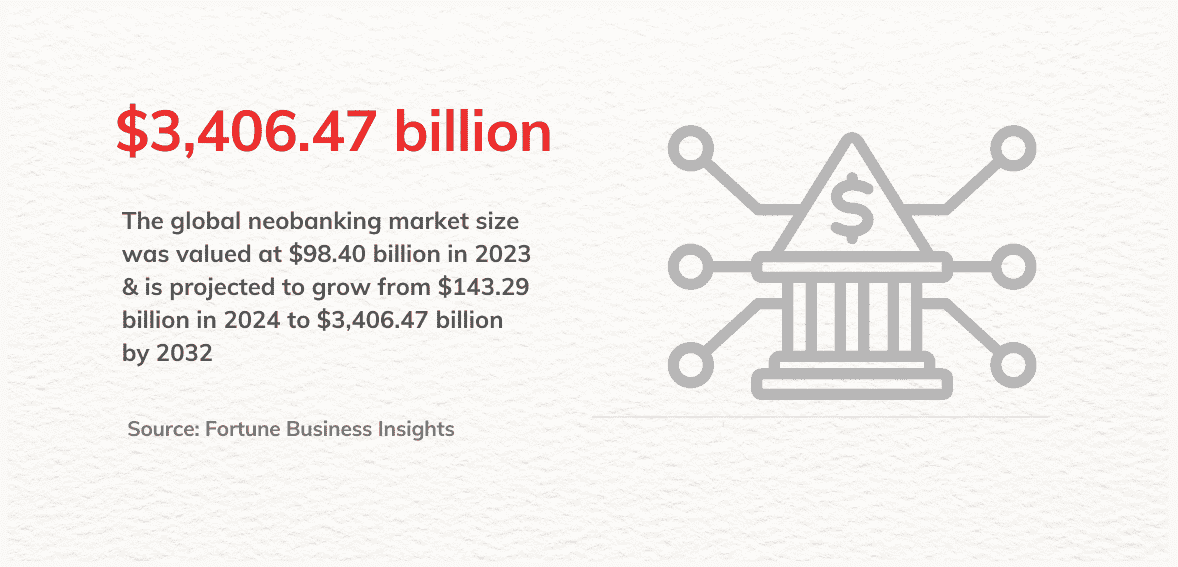
Despite their relatively short existence and lack of physical infrastructure, neobanks have managed to carve out a sizable market share and are poised for significant growth in the coming years. Reports suggest the global neobanking market was valued at over $98 billion in 2023. It is projected to grow significantly, reaching $143.29 billion in 2024 and soaring to $3,406.47 billion by 2032.

Neobanks operate on a distinct business model compared to traditional banks. A significant portion of their revenue comes from interchange fees, which businesses pay each time a customer purchases using the neobank’s debit card. Take Chime, for example, a leading neobank in the US with over 38 million users. Whenever a Chime user swipes their Visa debit card, Visa charges a transaction fee, of which Chime receives a portion.

In addition to interchange fees, neobanks also generate income through other avenues:

  • Subscription Fees: Certain neobanks, including Revolut and Chime, charge a monthly subscription fee for their premium services.
  • Interest from Loans: Many neobanks provide loans and credit cards, accruing interest on these financial products to bolster their revenue stream.

It’s important to note that revenue models can vary among neobanks, leading to differences in charges. However, due to their streamlined operations and reduced overhead costs, neobanks typically require less revenue to sustain profitability compared to traditional banks.

Are Neobanks Safe?

In general, neobanks are considered to be as safe as traditional banks, provided they partner with licensed banks that offer FDIC insurance on their customers’ deposits. Since neobanks typically aren’t licensed or chartered as traditional banks, they cannot directly access FDIC insurance. To determine if funds deposited in a neobank’s checking or savings account are federally insured, check the neobank’s website for information on their banking partners and FDIC coverage.

Neobanks often collaborate with larger financial institutions, allowing them access to deposit services and the protection of the partner bank’s umbrella. While neobanks are fintech companies and not traditional banks, this partnership provides them with a level of safety comparable to other financial institutions.

This collaboration also enables neobanks to insure their products with FDIC coverage, extending protection to your funds held by the neobank at the partner institution. This coverage insures deposits up to $250,000 per depositor, per institution, per ownership category, similar to traditional “big name” banks.

What Are Some Popular Neobanks?

Here are some well-known neobanks and what they offer:

  • Chime: It offers no monthly fees and does not charge overdraft fees for purchases made with debit cards up to $200. In addition, Chime provides a secured credit card and a high-yield savings account for credit building.
  • Aspiration: Gives cash back for purchases made at eco-friendly businesses and monthly savings after $500 in eligible debit card purchases. Together with the option to plant a tree with each card swipe, it reimburses users for one out-of-network expense.
  • Revolut: Offers three plans, including free standard and paid premium options. The free account connects users with discounts and cash-back offers from favorite brands.
  • Current: Like other neobanks, Current does not charge annual fees or impose minimum balance requirements, and it offers early access to direct deposit payments. Current partners with Choice Financial Group and Cross River Bank to ensure its deposits are FDIC-insured.
  • Varo: As the first self-chartered neobank, Varo Bank seeks to ease financial burdens and offer first-rate banking services to all. Initially established as Varo Money in 2015, it was the first neobank to be granted a national bank charter in 2020. Checking accounts, high-yield savings accounts, and free cash advances of up to $100 are all provided by Varo. Further advantages include No credit check, minimum balance requirement, and overdraft fees.

Conclusion

Neobanks epitomize the modernization of banking, offering digital-first solutions tailored to today’s consumers. With streamlined operations and innovative mobile platforms, they provide convenience, lower fees, and higher interest rates than traditional banks. Neobanks generate revenue through interchange fees, subscription models, and interest from loans, ensuring sustainability.

Partnering with licensed banks ensures FDIC insurance on deposits, guaranteeing the safety of customers’ funds. As they continue to redefine banking norms, neobanks are poised for continued growth, reshaping the financial landscape with their tech-driven, customer-centric approach.

Frequently Asked Questions

  1. What is a neobank?

    A fintech providing digital banking services, including accounts, transfers, and budgeting tools, via mobile apps or websites. Neobanks partner with licensed banks for federally insured accounts, ensuring customer fund safety.

  2. How do neobanks work?

    Operating online, neobanks partners with chartered banks for core infrastructure and compliance. They focus on user-friendly digital platforms, reducing costs to offer competitive fees and interest rates.

  3. How do neobanks differ from traditional banks?

    Neobanks are digital-only, without physical branches, and offer lower fees and higher interest rates. Traditional banks offer a wider range of services, are directly chartered and regulated, while neobanks rely on partnerships for insured accounts.

  4. What are the benefits of using a neobank?

    They offer lower fees, convenient digital platforms, quick loan processing, and user-friendly features like budgeting tools, which enhance users’ financial management experiences.

Stanley Tumbler

Secrets to the Viral Success of the Stanley Tumbler

Have you ever wondered how Stanley cups, crafted initially for practicality, have become a major trend in recent years? Join us as we explore the Stanley Tumbler sensation, delving into the factors that have propelled its immense popularity. We’ll examine successful marketing strategies and the psychology behind consumer behavior, unveiling how Stanley cups have transcended their role as mere drink containers to become symbols of lifestyle, aspiration, and social status.

The story of the Stanley cup’s rise to widespread acclaim is fascinating, and we’re not discussing hockey here. Instead, we focus on hydration and how Stanley Tumbler has become a cultural icon. Read on to discover more about this intriguing development.

Key Takeaways
  • Suburban Sensation: Stanley cups have become universal in suburban areas and college towns, emerging as the season’s must-have accessory, particularly after the 2023 holiday season. Their popularity is fueled by enthusiasts lining up for special editions like the TargetGalentine’s Day” release, showcasing their cups online and garnering admiration from others.
  • Legacy of Stanley 1913: Stanley’s strategic rebranding effort in 2016, with the launch of the Stanley Quencher bottle, transformed it into a lifestyle icon and status symbol, even among children. Leveraging social media, affiliate marketing, and influencer endorsements, Stanley successfully redefined its place in the market and secured widespread recognition.
  • Convenient Design and Diversification: The convenience of the Stanley cup’s design, coupled with its ability to keep drinks hot or cold for extended periods, has contributed to its popularity for everyday use and outdoor activities. Stanley’s strategic shift towards targeting new demographics, including women and children, has facilitated its growth and expansion into new markets.
  • FOMO Marketing and Viral Moment: Stanley’s use of FOMO marketing tactics, such as limited editions and strategic collaborations, has created urgency and exclusivity around its products, spurring sales and generating buzz on social media. A viral video showcasing the tumbler’s durability further solidified the brand’s robust image and boosted sales.

The Stanley Water Bottle: A Suburban Sensation

A Suburban Sensation

Across the US, particularly in suburban areas and college towns, the Stanley water bottle has become the season’s must-have accessory. Following the 2023 holiday season, where it emerged as a top gift choice, the Stanley cup has become ubiquitous. Enthusiasts wake up early and line up just for a chance to buy one, and some are willing to spend hundreds on resale platforms to snag special editions like the Target “Galentine’s Day” release. They proudly share their Stanleys online, garnering admiration from others.

When people refer to “a Stanley,” they are talking about a stylish, reusable water bottle from Stanley, a company with a 111-year history of making durable, insulated beverage containers designed initially for WWII pilots and working-class American men. Now targeting a predominantly female audience, Stanley maintains its longstanding promise: its tumblers keep drinks at the desired temperatureβ€”hot drinks stay hot, and cold drinks stay cold. The particularly popular pinks and greens are available in various sizes and colors. The most sought-after models are the 40-ounce “Quenchers,” notable for their robust handles.

2 26

Image source

After all, Stanley’s achievement seems almost too good to be true. The specific reasons behind the 111-year-old company’s more than 10-fold revenue increaseβ€”from $73 million in 2019 to a projected $750 million in 2023β€”never seem to escape the analysis that is written about it.

Certainly, the tumbler’s features were helpful. The straw top allows users to sip with just one free hand, the bottle’s tapered design fits comfortably in a car cupholder, the handle makes the vessel easier to handle, and the vacuum insulation keeps drinks hot or cold for up to nine hours. Perhaps combining these characteristics was the magic ingredient that increased Stanley’s revenue by billions.

However, other knockoff cups also have all these characteristics. Based on the quality of the counterfeits available, it was not difficult to imitate the well-known product. The intangible elements of Stanley’s tumblers were more important to its success than their physical attributes. Superior water bottles have long been fashionable status symbols (yes, there is such a thing as a legitimate market category). By definition, anyone ready to spend between $50 and $90 on a bottle has a lot of extra money, or at the very least, is someone who wants to be perceived as having extra money.

The Legacy of Stanley 1913

The Legacy of Stanley 1913

Since its inception in 1913, the Stanley brand has become a hallmark of robust, high-quality thermoses and drinkware for over a hundred years. Favored by blue-collar workers and outdoor aficionados, Stanley has long been a beloved and prominent name within its specialized market.

Yet, Stanley Tumblers were not gaining traction among broader consumer groups, and they were overshadowed by competitors like Hydro Flask, RTIC, or Yeti in an ever-complicated market. Despite delivering products of superior quality, Stanley found itself at a disadvantage. In response to these challenges, Stanley initiated a strategic rebranding effort to redefine its place in the market and secure the recognition and market share it merited.

In 2016, Stanley 1913 launched the Stanley Quencher bottle. It took a while to catch on, but by late 2023, the Quencher had transcended its status as just another product, becoming a lifestyle icon and a status symbol, even among children.

The turnaround began with a pivotal partnership. In 2019, after initially deciding to discontinue the Quencher due to sluggish sales, a serendipitous encounter with e-commerce blogger Ashlee LeSueur changed everything. She was allowed to buy and resell a large batch of tumblers, leading to a staggering 5,000 Quenchers selling out in just a few days! This marked the start of the Quencher craze.

Since then, the Quencher has dethroned the classic Stanley bottle as the company’s bestseller. Stanley leveraged social media to amplify its reach, creating a vibrant community around the product. Hashtags like #stanleycup and #stanleytumbler became trending topics, especially on TikTok, a hotspot for Quencher fans.

Moreover, Stanley expanded its marketing strategy to include affiliate and influencer marketing, ensuring influencers who resonated with their target audience showcased their products. The impact of user-generated content was also significant, with authentic stories and endorsements from real users bolstering the Quencher’s presence across various social platforms.

A Look Behind the Genius/Luck of Stanley Tumbler

A Look Behind the Genius/Luck of Stanley Tumbler
  • Convenient Design:

No one appreciates a cumbersome cup that holds too little water. In stark contrast to earlier models, the Stanley cup emerges as the quintessential hydration vessel. It boasts a slender base that fits most cup holders seamlessly.

The Stanley Quencher Tumbler can accommodate up to 40 ounces of water, enabling users to stay hydrated conveniently throughout the day. Stanley products come in various capacities, so it’s advisable to select a size that suits your hydration needs before making a purchase.

  • Leveraging User-Generated Content:

Understanding the impact of user-generated content, Stanley has actively encouraged its customers to post their personal experiences and use branded hashtags on social media. This strategy has fostered a community atmosphere among Stanley users, enhanced the brand’s visibility, and provided prospective customers with the social proof necessary to trust in the quality of Stanley products.

  • Diversification:

Stanley’s strategic shift from focusing solely on blue-collar workers and outdoor enthusiasts to embracing markets that include women and children exemplifies how exploring new demographics and expanding product lines can facilitate growth. This serves as a valuable lesson for small businesses about the importance of venturing beyond familiar territories to uncover fresh opportunities.

  • Insulation for Iced and Hot Beverages:

With a Stanley cup, your morning coffee remains steaming hot; these products maintain hot temperatures for seven hours. Additionally, iced beverages stay cold for up to four hours longer, an advantage that spares your tables from condensation rings.

Thanks to these impressive features, Stanley cups are ideal for staying hydrated during road trips and outdoor activities, as well as for everyday use at home or in educational settings. Whether you favor ice-cold refreshments or piping hot beverages, the stainless steel Quenchers from Stanley are designed to satisfy your drinking preferences in any setting.

  • FOMO Marketing

The fear of missing out (FOMO) is more than a psychological phenomenon; it’s a pivotal component of Stanley’s marketing strategy. Stanley has perfected the art of creating urgency- a marketer’s dream by offering limited editions, engaging in strategic collaborations, and announcing frequently sold-out releases. This approach has seen Stanley cups flying off shelves at an unprecedented rate.

Exclusivity is a potent marketing lever, and Stanley has leveraged it with great finesse. By making specific products or colors available only for a limited period, Stanley has not only spurred sales and generated buzz on social media but also made ownership of a Stanley cup akin to entry into an exclusive club. This sense of scarcity and uniqueness enhanced the allure of the Stanley cup and played a crucial role in the company’s explosive growthβ€”from $75 million to an impressive $750 million in sales in 2023 alone.

  • The Viral Moment

Stanley’s resurgence peaked with a serendipitous event: a viral video. The footage displayed a Stanley tumbler miraculously surviving a fall from a moving car, highlighting the product’s remarkable durability and solidifying the brand’s robust image. The video spread like wildfire across social platforms, dramatically boosting brand recognition and sales.

Why do Consumers Rush to Buy Certain Products? Understanding the Psychology

Labeling a product as “exclusive” or “limited edition” or restricting its availability taps directly into consumer psychology. Declaring an item as limited can elevate its perceived value, not necessarily its actual monetary worth. This phenomenon is linked to the notion that we desire what we cannot easily have and dislike restrictions on our choices. For example, many consumers justify purchasing high-quality Stanley cups because the purchase seems justified if you use them daily and value each use at one dollar.

Plus, when a product is marketed as a “limited edition,” companies effectively create a sense of urgency. This urgency heightens the fear of missing out, which can be more distressing than regret over a purchase that didn’t meet expectations.

Upon reflection, we often regret what we didn’t do more than what we did. This mindset fuels the initial rush to acquire limited items. However, once the excitement fades, it’s common to reevaluate the necessity of such purchases. This urgency creates a whirlwind of excitement and buzz, resembling a snowball effect. Eventually, it leads one to wonder how things escalated so quickly.

About Stanley 1913

Stanley 1913 is a company focused on crafting and distributing various drinkware and cookware. Their offerings encompass vacuum bottles, mugs, thermoses, and various accessories, including replacement parts.

Known for their robust durability, Stanley 1913 products feature double-walled vacuum insulation that effectively maintains the temperature of beverages, whether hot or cold, for extended durations. Among their products is the Adventure Quencher Travel Tumbler, designed to enhance the drinking experience with a reusable straw, making it ideal for enjoying your favorite beverages on the go.

Conclusion

The viral success of the Stanley Tumbler underscores strategic marketing, consumer psychology, and product innovation. From its utilitarian origins, the tumbler has become an essential cultural icon and lifestyle. Key to its acclaim are its convenient design, superior insulation, and the fostering of a vibrant user community. Diversification into new demographics and FOMO marketing tactics have propelled Stanley’s exponential growth. Stanley taps into consumer desires by leveraging exclusivity and urgency, driving demand. A stroke of viral luck further bolstered its ascent. In 120 words, Stanley Tumbler’s journey from practicality to cultural phenomenon exemplifies modern marketing and product development.

Joann Stores Closures and Layoffs: Joann Fabrics and Crafts Stores File Bankruptcy

Joann Stores Closures and Layoffs: Joann Fabrics and Crafts Stores File Bankruptcy

With mounting debt, changing customer tastes, diminishing sales, and rising expenses, Joann Inc., a retailer of crafts and fabric, is now facing bankruptcy, which was all but inevitable. Joann filed for Chapter 11 bankruptcy. Despite the financial obstacles, the Hudson, Ohio-based corporation plans to continue operating Joann stores at more than 800 locations during the restructuring process. According to Joann, the company owes between $1 billion and $10 billion. According to the bankruptcy documents, the company’s financial health is significantly impacted by a fall in consumer interest and higher costs associated with delivering goods internationally.

Joann expects to reduce its financed debt by approximately $505 million as part of its restructuring activities. Joann has acquired around $132 million in new funding, which is said to be a significant step forward in enabling the stores to continue operating.

Key Takeaways
  • Joann Enters Chapter 11 Bankruptcy Protection Amid Shifting Consumer Trends: Joann Fabric and Crafts Stores filed for Chapter 11 bankruptcy due to a drop in disposable income and a loss of interest in doing crafts at home, indicative of larger shifts in post-pandemic consumer behavior.
  • Continued Operations During Restructuring: Joann plans to continue operating its more than 800 stores and its online platform while filing for bankruptcy, providing consumers and stakeholders with continuous service.
  • Financial Restructuring and Debt Reduction: Joann’s efforts to procure $132 million in fresh funding and curtail its financed debt by about $505 million signify a crucial stride towards reorganizing its capital structure and bolstering continuous operations.
  • Challenges and Future Prospects: The bankruptcy filing underscores challenges such as increased costs, declining sales, and intensifying competition in the crafts market. Joann’s ability to adapt to evolving consumer preferences and streamline operations will be critical for its future success amidst changing market dynamics.

Joann Files for Chapter 11 Bankruptcy Protection Amid Shifting Consumer Trends

Joann Files for Chapter 11 Bankruptcy Protection Amid Shifting Consumer Trends

Fabric and crafts retailer Joann has entered Chapter 11 bankruptcy protection due to a downturn in discretionary spending and a drop-off in pandemic-era hobbies. In a statement released Monday, the company, headquartered in Hudson, Ohio, announced its anticipation to exit bankruptcy by the end of next month. Post-bankruptcy, Joann is expected to transition to private ownership by certain lenders and industry stakeholders, which means its shares will no longer be listed on public stock exchanges.

Joann’s more than 800 locations and website will stay open during the reorganization. Thanks to a financial deal obtained with the majority of its shareholders, the company has guaranteed that payments to vendors, landlords, and other trade creditors will not be disrupted.

In addition to its recent bankruptcy filing in the U.S. Bankruptcy Court, Joann announced it has secured approximately $132 million in new financing and anticipates reducing its funded debt by roughly $505 million.

Scott Sekella, Joann’s CFO and co-leader of the interim CEO office, remarked that the transaction support agreement represents a crucial advancement in restructuring the company’s capital framework. He emphasized that the retailer is dedicated to maintaining normal operations and continuing to serve its millions of customers across the country.

Joann’s bankruptcy comes when overall discretionary spending is slowing, and consumer interest in at-home crafting activities is waning, especially compared to the surge experienced at the onset of the COVID-19 pandemic.

Neil Saunders, Managing Director of GlobalData, noted that the crafting sector, which thrived during the pandemic, is now experiencing a modest decline as people shift their focus and spending towards outdoor experiences like dining out or attending sporting events. This shift is creating challenges for all players in the crafts market. Saunders also pointed out specific hurdles for Joann, including significant debt and intensifying competition.

Joann had a brief period of time as a publicly traded firm. Motivated by a notable surge in sales, the store launched a $100 million IPO in early 2021. Comp sales in the first ten months of 2020 increased by more than 24%. This increase was mostly brought about by the social isolation and lockdowns imposed during the epidemic, which led to increased crafts being done at home.

However, as pandemic restrictions eased, the initial surge in interest waned. Over the past few years, consumer spending has shifted away from discretionary purchases, with shoppers increasingly seeking discounts. According to Neil Saunders, Managing Director of GlobalData, crafters have turned to more economical options like Hobby Lobby or online shopping. Saunders also noted that Joann is partly to blame for its challenges, citing a decline in store standards and customer service, often due to staffing reductions.

These issues have made physical stores less appealing, while the convenience of online shopping from various craft supply websites has grown. Despite efforts to enhance its own website, Joann has seen limited success in countering these trends.

In February, Joann shut down its Wooster store, following the closure of its Zanesville location in January. The company, which has been in business for approximately 80 years, also experienced layoffs at its Hudson headquarters last year. Joann reported a 4% decrease in revenue in December, failing to meet analysts’ expectations as it struggled to regain stability post-pandemicβ€”a period that had initially boosted sales and interest in home-based hobbies.

According to the most recent city data, Joann is the largest employer in Hudson, with 979 employees as of last January.

What Would Bankruptcy Mean for Joann Stores and Customers?

What Would Bankruptcy Mean for Joann Customers?

Image source

Should Joann proceed with a bankruptcy filing, legal experts indicate that customers would likely see little change in the retailer’s day-to-day operations. The primary goal of such filings is to reorganize the company’s finances and restructure its debt, aiming to preserve the fundamental aspects of the business.

During the restructuring process, efforts to reduce expenses might lead to further store closures, mainly targeting underperforming or costlier locations, as part of a strategy to streamline operations.

About Jo-Ann Stores LLC

About Jo-Ann Stores LLC

A division of Joann Inc., Jo-Ann Stores LLC is a specialty retailer that specializes in textiles and craft products. The company sells a wide variety of goods, such as frames, scrapbooking equipment, crafts, paper crafts, faux flowers, sewing supplies, home decorations, seasonal goods, and different do-it-yourself (DIY) projects.

These goods are sold under several national and exclusive labels, including Jo-Ann Sensations and Fabric and Craft. Jo-Ann Fabric, Jo-Ann, and Jo-Ann are the store names under which Jo-Ann oversees its retail activities. The business also sells its goods online at joann.com, its e-commerce platform. Jo-Ann’s corporate office in the United States is in Hudson, Ohio.

Conclusion

Joann’s filing for Chapter 11 bankruptcy reflects a culmination of challenges stemming from evolving consumer preferences, mounting debt, and shifting economic landscapes. Despite the adversity, the company remains committed to preserving its operations across its extensive network of stores and online platforms.

Joann aims to emerge from bankruptcy with a strengthened financial footing with a focus on securing new financing and reducing debt. However, uncertainties persist regarding potential store closures and the overall impact on customers and employees. As Joann navigates this restructuring phase, its resilience and ability to adapt to changing market dynamics will be crucial in determining its future success in the competitive fabric and crafts retail sector.