

Quarterly Restaurant Report for Spring 2024

Square Unveils Quarterly Restaurant Report for Spring 2024

Square has recently published the latest Quarterly Restaurant Report, which provides a detailed analysis of the current trends shaping the food and beverage industry. Drawing on data from its merchants, the report offers insights into evolving consumer dining preferences, changes in spending patterns, and the impact on restaurant wages.

The quarterly restaurant report for the Spring 2024 edition highlights significant shifts in the sector, shedding light on emerging dining trends, the dynamics of payroll costs, the influence of technological advancements on operational efficiency, and more. Keep reading to learn more about what the restaurant industry holds in 2024.

Key Takeaways
  • Increase in Payroll Costs for Full-Service Restaurants and Bars: The report highlights a significant rise in payroll expenses for bars and full-service restaurants, with wages increasing by 66% from 2017 to 2024. This is due to the employment of more highly skilled workers for tasks that are difficult to automate. In contrast, cafes and quick-service restaurants (QSRs) have leveraged technology to reduce operational costs.
  • Impact of Tip Credit Regulation Changes: The “One Fair Wage” Ordinance in Chicago is set to eliminate the city’s tip credit system by 2028, mandating incremental increases in the minimum wage for tipped employees. This change will result in a 76% increase in the minimum wage for these employees, affecting payroll structures and operational costs for restaurants.
  • The shift in Consumer Dining Patterns: The report notes a shift in consumer dining behavior, with a decline in weekday lunch outings and an increase in weekend dining. This change is attributed to the rise in remote work, which has led to higher restaurant traffic on weekends and sustained popularity of happy hour gatherings post-pandemic.
  • Regional Preferences for Spirits: Consumer preferences for spirits show regional variations, with vodka and tequila being particularly popular. Cities like Los Angeles, Miami, and San Antonio strongly prefer tequila, suggesting that restaurants in these regions can expect increased demand for tequila-based drinks during the summer.

Square Releases Spring 2024 Quarterly Restaurant Report Highlighting Industry Trends

On May 14, 2024, Square unveiled its latest Spring Quarterly Restaurant Report. This report offers an in-depth look at the evolving dynamics and trends within the restaurant industry as it progresses.

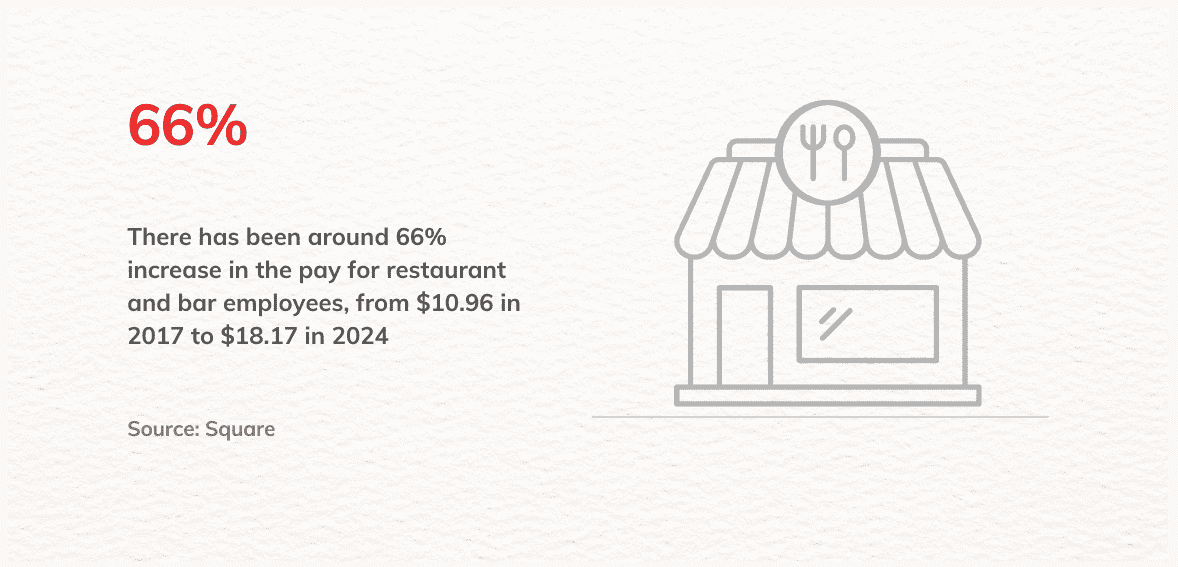
A key finding of the report is the significant rise in payroll expenses for bars and full-service restaurants, which is linked to the employment of more highly skilled workers. These workers are required for tasks that are challenging to automate. The report reveals that over the past seven years, there has been around 66% increase in the pay for restaurant and bar employees, from $10.96 in 2017 to $18.17 in 2024. This increase is also 26% higher than in the retail sector.
Square Releases Spring 2024 Quarterly Restaurant Report Highlighting Industry Trends

The report also examines payroll expenses as a percentage of revenue, noting that these costs have increased more rapidly in certain sub-sectors than in others. While bars (38%) and full-service restaurants (40%) have experienced a rise in payroll costs since 2019, cafes (42%) and quick-service restaurants (38%) have seen a decrease.

Talking about it, Ming-Tai Huh, Square’s Head of Restaurants, explained that full-service restaurants and bars depend increasingly on highly skilled employees to carry out difficult tasks, leading to higher payroll costs. In contrast, cafes and quick-service restaurants (QSRs) face a different scenario. These establishments can leverage technology more effectively to automate and streamline operations, thereby reducing operating costs for both the front and back of the house.

The report also sheds light on the implications of changes in tip credit regulations.

To provide some context, on October 6, 2023, the Chicago City Council approved the “One Fair Wage” Ordinance. This legislation mandates gradually eliminating the city’s tip credit system over five years. Under the ordinance, employers must incrementally raise the minimum wage for their employees each year without offsetting these increases with tips earned. Full implementation is set for June 30, 2028, when employers can no longer apply a tip credit to wages.

According to the report, this legislative change is expected to increase the minimum wage for tipped employees by 76%, from around $9 to around $15.80 per hour for businesses with 21 or more employees. The first of these increases will take effect in July this year, with annual increases to follow until the ordinance is fully enacted in 2028.

As of last month, over 60% of restaurant workers in Chicago were earning a base wage of $15.80 per hour. Currently, the median restaurant worker in the city earns $16.12 per hour before tips and overtime and $21.70 when tips and overtime are included.

Chicago restaurant wages infographic

Source: Square

Ara Kharazian, the research lead and principal developer of the Square Payroll Index, noted that 22 states have already increased their minimum wages this year, and more are expected to do so in the upcoming months. Additionally, numerous state and local governments are drafting legislation to phase out tip credits. In an industry characterized by narrow profit margins, restaurants can enhance staff efficiency through technology, allowing employees to devote more time to customer interactions rather than repetitive, manual tasks.

The report indicated that although remote work has become widespread, the happy hour tradition continues to thrive, with end-of-day gatherings slightly surpassing pre-pandemic levels. There has been a noticeable shift in consumer behavior, with a decline in weekday lunches and a rise in weekend dining, mirroring the evolving balance between work and leisure.

Analyzing restaurant and bar traffic from 4 to 6 p.m., happy hour has remained robust, even slightly exceeding the levels seen in 2019 as of 2023.

Ara points out that consumers are reducing their restaurant spending, and total expenditures have actually risen. The more significant shift is in consumer behavior. Before COVID-19, people often ate lunch near their workplaces and went out for drinks after work during the weekdays. However, with the increase in remote work, restaurant spending has now moved predominantly to weekends, experiencing peak traffic.

The report highlights a competitive edge in consumer preferences for spirits, with vodka and tequila jockeying for prominence despite regional differences. Los Angeles, Miami, and San Antonio strongly prefer tequila, with New York City and Houston also favoring this spirit. Whether in a margarita or other cocktail forms, restaurants in these cities can expect a busy season ahead.

Annually, restaurant spending surges at the end of March when patio season begins, continuing robustly through early September before a natural decline prior to the holiday season surge post-Thanksgiving. This trend is especially pertinent as restaurants prepare for the summer rush, a time marked by increased dining out driven by warmer weather and outdoor activities.

About Square

square POS for golf course

Square is an online banking system run by Block, Inc., that supports businesses of all sizes. It facilitates several business operations and enables companies to accept credit card payments by utilizing cell phones as point-of-sale registers.

The platform provides tools for business owners to sell products, manage inventory, process transactions, schedule appointments, engage with customers, process online orders, and more. It caters to various industries, including food and beverage, retail, home and repair services, and fitness and beauty.

Square’s offerings include enabling online sales, providing BNPL options through Afterpay, building customer loyalty, managing appointments, and facilitating staff recruitment and payroll. Additionally, it integrates financial services tools at the point of sale, allowing merchants to obtain business loans and manage their finances effectively.

Conclusion

The Spring 2024 Quarterly Restaurant Report by Square highlights significant trends in the food and beverage industry. Notably, there has been a substantial rise in payroll costs for bars and full-service restaurants due to the need for skilled labor, while cafes and QSRs have reduced costs through technology. Changes in tip credit regulations, particularly in Chicago, will impact wage structures.

Additionally, consumer dining patterns are shifting, with remote work leading to increased weekend dining and sustained happy hour popularity. Regional preferences for spirits, particularly tequila in certain cities, present opportunities for targeted marketing. These insights underscore the evolving landscape and challenges faced by the restaurant industry in 2024.


1 18

Visa Announces New Card Innovations

This week, Visa unveiled seven new payment solutions, including one that could be seen as a “reimagining” of the conventional payment card. Visa, the credit card giant, is paving the way for a future where physical credit cards and card numbers may become obsolete. At the annual Visa Payments Forum in San Francisco, the company announced several new card innovations and digital products to transform the payment landscape.

Traditional features in the payment card industry, such as embedded chips, plastic cards, closed-loop systems, and the need to recall 16-digit numbers and CVVs, now seem outdated, reminiscent of 20th-century relics. The movement towards digital platforms and mobile devices and the swift growth of cutting-edge technologies like artificial intelligence are revolutionizing the design, issuance, personalization, and use of payment cards.

These innovations are part of Visa’s strategy to utilize generative AI to revolutionize payments, potentially eliminating the need to shuffle through multiple cards and enhancing user experience.

Key Takeaways of Visa New Card Innovations
  • Visa Introduces Flexible Credential and Payment Passkey Service: Visa’s new digital products, including the Visa Flexible Credential and Payment Passkey Service, are designed to simplify and secure the payment process. The Flexible Credential allows consumers to switch between different payment methods using one card, while the Payment Passkey Service enables biometric authentication for online purchases.
  • Enhanced Tap-to-Pay Features: Visa is upgrading its tap-to-pay technology with new functionalities like “tap to confirm,” “tap to add card,” and “tap to P2P payments.” These features aim to enhance the security and convenience of digital transactions, making it easier for users to authenticate their identity and manage their cards.
  • Pay by Bank Service: Pay by Bank allows customers to make payments directly from their bank accounts through Visa’s secure network. This service is designed to streamline the checkout process by eliminating the need for card details and passwords, thereby reducing the risk of fraud.
  • Visa Protect for A2A Payments and Data Tokens: Visa Protect for A2A Payments uses AI to enhance the security of account-to-account transactions by detecting and preventing fraud. Additionally, Visa’s introduction of data tokens enables consumers to manage and control their personal data sharing, providing more transparency and personalized shopping experiences.

Visa Unveils New Digital Payment Solutions, Paving the Way for a Cardless Future

Visa Unveils New Digital Payment Solutions, Paving the Way for a Cardless Future

Visa is at the forefront of a movement towards a future where physical credit cards and card numbers may become less necessary. At the annual Visa Payments Forum in San Francisco, the credit card giant revealed a range of digital products to revolutionize the payments industry.

Jack Forestell, the Chief Product Officer (CPO) and Chief Strategy Officer (CSO), highlighted the significant shift occurring in the industry, propelled by advancements in generative AI. These technologies are reshaping the way we shop and manage our finances, setting the stage for the introduction of digital-native payment card experiences. Visa announced new card features and digital innovations aimed at providing consumers with more personalized, convenient, and secure payment options. These products and services are set to begin rolling out later this year.

1. Visa Flexible Credential

The Visa Flexible Credential is an innovative technology that enables issuers to offer their clients the ability to access multiple funding sources through a single existing payment card. This new feature allows consumers to seamlessly switch between various funding options such as checking accounts, lines of credit, prepaid debit cards, loyalty points, or Buy Now, Pay Later (BNPL) plans.

Shoppers in Asia have already started experiencing this flexibility, and as more issuers adopt the technology, all consumers will soon enjoy the convenience of accessing diverse funding sources with just one card, marking a significant advancement in the future of payments.

2. Visa Payment Passkey Service

Visa has introduced passkeys as a new method for authorizing payments, allowing customers to make purchases online using a biometric scan on their smartphone or computer. This capability is provided through the Visa Payment Passkey Service, which is built on Visa’s own Fast Identity Online (FIDO) server. The service adopts a federated model, enabling merchants to easily integrate this biometric authentication feature into their checkout processes without the need to develop their own servers or undergo complex technical integrations.

Visa Payment Passkey Service

This means consumers can utilize the same biometric authentication systems they already use to unlock their devices and securely make Visa payments online. Enrollment is simple and needs to be done only once during checkout. Visa also plans to enable enrollment through banking apps in the future, further simplifying the process.

Jack Forestell emphasized the widespread demand for uniformity, interoperability, and simplicity in online payments. Visa’s introduction of passkeys, specifically tailored for payment authentication, marks a significant shift in the industry. These passkeys streamline the checkout process by confirming identity without disruption. The Visa Payment Passkey Service enhances security while minimizing friction during online payments across any device or website worldwide.

In its initial deployment of passkeys, Visa has incorporated the Visa Payment Passkey Service into its Click to Pay feature, creating a more seamless and secure checkout experience on a large scale. Furthermore, Visa is collaborating with issuers in various global markets to integrate the Visa Payment Passkey Service and Click to Pay into new Visa cards. This integration will eliminate the need for manual card details and password entries when the card is first received, simplifying the payment process right from the start.

3. Tap-to-Pay

Visa is enhancing its tap-to-pay capabilities by offering several innovative features. Alongside the conventional method of tapping a smartphone to pay without needing specialized point-of-sale hardware, Visa is introducing several new functions. These include “tap to confirm,” which authenticates a user’s identity during online shopping, and “tap to add card,” which offers additional security when adding a card to a digital wallet or app. Visa also integrates “tap to P2P payments,” enabling consumers to send money to family and friends easily.

Furthermore, Visa has streamlined the transaction confirmation process. Now, transactions can be authenticated simply by tapping the card against a phone, removing the need for further input. This enhancement aims to make digital payments quicker and more secure for users.

4. Pay by Bank

Pay by Bank enhances the convenience and security of online payments by allowing customers to transact directly from their bank accounts over Visa’s secure network. Designed to simplify the checkout process, this service eliminates the need to enter card details or remember passwords, saving time and minimizing the risk of sharing sensitive information online.
Utilizing advanced security measures and technology, “Pay by Bank” ensures robust protection for transactions by integrating directly with bank accounts and leveraging Visa’s security protocols. This service simplifies account-to-account (A2A) payments, offering consumers various payment options, including loan applications, A2A transfers, or using other funding sources like credit cards. Visa is introducing this technology in the U.S., aiming to support its clients in delivering seamless and secure banking experiences.

5. Visa Protect for A2A Payments

Visa has introduced a new service called Visa Protect for A2A Payments to enhance the security of account-to-account (A2A) transactions. Using its extensive fraud prevention experience, Visa has integrated artificial intelligence (AI) to mitigate fraud risks across real-time payment (RTP) networks globally. This service scrutinizes a variety of transaction data to detect and thwart fraud. Already active in regions like Latin America and undergoing trials in the UK, it has effectively identified numerous RTP frauds and scams that were previously undetected.

With a significant investment of $10 billion in technology and innovation over the past five years, Visa continues to lead in securing digital transactions. These investments underscore its dedication to safeguarding all types of electronic payments.

Visa Protect for A2A Payments

6. Data Tokens

One of the key highlights from the Visa Payments Forum was the introduction of Visa data tokens. This innovative development utilizes Visa’s tokenization infrastructure and a network of partner banks to enhance consumer control over their personal data usage. These AI-powered tokens enable consumers whose banks participate in the program to actively manage how their data is shared with merchants and financial institutions, aiming to deliver personalized experiences.

Consumers can consent to share their data while shopping online, monitor where their data has been shared, and revoke access directly through their banking app. Additionally, when a consumer agrees to share their data, Visa generates a private data token for the merchant, which includes AI-generated insights from the consumer’s transaction data.

This token can be integrated into the merchant’s AI models to provide tailored real-time shopping recommendations. Furthermore, Visa ensures transparency by providing information to the consumer’s bank about where the data has been shared, enabling consumers to review and manage these settings conveniently through their mobile banking app.

About Visa

visa card

Visa Inc. is a global payment technology company based in the United States with international operations. The company manages VisaNet, a transaction processing network that handles the authorization, clearing, and settlement of payment transactions. Visa provides various products, including debit, credit, and prepaid cards; it also offers tokenization, tap-to-pay, and click-to-pay services. Additionally, Visa Direct enables the transfer of funds to eligible cards, digital wallets, and bank accounts; Visa B2B Connect serves as a business-to-business cross-border payment network; and Visa Cross-Border Solution facilitates cross-border consumer payments.

Visa DPS delivers value-added services like dispute resolution, fraud prevention, campaign management, data analytics, contact center support, and digital solutions. The company’s acceptance solutions feature Cybersource, which connects merchants to payment processing and offers risk management and identity solutions like Visa Advanced Authorization and Visa Secure. Furthermore, Visa Consulting and Analytics provides advisory services in payment consulting. Visa operates under various brand names including Visa Electron, Interlink, V PAY, and PLUS, serving merchants, financial institutions, and governmental entities. Founded in 1958, Visa is headquartered in San Francisco, California.

Conclusion

Visa’s recent announcements at the Visa Payments Forum highlight its dedication to evolving the digital payment landscape. By introducing the Visa Flexible Credential, Payment Passkey Service, and enhanced tap-to-pay features, Visa aims to provide more secure, convenient, and versatile payment options.

The Pay by Bank service and Visa Protect for A2A Payments focus on streamlining transactions and enhancing security, while data tokens offer greater control over personal data. These innovations signify Visa’s commitment to leveraging advanced technology, particularly generative AI, to improve the user experience and adapt to changing market needs. As these features roll out, they promise to redefine how consumers interact with payment systems, moving towards a more cardless and secure future.

4 10

How Can I Increase eCommerce Conversions in 2026?

The Internet is a big place, so it makes sense that those with an online store are keen to do what it takes to increase eCommerce conversions. The journey a brand takes when increasing conversions can differ, but it is important to ensure that areas of a website are noticed.

The Internet’s competitive nature means that a simple flaw with a website is all that is needed to rank lower than the competition online. Fortunately, some steps can be taken to ensure that eCommerce conversions are always the best they can be, regardless of the product or service sold.

What Is Conversion Rate

What Is Conversion Rate

Before exploring ways to increase conversion rates, defining what a conversion rate is is essential. A conversion rate is not merely the number of customers buying your products. Instead, it represents the number of people who take any action you’ve asked them to take on your site. This action could be signing up for a newsletter, subscribing to a webinar about your new product launch, or filling out a contact form. Your conversion rate measures the ratio of site visitors to those who take action.

For instance, if you get 20,000 visitors to your webinar landing page and only 200 people sign up, your conversion rate would be 1%. Investing in conversion rate optimization involves taking specific measures designed to encourage more positive actions from your audience. When done successfully, this improves revenue and provides the necessary tools to achieve consistent sales.

How to Increase eCommerce Conversions?

How to Increase eCommerce Conversions?

Let’s explore some strategies for increasing your eCommerce conversion rate and scaling your business. Feel free to start with the approach that resonates most with you.

1. Ensure The Design is Persuasive

Despite there being several ways of increasing conversions, one of the essential starting points is the design of the website. Of course, an e-commerce store mustn’t compromise its brand. However, the design must persuade visitors to remain on a site.

A clean design with an obvious call to action (we will talk about it further) will always fare better than a page cluttered with options and information. Likewise, explicit imagery of the products that reflect the brand’s essence should be used instead of standard stock imagery. An e-commerce site that can keep visitors on the site longer is more likely to see increased conversions.

2. Ensure the User Experience is the Best it Can Be

The design of the website may entice visitors, but niggly navigation and slow-loading pages will often be enough for a potential customer to look elsewhere for products or services. Fortunately, this can be easily avoided by ensuring the user experience is the best it can be.

Not only must the site load quickly, but it must also be designed with mobile users in mind. It is also important that any information regarding products or services can be found quickly. Users who can find information quickly are more likely to make a purchase, thus increasing conversions.

3. Use SEO and CRO Together

Use SEO and CRO Together

When promoting an e-commerce store online, some may choose search engine optimization or conversion rate optimization. Both are important, but those wanting to increase conversion will find using both methods is often the key to success.

SEO is often about being found online and is carried out via keyword research. However, this doesn’t mean that visitors will stick around after visiting the site. This is where CRO comes in.

Keywords need to be used in the content, but not to the point where it is unreadable and bewilders visitors. Conversion rate optimization means taking the keywords and using them in a way that still offers value to the visitors while being complimented by a clear call-to-action and an easy sign-up process.

4. Establish a Referral Program

Referral marketing can yield conversion rates that are 3–5 times higher than other channels, with referred customers proving to be 18% more loyal and 4 times more likely to refer to others. People tend to favor purchasing products recommended by trusted individuals, such as friends or colleagues. Additionally, implementing a referral program that rewards both new customers and those who direct them to your business can significantly improve retention rates, resulting in a customer base with higher lifetime value.

For example, you could offer customers discounts or rewards for successfully referring a friend to your business, similar to what Dropbox does. Fortunately, creating a referral program is often simpler than expected.

There are various apps and platforms compatible with website builders like WordPress, enabling you to set up referral programs quickly. After establishing your program, promote it widely. Highlight it on your website, email customers with links, and emphasize the benefits in your social media posts.

5. Take The Shopping Experience to Social Media Platforms

Very few businesses need information about social media’s popularity, but many are surprised to discover how lucrative social media websites can be for increasing conversions.

Although nothing can replace an efficient e-commerce store, offering the same great products and services with the same branding on social media allows a business to connect with customers who may have been overlooked. In addition to promoting products to a new audience, social media integrations mean making a purchase is easy and can increase the likelihood of repeat purchases in the future.

6. Add Live Chat

Adding a live chat feature to your website can greatly increase customer service in real-time, satisfying visitors and increasing conversion rates. In fact, 63% of customers report that they are more likely to return to a website that offers online chat. Live chat also facilitates client feedback collection and pain point identification, enabling enhancements.

Use platforms like Drift, Zendesk Chat, or Intercom to add live chat to your website. You can alter the chat widget’s layout and appearance with these tools. Make sure live chat is used efficiently after it is set up by answering questions promptly and professionally, offering useful resources and information, and following up with clients after their initial conversation.

AI chatbots can also answer simple questions and offer round-the-clock assistance, keeping a personal touch while speeding up response times.

7. Make Sure to Promote Reviews and Feedback on the Website

Make Sure to Promote Reviews and Feedback on the Website

An e-commerce store is about finding balance when delivering information to customers, but showcasing a brand’s excellence should be a priority for all e-commerce stores. Despite many e-commerce stores offering fantastic products and services, some mislead or exploit customers. Fortunately, those shopping for products online have become more knowledgeable about checking the integrity of an e-commerce store.

An e-commerce store with a strong social presence online will find more favor with customers than those who don’t. Customers can leave reviews on various platforms, but there will be no issues integrating reviews into the website. Showcasing genuine reviews from others instills confidence in those using the site, increases the likelihood of a purchase being made, and helps improve the social proof of an e-commerce store moving forward.

8. Abandoned Carts Should Be Treated as a Benefit

When checking the sales of a product, it can be disheartening to see an abandoned cart. However, it is important to ascertain why this has happened. If there are many abandoned carts, then it could be due to a checkout problem. Making a few changes could be all it takes to improve conversions. However, there can be other reasons for abandoned carts that aren’t due to a fault with the e-commerce store. Some may have been in the middle of a transaction before becoming distracted by something else.

Similarly, those using a smartphone to make a purchase may have lost Internet access when trying to make a payment. Reaching out to customers with a small discount can often be enough for them to make a purchase and gives customers an example of the brilliant service they can expect moving forward.

The steps taken to increase conversions can differ among e-commerce stores. However, taking advantage of the steps taken ensures that a website is taking full advantage of every opportunity when increasing its online conversions.

9. Enhance Your CTAs

A clear and compelling CTA (call to action) can greatly improve your site’s conversion rates by guiding users along a defined path. To make your CTAs more engaging, consider these design and placement strategies. Larger buttons draw more attention but should be proportionate and not overpowering.

Position CTAs strategically, either above the fold for immediate visibility or at the end of content sections, as a logical next step. Surrounding your CTAs with ample whitespace makes them stand out more and reduces visual clutter. Subtle animations, like hover effects, can draw attention to the CTA without distraction. Finally, use colors contrasting with your site’s color scheme to make your CTA buttons pop and grab attention.

10. Assessing Your Website’s Friction Points

Every website has inherent friction points that can disrupt a seamless user experience. Evaluating these areas is crucial to enhancing navigation and usability.

  • Scroll Depth and Heat Map Reports: These reports can indicate where users drop off on a page. Noticing a significant drop in attention at specific sections suggests those areas may be causing high friction.
  • FAQs: Frequently Asked Questions sections can be invaluable for research-oriented visitors. However, if they are dense or manageable, their effectiveness may remain high. To create a smoother user journey, consider integrating answers or solutions directly into the core site experience, making them readily accessible throughout.
  • Funnel Drop-Off Performance: Comparing the drop-off rate at each stage of the conversion funnel against benchmarks can highlight additional friction points. For example, a common friction point is the payment information page, where visitors may reconsider their purchase. Adding social proof, such as testimonials or a money-back guarantee, can help reassure potential customers and reduce drop-off rates.

11. Do Rigorous A/B Testing

6 2

A/B testing is a useful technique for website performance optimization. This technique compares two landing page variants with various text, buttons, and image elements. You can increase your conversion rates by making well-informed judgments based on the analysis of the test findings. Focusing on components like headlines, call-to-action buttons, or graphics that greatly affect user behavior is essential for successful A/B testing. Choose what you want to test first, such as several headlines, to discover which appeals to your audience the most.

After choosing which piece to test, make many versions of your landing page by altering the selected element. For instance, you may change the title but leave the remainder of the page unchanged. To ensure proper data collection, set up and run your tests using technologies such as Google Firebase A/B Testing. Continue the test until you have collected enough information to get statistically significant findings. Next, important performance metrics are evaluated to ascertain whether the version yielded superior results. If one version performs better than the other, adjust the modifications appropriately. Consider breaking up your A/B tests into distinct marketing campaigns targeted at various audience categories for more focused testing.

12. Optimize Your Technical Setup

A good technical setup can significantly help website conversion rates. Issues such as slow page loading times, inadequate mobile optimization, and broken links are common culprits. Fortunately, these elements are easily testable through various tools. Many tools offer actionable insights into page speed for ecommerce sites. Google provides a free mobile compatibility test, and Screaming Frog can scan your pages for broken links.

Leveraging these analyses can boost your conversions. For further improvement, consider A/B testing your strategies to validate their effectiveness.

Understanding a Good Conversion Rate for an eCommerce Business

Understanding a Good Conversion Rate for an eCommerce Business

If you run an online store, tracking your conversion rate is crucial. Tools like Google Analytics can help you monitor how visitors interact with your website and how many of them make a purchase.

To give you a benchmark, here are average eCommerce conversion rates by industry:

  • Food and Beverage: 6.64%
  • Home & Furniture: 1.85%
  • Beauty and Personal Care: 4.92%
  • Consumer Goods: 4.53%
  • Fashion, Accessories, and Apparel: 3.59%
  • Pet Care & Veterinary Services: 3.4%
  • Multi-Brand Retail: 4.71%
  • Luxury & Jewelry: 1.26%

Remember, these are averages. Many eCommerce stores can significantly increase their conversion rates with the right optimization strategies.

The Significance of Conversion Rate Optimization

The Significance of Conversion Rate Optimization

Conversion Rate Optimization (CRO) is far from a mere buzzword; it’s a fundamental strategy that can determine the success of a business. Here’s why:

  • Increases Customer Lifetime Value: CRO isn’t just about converting one-time buyers; it also improves the user experience and nurtures repeat customers. This increases each customer’s lifetime value and reduces the need for constant new customer acquisition.
  • Maximizes Marketing ROI: CRO ensures that the traffic driven to your website through various marketing campaigns isn’t wasted. By improving your site’s effectiveness, you extract more value from the same number of visitors, boosting your marketing return on investment.
  • Enhances User Experience: A key element of CRO is making your website user-friendly, naturally improving the overall user experience. Satisfied users are more likely to convert, recommend your site, and return in the future.
  • Reduces Acquisition Costs: By raising conversion rates, CRO lowers the cost of acquiring new customers. This way, instead of casting a wider net, the net you have is more efficient at catching and retaining fish.
  • Boosts Revenue: Ultimately, CRO’s importance lies in its ability to increase revenue. By turning more visitors into customers and doing so more efficiently, businesses can see a significant impact on their financial performance.
  • Fosters Data-Driven Decisions: CRO relies on analytics and user feedback, encouraging a culture of making informed, data-driven decisions rather than relying on intuition or incomplete information.

Conclusion

In the constantly evolving world of e-commerce, boosting sales in 2026 requires a comprehensive strategy that goes beyond just incentivizing purchases. It involves creating a seamless user experience, optimizing website design, and incorporating persuasive elements to drive conversions. By coordinating search engine optimization (SEO) and conversion rate optimization (CRO) channels, businesses can maximize their visibility and engagement, which is crucial for sustainable growth.

In addition, innovative tactics such as referral programs and social media integration can help deepen customer connections, increase loyalty, and encourage advocacy. By offering real-time support through live chat and showcasing social proof through customer reviews, businesses can establish credibility and trust, which is pivotal for conversion success.

The e-commerce landscape is constantly changing, and businesses must be agile, creative, and relentlessly focused on customer-centricity to succeed. By continuously refining strategies and adapting to emerging trends, businesses can unlock new growth opportunities, drive conversions, and secure their position in the highly competitive digital marketplace.

Frequently Asked Questions

  1. How can I improve my e-commerce conversion rates through data analysis?

    Regular data analysis informs conversion rate optimization decisions. Segment data by pages and traffic channels to identify high-converting pages and quality traffic sources. Address friction points and optimize the conversion funnel based on scroll depth and heat map reports.

  2. What strategies can boost customer trust and reduce cart abandonment?

    Offer secure payment options, showcase trust badges, and provide clear return policies to build customer confidence. Simplify checkout with input examples, guest checkout, and free shipping to reduce cart abandonment and encourage conversions.

  3. How can A/B testing be used to increase conversions in 2026?

    A/B testing compares web page versions to identify performance improvements. Use tools like Google Firebase A/B Testing to test elements like headlines, CTAs, and design. Implement changes to enhance conversion rates across the site.

  4. What role do promotional activities and seasonal trends play in e-commerce conversion rates?

    Seasonal trends and promotions influence conversion rates, especially during holidays. Plan marketing campaigns around these trends, offering limited-time promotions and flash sales to create urgency and engage customers.

4 10

How Can I Increase eCommerce Conversions in 2025

The Internet is a big place, so it makes sense that those with an online store are keen to do what it takes to increase eCommerce conversions. The journey a brand takes when increasing conversions can differ, but it is important to ensure that areas of a website are noticed.

The Internet’s competitive nature means that a simple flaw with a website is all that is needed to rank lower than the competition online. Fortunately, some steps can be taken to ensure that eCommerce conversions are always the best they can be, regardless of the product or service sold.

What Is Conversion Rate

What Is Conversion Rate

Before exploring ways to increase conversion rates, defining what a conversion rate is is essential. A conversion rate is not merely the number of customers buying your products. Instead, it represents the number of people who take any action you’ve asked them to take on your site. This action could be signing up for a newsletter, subscribing to a webinar about your new product launch, or filling out a contact form. Your conversion rate measures the ratio of site visitors to those who take action.

For instance, if you get 20,000 visitors to your webinar landing page and only 200 people sign up, your conversion rate would be 1%. Investing in conversion rate optimization involves taking specific measures designed to encourage more positive actions from your audience. When done successfully, this improves revenue and provides the necessary tools to achieve consistent sales.

How to Increase eCommerce Conversions?

How to Increase eCommerce Conversions?

Let’s explore some strategies for increasing your eCommerce conversion rate and scaling your business. Feel free to start with the approach that resonates most with you.

1. Ensure The Design is Persuasive

Despite there being several ways of increasing conversions, one of the essential starting points is the design of the website. Of course, an e-commerce store mustn’t compromise its brand. However, the design must persuade visitors to remain on a site.

A clean design with an obvious call to action (we will talk about it further) will always fare better than a page cluttered with options and information. Likewise, explicit imagery of the products that reflect the brand’s essence should be used instead of standard stock imagery. An e-commerce site that can keep visitors on the site longer is more likely to see increased conversions.

2. Ensure the User Experience is the Best it Can Be

The design of the website may entice visitors, but niggly navigation and slow-loading pages will often be enough for a potential customer to look elsewhere for products or services. Fortunately, this can be easily avoided by ensuring the user experience is the best it can be.

Not only must the site load quickly, but it must also be designed with mobile users in mind. It is also important that any information regarding products or services can be found quickly. Users who can find information quickly are more likely to make a purchase, thus increasing conversions.

3. Use SEO and CRO Together

Use SEO and CRO Together

When promoting an e-commerce store online, some may choose search engine optimization or conversion rate optimization. Both are important, but those wanting to increase conversion will find using both methods is often the key to success.

SEO is often about being found online and is carried out via keyword research. However, this doesn’t mean that visitors will stick around after visiting the site. This is where CRO comes in.

Keywords need to be used in the content, but not to the point where it is unreadable and bewilders visitors. Conversion rate optimization means taking the keywords and using them in a way that still offers value to the visitors while being complimented by a clear call-to-action and an easy sign-up process.

4. Establish a Referral Program

Referral marketing can yield conversion rates that are 3–5 times higher than other channels, with referred customers proving to be 18% more loyal and 4 times more likely to refer to others. People tend to favor purchasing products recommended by trusted individuals, such as friends or colleagues. Additionally, implementing a referral program that rewards both new customers and those who direct them to your business can significantly improve retention rates, resulting in a customer base with higher lifetime value.

For example, you could offer customers discounts or rewards for successfully referring a friend to your business, similar to what Dropbox does. Fortunately, creating a referral program is often simpler than expected.

There are various apps and platforms compatible with website builders like WordPress, enabling you to set up referral programs quickly. After establishing your program, promote it widely. Highlight it on your website, email customers with links, and emphasize the benefits in your social media posts.

5. Take The Shopping Experience to Social Media Platforms

Very few businesses need information about social media’s popularity, but many are surprised to discover how lucrative social media websites can be for increasing conversions.

Although nothing can replace an efficient e-commerce store, offering the same great products and services with the same branding on social media allows a business to connect with customers who may have been overlooked. In addition to promoting products to a new audience, social media integrations mean making a purchase is easy and can increase the likelihood of repeat purchases in the future.

6. Add Live Chat

Adding a live chat feature to your website can greatly increase customer service in real-time, satisfying visitors and increasing conversion rates. In fact, 63% of customers report that they are more likely to return to a website that offers online chat. Live chat also facilitates client feedback collection and pain point identification, enabling enhancements.

Use platforms like Drift, Zendesk Chat, or Intercom to add live chat to your website. You can alter the chat widget’s layout and appearance with these tools. Make sure live chat is used efficiently after it is set up by answering questions promptly and professionally, offering useful resources and information, and following up with clients after their initial conversation.

AI chatbots can also answer simple questions and offer round-the-clock assistance, keeping a personal touch while speeding up response times.

7. Make Sure to Promote Reviews and Feedback on the Website

Make Sure to Promote Reviews and Feedback on the Website

An e-commerce store is about finding balance when delivering information to customers, but showcasing a brand’s excellence should be a priority for all e-commerce stores. Despite many e-commerce stores offering fantastic products and services, some mislead or exploit customers. Fortunately, those shopping for products online have become more knowledgeable about checking the integrity of an e-commerce store.

An e-commerce store with a strong social presence online will find more favor with customers than those who don’t. Customers can leave reviews on various platforms, but there will be no issues integrating reviews into the website. Showcasing genuine reviews from others instills confidence in those using the site, increases the likelihood of a purchase being made, and helps improve the social proof of an e-commerce store moving forward.

8. Abandoned Carts Should Be Treated as a Benefit

When checking the sales of a product, it can be disheartening to see an abandoned cart. However, it is important to ascertain why this has happened. If there are many abandoned carts, then it could be due to a checkout problem. Making a few changes could be all it takes to improve conversions. However, there can be other reasons for abandoned carts that aren’t due to a fault with the e-commerce store. Some may have been in the middle of a transaction before becoming distracted by something else.

Similarly, those using a smartphone to make a purchase may have lost Internet access when trying to make a payment. Reaching out to customers with a small discount can often be enough for them to make a purchase and gives customers an example of the brilliant service they can expect moving forward.

The steps taken to increase conversions can differ among e-commerce stores. However, taking advantage of the steps taken ensures that a website is taking full advantage of every opportunity when increasing its online conversions.

9. Enhance Your CTAs

A clear and compelling CTA (call to action) can greatly improve your site’s conversion rates by guiding users along a defined path. To make your CTAs more engaging, consider these design and placement strategies. Larger buttons draw more attention but should be proportionate and not overpowering.

Position CTAs strategically, either above the fold for immediate visibility or at the end of content sections, as a logical next step. Surrounding your CTAs with ample whitespace makes them stand out more and reduces visual clutter. Subtle animations, like hover effects, can draw attention to the CTA without distraction. Finally, use colors contrasting with your site’s color scheme to make your CTA buttons pop and grab attention.

10. Assessing Your Website’s Friction Points

Every website has inherent friction points that can disrupt a seamless user experience. Evaluating these areas is crucial to enhancing navigation and usability.

  • Scroll Depth and Heat Map Reports: These reports can indicate where users drop off on a page. Noticing a significant drop in attention at specific sections suggests those areas may be causing high friction.
  • FAQs: Frequently Asked Questions sections can be invaluable for research-oriented visitors. However, if they are dense or manageable, their effectiveness may remain high. To create a smoother user journey, consider integrating answers or solutions directly into the core site experience, making them readily accessible throughout.
  • Funnel Drop-Off Performance: Comparing the drop-off rate at each stage of the conversion funnel against benchmarks can highlight additional friction points. For example, a common friction point is the payment information page, where visitors may reconsider their purchase. Adding social proof, such as testimonials or a money-back guarantee, can help reassure potential customers and reduce drop-off rates.

11. Do Rigorous A/B Testing

6 2

A/B testing is a useful technique for website performance optimization. This technique compares two landing page variants with various text, buttons, and image elements. You can increase your conversion rates by making well-informed judgments based on the analysis of the test findings. Focusing on components like headlines, call-to-action buttons, or graphics that greatly affect user behavior is essential for successful A/B testing. Choose what you want to test first, such as several headlines, to discover which appeals to your audience the most.

After choosing which piece to test, make many versions of your landing page by altering the selected element. For instance, you may change the title but leave the remainder of the page unchanged. To ensure proper data collection, set up and run your tests using technologies such as Google Firebase A/B Testing. Continue the test until you have collected enough information to get statistically significant findings. Next, important performance metrics are evaluated to ascertain whether the version yielded superior results. If one version performs better than the other, adjust the modifications appropriately. Consider breaking up your A/B tests into distinct marketing campaigns targeted at various audience categories for more focused testing.

12. Optimize Your Technical Setup

A good technical setup can significantly help website conversion rates. Issues such as slow page loading times, inadequate mobile optimization, and broken links are common culprits. Fortunately, these elements are easily testable through various tools. Many tools offer actionable insights into page speed for ecommerce sites. Google provides a free mobile compatibility test, and Screaming Frog can scan your pages for broken links.

Leveraging these analyses can boost your conversions. For further improvement, consider A/B testing your strategies to validate their effectiveness.

Understanding a Good Conversion Rate for an eCommerce Business

Understanding a Good Conversion Rate for an eCommerce Business

If you run an online store, tracking your conversion rate is crucial. Tools like Google Analytics can help you monitor how visitors interact with your website and how many of them make a purchase.

To give you a benchmark, here are average eCommerce conversion rates by industry:

  • Food and Beverage: 6.64%
  • Home & Furniture: 1.85%
  • Beauty and Personal Care: 4.92%
  • Consumer Goods: 4.53%
  • Fashion, Accessories, and Apparel: 3.59%
  • Pet Care & Veterinary Services: 3.4%
  • Multi-Brand Retail: 4.71%
  • Luxury & Jewelry: 1.26%

Remember, these are averages. Many eCommerce stores can significantly increase their conversion rates with the right optimization strategies.

The Significance of Conversion Rate Optimization

The Significance of Conversion Rate Optimization

Conversion Rate Optimization (CRO) is far from a mere buzzword; it’s a fundamental strategy that can determine the success of a business. Here’s why:

  • Increases Customer Lifetime Value: CRO isn’t just about converting one-time buyers; it also improves the user experience and nurtures repeat customers. This increases each customer’s lifetime value and reduces the need for constant new customer acquisition.
  • Maximizes Marketing ROI: CRO ensures that the traffic driven to your website through various marketing campaigns isn’t wasted. By improving your site’s effectiveness, you extract more value from the same number of visitors, boosting your marketing return on investment.
  • Enhances User Experience: A key element of CRO is making your website user-friendly, naturally improving the overall user experience. Satisfied users are more likely to convert, recommend your site, and return in the future.
  • Reduces Acquisition Costs: By raising conversion rates, CRO lowers the cost of acquiring new customers. This way, instead of casting a wider net, the net you have is more efficient at catching and retaining fish.
  • Boosts Revenue: Ultimately, CRO’s importance lies in its ability to increase revenue. By turning more visitors into customers and doing so more efficiently, businesses can see a significant impact on their financial performance.
  • Fosters Data-Driven Decisions: CRO relies on analytics and user feedback, encouraging a culture of making informed, data-driven decisions rather than relying on intuition or incomplete information.

Conclusion

In the constantly evolving world of e-commerce, boosting sales in 2026 requires a comprehensive strategy that goes beyond just incentivizing purchases. It involves creating a seamless user experience, optimizing website design, and incorporating persuasive elements to drive conversions. By coordinating search engine optimization (SEO) and conversion rate optimization (CRO) channels, businesses can maximize their visibility and engagement, which is crucial for sustainable growth.

In addition, innovative tactics such as referral programs and social media integration can help deepen customer connections, increase loyalty, and encourage advocacy. By offering real-time support through live chat and showcasing social proof through customer reviews, businesses can establish credibility and trust, which is pivotal for conversion success.

The e-commerce landscape is constantly changing, and businesses must be agile, creative, and relentlessly focused on customer-centricity to succeed. By continuously refining strategies and adapting to emerging trends, businesses can unlock new growth opportunities, drive conversions, and secure their position in the highly competitive digital marketplace.

Frequently Asked Questions

  1. How can I improve my e-commerce conversion rates through data analysis?

    Regular data analysis informs conversion rate optimization decisions. Segment data by pages and traffic channels to identify high-converting pages and quality traffic sources. Address friction points and optimize the conversion funnel based on scroll depth and heat map reports.

  2. What strategies can boost customer trust and reduce cart abandonment?

    Offer secure payment options, showcase trust badges, and provide clear return policies to build customer confidence. Simplify checkout with input examples, guest checkout, and free shipping to reduce cart abandonment and encourage conversions.

  3. How can A/B testing be used to increase conversions in 2026?

    A/B testing compares web page versions to identify performance improvements. Use tools like Google Firebase A/B Testing to test elements like headlines, CTAs, and design. Implement changes to enhance conversion rates across the site.

  4. What role do promotional activities and seasonal trends play in e-commerce conversion rates?

    Seasonal trends and promotions influence conversion rates, especially during holidays. Plan marketing campaigns around these trends, offering limited-time promotions and flash sales to create urgency and engage customers.

How Long Do ACH Payments Take to Process

Top 10 Best Small Business Growth Strategies in 2026

Small business growth strategies are comprehensive plans designed to help a small business achieve its objectives, often boosting revenue, profits, and market share. These strategies involve pinpointing key opportunities such as expanding the product range, investing in effective marketing channels, or tapping into new markets.

Interestingly, 23% of U.S. consumers are planning to start a new business in 2026. To steer your business towards success in 2026, consider these ten expert-recommended growth strategies for small businesses.

23% of U.S. consumers are planning to start a new business in 2024

Source: Intuit

Best Small Business Growth Strategies in 2026

1. Know Your Value Proposition

In today’s competitive business environment, it’s easy to get sidetracked by new growth opportunities and lose sight of what makes your business unique. However, it’s crucial to maintain a clear focus on your value proposition, which sets you apart from your competitors and attracts customers. Your value proposition could be based on pricing, quality, value, service, sustainability, or another unique aspect of your business. By staying true to your value proposition, you can establish a strong brand identity and secure a significant position in the market. This not only benefits you but also your customers and employees.

Align each choice with your unique market role to make your value proposition a guiding star for business decisions.

Know Your Value Proposition

2. Go Online!

Everything is going online, and so is small business.

As digital interactions dominate, enhancing your online visibility goes beyond just maintaining a business website. Nowadays when 25% of business is online, where online platforms significantly influence consumer choices, your website must serve as an active, engaging hub for your visitors.

Transform your website into an interactive showcase for your products or services. Incorporate high-quality images, videos, and client testimonials to depict your offer vividly. Design your site to be user-friendly, allowing visitors to easily navigate, access necessary information, and engage with your business through making a purchase, scheduling a service, or reaching out for more details.

Producing and publishing valuable content regularly positions you as a thought leader in your field, enhancing your audience’s trust. This content should be relevant, instructive, and tailored to meet your audience’s needs, whether it’s articles, blog posts, how-to guides, videos, infographics, or social media updates.

By developing a dynamic website, engaging actively on social media, and implementing targeted digital marketing strategies, you can establish a robust online presence that connects you effectively with your ideal customers.

3. Optimize Your Sales Pipeline

A sales pipeline serves as a visual representation of a prospect’s engagement stages with your sales and marketing teams, providing insights into the actions taken by your team to facilitate purchases. Unlike a sales funnel, which primarily tracks conversion rates, a sales pipeline details the specific steps and tasks involved, breaking down larger sales objectives into manageable, trackable components. Typically, a sales pipeline includes five key stages, but customization is essential to maximize its effectiveness.

It is important to regularly evaluate and update your sales pipeline with the help of senior management and sales leaders. This involves updating the buyer personas, targeting new prospects, addressing their specific challenges and pain points, calculating the number of opportunities at each pipeline stage, and initiating lead generation. You should establish clear and measurable targets and KPIs for each stage to monitor progress and effectiveness. You can also assess the viability of each deal and identify actions that can help prospects move to the next stage.

4. Streamline Repetitive Tasks with Automation

Automation offers a practical solution for businesses to optimize repetitive tasks, enabling employees to concentrate on broader strategic goals.

Consider automating any labor-intensive processes currently occupying significant amounts of time for you or your team. Automation enhances the accuracy of tasks such as data entry and reconciliation and liberates your staff to focus on more critical activities, such as business expansion and exploring new markets. Here are some tips before considering automation:

  • Analyze each process in detail before automating. Identify inefficiencies and redundancies to ensure effective streamlining and enhance overall performance.
  • Design automation solutions tailored to specific, problematic processes rather than fitting processes to pre-built automation applications.
  • Evaluate automation’s return on investment (ROI) to ensure that the costs do not outweigh the benefits, making the process more cost- and time-efficient.
  • Plan for the long term when streamlining processes, considering future growth and changes. Focus on strategic changes that yield significant improvements.
  • Leverage existing automated solutions that fit your company’s needs to avoid reinventing the wheel. When possible, use pre-built apps and templates.

5. Improve Your Sales Training Methods and Goals

While many organizations have a basic sales onboarding program, focusing on continuous training for your sales team is crucial.

Go Online!

Source: Qwilr

Research shows that regular training can increase a sales representative’s net sales by up to 50% and significantly boost their motivationβ€”provided the training engages them and adds value. It’s essential to avoid monotonous seminars that fail to contribute meaningfully to their skills.

Start by revisiting your training objectives and establishing clear goals for your training modules, including how their effectiveness will be measured.

Here are some effective strategies for ongoing sales training:

  • Identify and Address Skill Gaps: Set specific training goals to close these gaps and communicate them to your team.
  • Ensure Accessibility and Relevance: Make training sessions affordable, accessible, and tailored to meet the needs of your target audience.
  • Offer Continuous Feedback: Replace annual reviews with regular feedback, making monitoring performance and development more effective.
  • Incorporate Gamification: Introduce elements like badges, challenges, and leaderboards to make learning engaging and enjoyable, enhancing motivation and skill acquisition.
  • Support Personalized Learning Plans: Cater to individual learning styles and needs to maximize training efficacy.
  • Allocate Time for Learning: Ensure employees have designated time within their schedule to focus on training.
  • Encourage Collaboration and Knowledge Sharing: Build an environment where team members can share insights and learn from each other.

6. Introduce Innovative New Products or Services

In a rapidly changing market, one of the most effective strategies for securing a competitive edge is innovation. Developing new products or services that meet the evolving needs of your target audience can set you apart and position you as a leader in your industry.

Creating groundbreaking offerings typically requires more than luck; it demands an in-depth understanding of the market. If you’re aiming to elevate your business, consider leveraging virtual assistants. They can conduct extensive research into market trends, customer needs, and competitive strategies, which are essential for crafting a feasible plan for a new product.

With the help of virtual assistants, you can focus your efforts on what truly mattersβ€”perfecting your product. This approach saves you time on market research and ensures that your energy is invested in enhancing the quality and appeal of your new offering.

7. Use the Freemium Model to Attract Early-stage Customers

The term “freemium” combines “free” and “premium” to describe a business strategy in which basic services are offered at no cost while advanced features come at a price. Global software developers widely adopt this model as a robust growth strategy.

Under the freemium model, users can access essential software features for free but must pay for upgrades or premium features. The structure of the freemium plan encourages users to become familiar with and engage regularly with the product.

In fact, the prevalence of freemium apps in the Apple App Store increased from 25% in 2009 to over 80% in 2022. Subscription numbers rose significantly, from 745 million in 2021 to 900 million in 2022.

It’s essential to understand your customers beyond surface-level knowledge. Are your customers technically skilled in your field, or are they novices seeking simple solutions? The freemium model tends to be more effective for the latter group. Consider offering a simplified version of your product; the success of the freemium approach often hinges on this “light” version. This version should be straightforward, requiring minimal training and no sales intervention, allowing users to operate independently.

Plus, it is crucial to differentiate between the free and premium offerings. The free version should be compelling enough to showcase the product’s value. If users need to access all features to recognize the product’s worth, then the freemium model may not be suitable. Packed with comprehensive features, the premium version should solve more complex problems and offer significant added value.

8. Leverage AI and Machine Learning Tools

Numerous experts are advocating for small businesses to adopt advanced technology solutions in 2026. These tools aim to phase out outdated processes and automate routine tasks.

With the widespread shift towards remote and hybrid work environments, robust platforms facilitating communication and promoting collaboration among team members are crucial. Consider utilizing project management software such as Trello, Wrike, or Asana for efficient planning, scheduling, and managing operational tasks. These tools help streamline workflows and improve team productivity.

9. Follow Omnichannel Approach

As mentioned, the online footprint is growing, and the distinctions between online and offline shopping are slowly fading. Consumers now expect a seamless brand interaction regardless of whether they shop online or in-store.

Over 55% of consumers visit physical stores before making online purchases. Another study indicates that 73% of shoppers favor a hybrid shopping model, which integrates in-store experiences with online transactions.

Follow Omnichannel Approach

Source: Intuit

Brands must ensure consistency across all platforms, from websites to physical stores. This includes uniform branding, promotions, and customer service. For example, a discount offered on a mobile app should also be valid in-store, maintaining a consistent brand voice and customer experience regardless of the customer’s touchpoint.

Here are some practical omnichannel strategies:

  • Provide real-time chat support through your app or website, offering assistance similar to what a customer would receive from a sales associate in-store.
  • Prioritize mobile accessibility as more users shop on smartphones and tablets, risking potential sales losses without a mobile-optimized e-commerce site.
  • Using tools like live chat ensures rapid response to customer inquiries to maintain high engagement and satisfaction, which is vital for effective omnichannel communication.
  • Implement marketing automation software to manage your omnichannel strategy efficiently, scale up campaigns, and personalize customer interactions across various platforms.
  • Equip your stores with tablets or interactive kiosks that allow visitors to explore your full catalog, read reviews, and order products unavailable on the shelves.
  • Analyzing demographic data and customer preferences can help you identify your audience’s most effective communication channels and streamline your marketing efforts.
  • Enable customers to order online and pick up their purchases at your physical locations, capitalizing on your online presence and in-store foot traffic.
  • Create loyalty programs that users can access from any channel. Allow customers to earn and redeem rewards whether they shop online or in-store.
  • Utilize customer journey mapping to understand and enhance touchpoints, identifying gaps in your omnichannel marketing strategy to improve customer engagement.
  • Maintain uniformity in customer service quality and tone, whether the interaction happens via X (formerly Twitter), email, or face-to-face.

A well-executed omnichannel strategy ensures that your branding, promotions, and customer service are consistent and effective, enhancing the customer experience across all channels.

10. Avoid Unprofitable Products or Services

While expanding your product line is essential, it’s equally important to phase out services and products that aren’t profitable strategically. Conduct a thorough analysis of the revenues and costs associated with each product to determine which ones are not yielding profits.

It’s only sometimes necessary to immediately discontinue unprofitable items. Consider reevaluating them to see if there are ways to reduce costs and make them viable. In some cases, products that incur slight losses may still be valuable if they lead customers to purchase other high-margin items. However, such scenarios should be cautiously approached and analyzed carefully to ensure they contribute positively to your overall business strategy.

Conclusion

As we move forward in the ever-changing business landscape of 2026, it’s clear that small businesses need to adapt and innovate in order to thrive. It’s important to prioritize growth strategies that are tailored to current market trends in order to achieve long-term success. To achieve this, businesses should focus on developing a clear value proposition, building a strong online presence, optimizing sales pipelines, and streamlining operations through efficient automation. Additionally, investing in ongoing sales training, introducing new and innovative products or services, and leveraging models like freemium can further enhance competitiveness and drive growth.

To meet consumers ‘ changing expectations, businesses must adopt advanced technologies such as AI and machine learning and an omnichannel approach. Additionally, it is crucial to manage product offerings wisely to ensure profitability and strategic alignment. By implementing these top 10 small business growth strategies, businesses can set themselves on a path toward success in 2026 and beyond.

2 11

Awesome Tips to Increase B2B Leads and Sales in 2026

In marketing, leads are potential customers who show interest in your product or service. Lead generation involves the methods and strategies used to attract and convert these prospects into customers. For businesses operating in a B2B (business-to-business) environment, lead generation strategies differ significantly from those used in B2C (business-to-consumer) settings. B2B lead generation refers to the process in which businesses aim to attract other businesses as potential customers. It is an essential initial phase in marketing strategies, funnels, or sales processes. Here are some effective strategies to increase B2B leads and to help maximize your business’s sales and return on investment (ROI).

This process involves gathering vital information about potential clients, such as their names, company names, email addresses, and job titles. This data is then utilized to tailor sales pitches or advertising campaigns targeting these potential clients.

Unlike business-to-consumer (B2C) lead generation, B2B focuses on selling to other businesses rather than directly to individual consumers. The strategies employed in B2B are different from those used in B2C, emphasizing the need for approaches specifically tailored for engaging business clients rather than consumer-facing tactics.

Top Strategies to Increase B2B Leads and Boost Sales

Discover these winning B2B sales strategies proven to elevate your lead rates and secure additional deals:

1. Know Who You Are Selling To

Understanding your target audience thoroughly is essential for B2B sales success. Begin by defining your Ideal Customer Profile (ICP), which involves specifying your potential customers’ geographic, demographic, firmographic, technographic, and psychographic characteristics. A well-defined ICP has been shown to improve account win rates significantly. Knowing details such as your customers’ pain points, how they make purchasing decisions, what content they consume, and their budgets can sharpen your sales focus and strategies.

Next, map your customer’s buying process by identifying all stakeholders involved and understanding their influence and concerns. This insight allows you to tailor your messaging and solutions effectively.

Additionally, set clear qualification criteria to identify which accounts fit your services well based on factors like company size, industry, and technology stack. This helps your sales team efficiently target qualified accounts.

Finally, prioritize these target accounts, focusing on high-potential accounts that closely resemble your best existing customers. Leveraging similarities with successful past customers when engaging with decision-makers can also be a powerful strategy to secure new accounts. By following these steps, you can ensure that your sales efforts are both strategic and effective.

2. Crafting Content That Resonates

Creating content that truly resonates with your target audience begins with understanding their needs and pain points rather than merely promoting product features. This approach is crucial as many companies often overlook it, focusing instead on the product itself. Your content should be placed where your potential buyers are most active, including your website, blogs, cold emails, social media, newsletters, and webinars. In fact, according to Spotio, most B2B buyers report that online content plays a significant role in influencing their purchasing decisions.

To develop content that genuinely addresses buyer needs, start by interviewing potential customers to gain insights into their challenges. Use this feedback to guide the creation of your content, making sure it’s relevant to various stages of the buyer’s journey, such as awareness or consideration. For instance, the type of content for someone just learning about your field would differ from content aimed at someone ready to purchase.

Additionally, collaborate with your sales team to tap into their direct communication with customers and understand common issues clients face. This collaboration can help produce content that directly addresses these challenges, positioning your brand as an authority in your niche. Also, conducting a competitive analysis to identify what your competitors might be missing can allow you to fill those gaps, further distinguishing your brand. Your content can significantly impact your target audience’s purchasing decisions by prioritizing empathy and genuinely addressing customer needs.

3. Do A/B Testing for Marketing Campaigns

A/B Testing

A/B testing is an essential tool in a marketer’s arsenal. It allows for a detailed comparison between two website versions, often the landing pages, to ascertain which performs better in engaging users and converting leads. This approach can extend beyond websites to include email marketing, which effectively optimizes lead-generation strategies.

To start with A/B testing on your website, consider altering various elements to see which version increases engagement. For instance, you could test two lead generation campaigns by setting up separate landing pages for each.

In email marketing, before launching an A/B test, it’s important to identify key performance indicators such as reply rates, open rates, click-through rates, or revenue generation. You can then experiment with several variables in your email campaigns to optimize performance, including:

  • Length of the email body
  • Subject lines and titles
  • Wording and formatting styles
  • Content variations
  • Sender’s name
  • Timing of emails

By methodically testing these elements, you can fine-tune your campaigns to meet the needs of your audience better and achieve more effective marketing outcomes.

4. Elevate Your Case Studies as a Key Part of Your Content Marketing

Case studies are crucial in your content marketing strategy, especially for B2B companies where buyers are analytical risk-averse and often require the approval of several ROI-focused decision-makers before committing to a purchase.

Recognizing that case studies are valuable sales enablement tools, particularly in the middle to later stages of the lead generation process, it’s essential to keep them from just lingering unnoticed on your website. Actively promote your case studies to enhance your credibility significantly.

Here are some effective strategies to publish and promote case studies to boost leads and sales:

  • Focus on customer experiences, incorporate visuals, and organize the content with a table of contents, headings, and subheadings. Start with the most impactful results, include a call to action (CTA), and add a glossary of terms for clarity.
  • Utilize relevant keywords, craft compelling titles and headings, and optimize meta descriptions and tags to improve search engine visibility.
  • Feature them prominently on your site, and consider adding a link to a recent case study in your email signature to draw more attention.
  • Post snippets, customer success stories, and relevant quotes on your social channels. Tagging featured clients can enhance engagement and reach.
  • Include case studies regularly in your newsletters to keep your audience informed and engaged with real-world examples of how your product or service can solve problems.

5. Offer Complimentary Product Demos or Consultations

Providing free services is an effective way to capture attention in the B2B market. Offering no-cost consultation calls or product demonstrations can be a compelling way to engage potential clients. This approach allows you to demonstrate your expertise and willingness to share knowledge freely, which can help build trust and foster relationships with prospective clients, increasing the likelihood of them choosing to do business with you. Starting with free consultations or demos is a crucial first step in successful B2B lead generation.

To attract potential clients, starting by evaluating your expertise and knowledge that aligns with your Ideal Customer Profile (ICP) is important. Consider the unique value your service or product offers and how it can be tailored to meet the needs of potential customers. Next, create a landing page highlighting the benefits of your free consultation. Clearly outline the advantages prospects will gain by engaging with you. This page should also include a form where prospects can provide their contact information and consultation schedule.

Aligning and coordinating your strategies is essential to improving your sales and marketing efforts. You can use calls to action (CTAs) in your content or direct links in cold emails to guide prospects to your landing page. This will streamline interactions and improve lead tracking.

To enhance the consultation experience, it’s essential to plan ahead and establish a structured approach or template to efficiently address prospect concerns and highlight the added value of your offerings. Finally, to achieve better conversion rates, you should guide prospects to the next step in the sales funnel as the consultation wraps up. This might involve offering a free sample of your product or service to allow prospects to directly experience its benefits or presenting a tailored, compelling pricing offer.

6. Leverage Social Media to Engage Leads

Step away from traditional sales approaches like aggressive tactics and dull brochures. The digital landscape has transformed, making social media a valuable tool for B2B sales. In today’s environment, informed buyers prefer engaging online, where they can readily access information and connect with brands. Neglecting this vast audience could mean missing out on significant opportunities.

Recent studies show that 56% of B2B purchasing decisions are influenced by an emotional connection with a brand. Platforms such as LinkedIn and X (formerly Twitter) provide ideal venues to showcase your expertise. By sharing interesting articles, industry insights, and compelling content, you establish yourself as the authority in your field.

1 10

Source: B2B International

Always appreciate the power of word-of-mouth. Encourage satisfied customers to share their positive experiences on your social media channels. Their endorsements can enhance trust and persuade others to explore your services.

So, abandon outdated sales methods and adopt the dynamic world of social media. It’s where your next customers are likely just waiting to be engaged!

7. Streamline Your Business Processes to Enhance Efficiency

Quick response times are crucial in today’s competitive market. Delaying your response to leads can mean losing potential business to competitors. Prioritize rapid engagement with prospects to position yourself as their first point of contact, enhancing your chances of securing a deal. Additionally, by reducing response times, you can free up more time to focus on your most valuable clientsβ€”those who generate most of your revenue.

Utilize tools like CRM systems, marketing automation, B2B mobile ordering apps, and digital catalogs to optimize your and your sales team’s efficiency. These technologies automate routine tasks such as order processing, inventory checks, report generation, and data collection, allowing your sales team to focus on client interaction and task management.

Flexibility is key to staying competitive in a rapidly evolving business environment. Technology supports this adaptability by enabling you to customize offers quickly and respond to market demands efficiently, saving time and enhancing customer satisfaction.

8. Enhance Your Network Through Industry Events

Participating in or speaking at industry events is a strategic way to enhance your network and connect directly with potential clients. These interactions often provide a significant advantage when building relationships with potential customers.

To maximize your impact, choose events that attract your target audience. For instance, sales development representatives (SDRs) from a company that offers DevOps solutions would benefit from attending technology conferences that will likely attract software engineers and their managers.

Additionally, consider the value of having a booth at the event for promotional activities, setting aside a budget to entertain potential clients with meals or other social gatherings, and securing a speaking slot. Being a speaker increases your visibility and establishes your authority and expertise in the field, making it a potent tool for attracting and engaging potential customers.

9. The Power of Event Sponsorship

The Power of Event Sponsorship

Sponsoring industry-specific events is an effective strategy to boost B2B sales leads by placing your brand directly in front of your target market. This approach increases brand visibility and provides opportunities for direct interaction with prospective customers with a vested interest in your industry. You can make significant connections at these events, showcase your expertise, and gather immediate market feedback to refine your products and strategies.

To maximize the benefits of event sponsorship, start by selecting events that align with your business goals and attract your target audience. Design an engaging booth and provide interactive demonstrations highlighting your product’s unique features. Additionally, promote your event participation through your marketing channels, such as your website, email newsletters, and social media, to attract more attendees.

Finally, networking should be a priority. Engage actively with event attendees, exchange contact information, and follow up to strengthen those connections after the event. Post-event, evaluate the effectiveness of your sponsorship by analyzing metrics such as lead generation volume, conversion rates, and overall return on investment. By doing so, you can position your company as a leader in the industry, forge valuable relationships, and significantly enhance your brand’s visibility, ultimately driving high-quality B2B sales leads.

Conclusion

Mastering B2B lead generation in 2026 requires a strategic combination of understanding, innovation, and adaptability. To achieve this, you need to precisely define your target audience and map their buying process to lay the foundation for effective engagement. Crafting empathetic content that resonates with your audience’s needs and leveraging A/B testing for continuous improvement are crucial tactics.

Promoting case studies, offering complimentary consultations, and leveraging social media can enhance your reach and credibility. Additionally, you can streamline your business processes with technology and maximize industry event participation, including sponsorship, to further solidify your position in the market. By embracing these insights, you can propel your B2B lead generation efforts toward sustained success in the dynamic landscape of 2026.

Dental Payment Processing Trends: What to Expect in the Next Decade

Top Growth Hacking Strategies for Startups in 2026

Efficiently marketing products is a crucial step towards scaling a business. The journey may be challenging, but with the right growth hacking strategies, scalability becomes not just a possibility, but a potential for significant success.

Implementing various growth hacking techniques is within reach for companies aiming to reach a wide audience. While some of these techniques have only emerged in recent years, they have proven essential for the expansion of modern businesses. Many entrepreneurs have integrated them into their growth strategies after seeing beneficial outcomes and now is an ideal time for you to consider doing the same.

Entrepreneurs constantly search for effective growth hacks to increase their customer base and rapidly boost revenue. Growth hacking has established itself as an effective and reliable method for the rapid success of emerging startups. However, only a few businesses manage to implement these hacks perfectly. This blog provides insights into the top growth hacking strategies that have been successful across different industries.

Understanding Growth Hacking and Top Strategies for Startups in 2026

Growth hacking, or growth marketing, involves employing cost-effective and efficient digital marketing strategies to expand and maintain an active user base, increase product sales, and enhance visibility. The term “hacking” here refers to clever shortcutsβ€”similar to life hacks that simplify daily tasks. While growth hacking is often associated with startups and small businesses, older firms or companies with limited budgets use it for rapid results. Any business aiming to sustain growth and user retention can adopt growth-hacking strategies. Here are the top strategies you can follow for success in 2026:

1. Freemiums and Free Trials

A proven growth hacking technique is the provision of freemiums or free trials for your product or service. By offering potential users a preview of what’s available, you can encourage them to commit to a paid plan or purchase additional features. This approach helps acquire new customers and demonstrates the value and advantages of your offerings.

When implementing freemiums or free trials, it’s crucial to find the right balance between offering sufficient value to engage users and motivating them to make a purchase. Introducing limited functionality or time-bound trials can lead to a sense of urgency and boost conversions. Moreover, utilizing user data and feedback during the trial phase can yield critical insights that help enhance your products and services.

2. Driving Growth with High-Quality Content

High-quality, informative content is fundamental to growth hacking for startups. Whether blog posts, engaging infographics, captivating videos, or interactive quizzes, content can educate, engage, and convert visitors into loyal customers.

In 2026, the COPE or β€œCreate Once and Publish Everywhere” strategy is essential. Repurposing standout content across various platforms can enhance reach and SEO benefits. Moreover, cultivating an engaged community around your content is vital. Encourage discussions in forums, on Reddit, and within social media groups related to your field, establishing yourself as a strong leader.

Another effective strategy for content-driven growth is guest blogging on established blogs within your industry. This provides valuable backlinks and exposes you to a new audience, leveraging your expertise for expanded influence.

3. Utilize Platform Integration

Instead of building a user base from scratch, tap into an existing audience on a popular platform with millions of active users.

This approach, known as platform integration, was effectively utilized by Airbnb when they leveraged Craigslist to expand their user base significantly. Although Airbnb offered a more sophisticated platform, it initially lacked Craigslist’s vast user base. To bridge this gap, Airbnb listed its rentals on Craigslist, which exposed its offerings to a larger audience searching for vacation rentals.

Additionally, Airbnb complemented this strategy with an email campaign targeting Craigslist users, highlighting the ease and convenience of posting directly on Airbnb.

To apply this growth hack to your startup, identify platforms that already cater to a large target audience segment. Consider promoting your product through partnerships with these platforms. These partnerships can be financial, paying for placement, or through an affiliate arrangement where you pay a commission for sales generated through their platform.

4. Build a Pre-Launch Email List

Build a Pre-Launch Email List

Email marketing remains a top strategy for generating leads and conversions in the startup world. Focus on creating an email list to communicate effectively with your audience and build anticipation for your product or event. This approach not only allows you to deliver your message directly but also helps you acquire potential customers before you even launch.

Gather email addresses and remain active. Spend a few weeks before your launch generating excitement and making your audience look forward to what’s coming. Consider using email services like MailChimp, Zoho, or Outlook to manage your email list. These platforms enhance your ability to send out messages efficiently. Since timely communication is crucial for conversions, aim to reach your potential customers at least a week before launch.

5. Leveraging Partnerships for Growth

Many businesses fail to consider utilizing the power of partnerships as a growth hacking strategy. This strategy involves teaming up with non-competitive businesses that cater to your target audience beyond just product integration. By engaging in cross-promotions, hosting joint webinars, and producing collaborative content, you can effectively introduce your brand to a wider audience.

Another powerful aspect of partnerships is influencer marketing. Working with micro-influencers who resonate with your target demographic enhances your brand’s authenticity and credibility. Their genuine endorsements can be highly influential, boosting brand recognition and attracting new users.

Additionally, affiliate marketing serves as a strategic expansion of partnerships. You create a mutually beneficial relationship by incentivizing your existing customers to promote your brand and rewarding them with a commission for each sale they facilitate.

6. Use β€œGuerrilla Marketing” Strategy

Guerrilla marketing is a growth hacking technique that utilizes unconventional and cost-effective strategies to increase interest and enhance brand recognition. By embracing creativity and thinking innovatively, businesses can grab the attention of their target audience in surprising ways. Guerrilla marketing efforts often become viral, boosting brand exposure and attracting new customers (such as with Stanley Tumblers).

Examples of guerrilla marketing tactics include flash mobs, street art, or dramatic publicity stunts. These approaches aim to create an unforgettable and shareable experience, sparking discussions and driving social media engagement. Ensuring that the message and methods resonate with your brand’s identity and values is crucial to maintaining authenticity when orchestrating a guerrilla marketing campaign.

7. Incorporate Virality into Your Product

Integrating virality into your product’s core functionality can lead to a rapid increase in your user base. Consider the example of WhatsApp. The platform naturally encouraged new users to invite their friends and family to join them, offering free calls and messages as a compelling incentive. As more people joined and experienced the benefits, they, too, felt motivated to invite others, creating a self-sustaining cycle of growth and increasing engagement.

This concept of built-in virality, which contributed significantly to WhatsApp’s widespread popularity, is common among platform-based products. Other notable examples include Facebook, LinkedIn, and Craigslist, where network effects are leveraged to enhance user engagement and expand reach.

To successfully apply this growth hack in your startup, you should offer a unique value propositionβ€”similar to WhatsApp’s free internet callsβ€”that is accessible exclusively on your platform and becomes more beneficial as more users join. This encourages existing users to bring in new ones, effectively using your product’s functionality to drive its own expansion.

8. Maximizing Growth with Referral Programs

Maximizing Growth with Referral Programs

Referral programs are an effective growth hacking tactic that capitalizes on word-of-mouth marketing. By offering rewards to existing customers for referring their friends and connections, you can generate new leads and acquire customers more cost-effectively. These programs create a win-win scenario, providing benefits to your loyal customers while driving your business’s growth.

To ensure your referral program is successful, it’s crucial to offer attractive incentives that encourage participation, such as discounts, exclusive access, or monetary rewards. Additionally, simplifying the referral process makes it easier for users to participate, which can lead to higher engagement and more effective results. Monitoring and analyzing referral data allows you to continuously improve your program and gain valuable insights into your customer base.

9. Cultivate FOMO with Exclusivity

Utilizing exclusivity, such as offering early access passes, members-only sales, and VIP experiences, can effectively create a sense of FOMO (Fear of Missing Out). This strategy can make individuals feel special and encourage them to share their exclusive experiences with others. Consider providing early previews, additional features, or special discounts to select groups before a broader release, and actively promote these exclusives on social media to generate excitement.

For instance, Tesla initially released its roadsters exclusively to influencers, creating significant buzz as these vehicles started appearing on public roads. This approach has led to such high demand that people now camp out overnight to be among the first to purchase new models.

10. Stay Patient and Persistent

Stay Patient and Persistent

Growth hacking is more of a marathon than a sprint. Although some tactics may produce quick wins, achieving sustainable growth takes time, patience, and persistence. Keep your eyes on your long-term objectives, monitor your progress, and be ready to adjust your strategies as necessary.

Consistency is essential for long-term success. A startup’s journey is fraught with challenges and fluctuations, making resilience vital. Celebrate your small victories, learn from any setbacks, and continuously refine your growth hacking tactics to build and maintain momentum.

Conclusion

In 2026, the world of growth hacking for startups provides numerous strategies to help businesses achieve success. By adopting innovative techniques such as content-driven growth, platform integration, and referral programs, startups can effectively increase their customer base. Collaborating with partners, using guerrilla marketing, and incorporating virality into products can also amplify growth potential.

Additionally, by creating exclusivity and FOMO and being patient and persistent, startups can ensure sustainable progress. As startups navigate through the dynamic market, integrating these growth hacking strategies can pave the way for significant and long-lasting success.

Dental Payment Processing Trends: What to Expect in the Next Decade

Top Growth Hacking Strategies for Startups in 2025

Efficiently marketing products is a crucial step towards scaling a business. The journey may be challenging, but with the right growth hacking strategies, scalability becomes not just a possibility, but a potential for significant success.

Implementing various growth hacking techniques is within reach for companies aiming to reach a wide audience. While some of these techniques have only emerged in recent years, they have proven essential for the expansion of modern businesses. Many entrepreneurs have integrated them into their growth strategies after seeing beneficial outcomes and now is an ideal time for you to consider doing the same.

Entrepreneurs constantly search for effective growth hacks to increase their customer base and rapidly boost revenue. Growth hacking has established itself as an effective and reliable method for the rapid success of emerging startups. However, only a few businesses manage to implement these hacks perfectly. This blog provides insights into the top growth hacking strategies that have been successful across different industries.

Understanding Growth Hacking and Top Strategies for Startups in 2026

Growth hacking, or growth marketing, involves employing cost-effective and efficient digital marketing strategies to expand and maintain an active user base, increase product sales, and enhance visibility. The term “hacking” here refers to clever shortcutsβ€”similar to life hacks that simplify daily tasks. While growth hacking is often associated with startups and small businesses, older firms or companies with limited budgets use it for rapid results. Any business aiming to sustain growth and user retention can adopt growth-hacking strategies. Here are the top strategies you can follow for success in 2026:

1. Freemiums and Free Trials

A proven growth hacking technique is the provision of freemiums or free trials for your product or service. By offering potential users a preview of what’s available, you can encourage them to commit to a paid plan or purchase additional features. This approach helps acquire new customers and demonstrates the value and advantages of your offerings.

When implementing freemiums or free trials, it’s crucial to find the right balance between offering sufficient value to engage users and motivating them to make a purchase. Introducing limited functionality or time-bound trials can lead to a sense of urgency and boost conversions. Moreover, utilizing user data and feedback during the trial phase can yield critical insights that help enhance your products and services.

2. Driving Growth with High-Quality Content

High-quality, informative content is fundamental to growth hacking for startups. Whether blog posts, engaging infographics, captivating videos, or interactive quizzes, content can educate, engage, and convert visitors into loyal customers.

In 2026, the COPE or β€œCreate Once and Publish Everywhere” strategy is essential. Repurposing standout content across various platforms can enhance reach and SEO benefits. Moreover, cultivating an engaged community around your content is vital. Encourage discussions in forums, on Reddit, and within social media groups related to your field, establishing yourself as a strong leader.

Another effective strategy for content-driven growth is guest blogging on established blogs within your industry. This provides valuable backlinks and exposes you to a new audience, leveraging your expertise for expanded influence.

3. Utilize Platform Integration

Instead of building a user base from scratch, tap into an existing audience on a popular platform with millions of active users.

This approach, known as platform integration, was effectively utilized by Airbnb when they leveraged Craigslist to expand their user base significantly. Although Airbnb offered a more sophisticated platform, it initially lacked Craigslist’s vast user base. To bridge this gap, Airbnb listed its rentals on Craigslist, which exposed its offerings to a larger audience searching for vacation rentals.

Additionally, Airbnb complemented this strategy with an email campaign targeting Craigslist users, highlighting the ease and convenience of posting directly on Airbnb.

To apply this growth hack to your startup, identify platforms that already cater to a large target audience segment. Consider promoting your product through partnerships with these platforms. These partnerships can be financial, paying for placement, or through an affiliate arrangement where you pay a commission for sales generated through their platform.

4. Build a Pre-Launch Email List

Build a Pre-Launch Email List

Email marketing remains a top strategy for generating leads and conversions in the startup world. Focus on creating an email list to communicate effectively with your audience and build anticipation for your product or event. This approach not only allows you to deliver your message directly but also helps you acquire potential customers before you even launch.

Gather email addresses and remain active. Spend a few weeks before your launch generating excitement and making your audience look forward to what’s coming. Consider using email services like MailChimp, Zoho, or Outlook to manage your email list. These platforms enhance your ability to send out messages efficiently. Since timely communication is crucial for conversions, aim to reach your potential customers at least a week before launch.

5. Leveraging Partnerships for Growth

Many businesses fail to consider utilizing the power of partnerships as a growth hacking strategy. This strategy involves teaming up with non-competitive businesses that cater to your target audience beyond just product integration. By engaging in cross-promotions, hosting joint webinars, and producing collaborative content, you can effectively introduce your brand to a wider audience.

Another powerful aspect of partnerships is influencer marketing. Working with micro-influencers who resonate with your target demographic enhances your brand’s authenticity and credibility. Their genuine endorsements can be highly influential, boosting brand recognition and attracting new users.

Additionally, affiliate marketing serves as a strategic expansion of partnerships. You create a mutually beneficial relationship by incentivizing your existing customers to promote your brand and rewarding them with a commission for each sale they facilitate.

6. Use β€œGuerrilla Marketing” Strategy

Guerrilla marketing is a growth hacking technique that utilizes unconventional and cost-effective strategies to increase interest and enhance brand recognition. By embracing creativity and thinking innovatively, businesses can grab the attention of their target audience in surprising ways. Guerrilla marketing efforts often become viral, boosting brand exposure and attracting new customers (such as with Stanley Tumblers).

Examples of guerrilla marketing tactics include flash mobs, street art, or dramatic publicity stunts. These approaches aim to create an unforgettable and shareable experience, sparking discussions and driving social media engagement. Ensuring that the message and methods resonate with your brand’s identity and values is crucial to maintaining authenticity when orchestrating a guerrilla marketing campaign.

7. Incorporate Virality into Your Product

Integrating virality into your product’s core functionality can lead to a rapid increase in your user base. Consider the example of WhatsApp. The platform naturally encouraged new users to invite their friends and family to join them, offering free calls and messages as a compelling incentive. As more people joined and experienced the benefits, they, too, felt motivated to invite others, creating a self-sustaining cycle of growth and increasing engagement.

This concept of built-in virality, which contributed significantly to WhatsApp’s widespread popularity, is common among platform-based products. Other notable examples include Facebook, LinkedIn, and Craigslist, where network effects are leveraged to enhance user engagement and expand reach.

To successfully apply this growth hack in your startup, you should offer a unique value propositionβ€”similar to WhatsApp’s free internet callsβ€”that is accessible exclusively on your platform and becomes more beneficial as more users join. This encourages existing users to bring in new ones, effectively using your product’s functionality to drive its own expansion.

8. Maximizing Growth with Referral Programs

Maximizing Growth with Referral Programs

Referral programs are an effective growth hacking tactic that capitalizes on word-of-mouth marketing. By offering rewards to existing customers for referring their friends and connections, you can generate new leads and acquire customers more cost-effectively. These programs create a win-win scenario, providing benefits to your loyal customers while driving your business’s growth.

To ensure your referral program is successful, it’s crucial to offer attractive incentives that encourage participation, such as discounts, exclusive access, or monetary rewards. Additionally, simplifying the referral process makes it easier for users to participate, which can lead to higher engagement and more effective results. Monitoring and analyzing referral data allows you to continuously improve your program and gain valuable insights into your customer base.

9. Cultivate FOMO with Exclusivity

Utilizing exclusivity, such as offering early access passes, members-only sales, and VIP experiences, can effectively create a sense of FOMO (Fear of Missing Out). This strategy can make individuals feel special and encourage them to share their exclusive experiences with others. Consider providing early previews, additional features, or special discounts to select groups before a broader release, and actively promote these exclusives on social media to generate excitement.

For instance, Tesla initially released its roadsters exclusively to influencers, creating significant buzz as these vehicles started appearing on public roads. This approach has led to such high demand that people now camp out overnight to be among the first to purchase new models.

10. Stay Patient and Persistent

Stay Patient and Persistent

Growth hacking is more of a marathon than a sprint. Although some tactics may produce quick wins, achieving sustainable growth takes time, patience, and persistence. Keep your eyes on your long-term objectives, monitor your progress, and be ready to adjust your strategies as necessary.

Consistency is essential for long-term success. A startup’s journey is fraught with challenges and fluctuations, making resilience vital. Celebrate your small victories, learn from any setbacks, and continuously refine your growth hacking tactics to build and maintain momentum.

Conclusion

In 2026, the world of growth hacking for startups provides numerous strategies to help businesses achieve success. By adopting innovative techniques such as content-driven growth, platform integration, and referral programs, startups can effectively increase their customer base. Collaborating with partners, using guerrilla marketing, and incorporating virality into products can also amplify growth potential.

Additionally, by creating exclusivity and FOMO and being patient and persistent, startups can ensure sustainable progress. As startups navigate through the dynamic market, integrating these growth hacking strategies can pave the way for significant and long-lasting success.

2 8

Top Crypto Market Predictions for 2026

Will cryptocurrency experience a surge, a decline, or continue to navigate a volatile path in the foreseeable future? Will Bitcoin maintain its erratic behavior? How will regulation impact the market? And which type of cryptocurrency might be the wisest investment this coming year? Here are countless crypto market predictions, reflecting the diverse opinions of numerous analysts.

Cryptocurrency will remain popular in 2026. Based on historical trends, cryptocurrency investors can expect an exhilarating journey ahead. The crypto world is rapidly evolving, and 2026 holds significant promise and potential for both investors and those involved in the industry. With groundbreaking technological innovations, regulatory changes, and shifts in market dynamics on the horizon, staying informed is essential for successfully navigating the complexities of the cryptocurrency landscape.

Let’s explore the key trends shaping the crypto environment in 2026 and their implications for the future of digital assets.

Recent Crypto Market Performance

In March, new spot bitcoin ETFs helped drive Bitcoin prices to record highs, surpassing $73,000. Bitcoin, the pioneering cryptocurrency, has demonstrated considerable resilience. Although it has slightly retreated from its peak earlier last month, Bitcoin’s value has been supported by the anticipation of the halving event.

This halving is expected to decrease the reward for mining new blocks, which, based on historical trends, tends to lead to a price increase as the supply of new bitcoins becomes more limited. Analysts believe that if Bitcoin can hold above the support level of $69,715, it may rise to $77,000, though it is currently trading under $60,000.

bitcoint price in may

Ethereum also saw significant price movements, reaching up to $4,092 in March but ending April just below $3,000. Investors remain optimistic that the approval of spot bitcoin ETFs could pave the way for the U.S. Securities and Exchange Commission to greenlight spot Ethereum ETFs.

Solana showcased a strong performance, buoyed by substantial institutional interest and high transaction volumes on its decentralized exchange, Jupiter. This surge in interest pushed Solana’s price toward the $250 mark.

In contrast, Fantom encountered challenges, with analysts predicting a price drop of about 20% due to emerging bearish trends. This variance highlights the diverse outcomes in the cryptocurrency market, where some assets see growth while others face corrections. The broader market experienced an influx of new tokens, with over 540,000 created by early April, translating to an average of about 5,300 new tokens daily.

In April, Toncoin rose 5% among the top 10 cryptocurrencies by market capitalization. On the other hand, Avalanche dropped 37%, the greatest reduction.

Top Crypto Market Predictions for 2026

1. The Emergence of New Cryptocurrencies

In 2026, the cryptocurrency market is expected to witness a significant increase in the number of new cryptocurrencies. While established players like Bitcoin and Ethereum are likely to maintain their dominance, a new wave of emerging cryptocurrencies will compete for market attention.

Cryptocurrencies such as Polkadot, Solana, and Cardano are anticipated to make notable advances in 2026. These currencies are known for their innovative solutions and have attracted considerable interest from investors. Observing their performance over the next few years will be particularly intriguing.

Plus, the market might also see some unexpected successes from lesser-known cryptocurrencies. These potential dark horses could possess unique features or establish key partnerships that drive their success. For investors, it’s advisable to monitor these under-the-radar cryptocurrencies for unexpected opportunities.

2. Decentralized Finance (DeFi)

defi

In the cryptocurrency sector, decentralized finance (DeFi) and decentralized autonomous organizations (DAOs) are expected to grow the fastest. DeFi seeks to replicate traditional financial services without intermediaries, while DAOs represent a new form of internet-based community.

The DeFi market has been experiencing significant growth lately. In fact, the Total Value Locked (TVL) recorded a 14% increase in March 2026. Among the leading blockchains, Base and Solana have shown remarkable gains, with increases of 94% and 143%, respectively. This rise in TVL is mainly due to the heightened interest in meme coins. Solana’s decentralized exchange (DEX) volume reached an all-time high of $60 billion, while Base also achieved a record volume of $7.82 billion. The role of meme coin trading in driving network adoption has become a hot topic within the crypto community.

3. Somewhat Uncertain Regulatory Landscape

As of 2026, the regulatory environment for cryptocurrencies in the U.S. is continually developing, with major repercussions for the industry. The U.S. Securities and Exchange Commission (SEC) has been actively applying securities laws, especially focusing on unregistered initial coin offerings deemed securities.

Significant legal actions include the U.S. Department of Justice charging the co-founders of Samourai Wallet on April 24 for allegedly facilitating over $100 million in money laundering. In early April, after receiving a Wells notice from the SEC, which signals potential enforcement, Consensys Software initiated a lawsuit against the SEC, contesting the regulator’s jurisdiction over Ethereum. Additionally, Uniswap Labs revealed on April 10 that it, too, had received a Wells notice, indicating that the SEC might pursue legal action against the crypto exchange.

However, with a divided Congress, the passing of new crypto regulation might face challenges. Analysts suggest that while there might be movement on specific crypto-related bills, broader regulatory frameworks might not see substantial progress until after 2026, particularly due to the political dynamics of a presidential election year.​

4. J.P. Morgan Will Venture into Tokenized Assets

In October 2023, J.P. Morgan’s Onyx blockchain and Tokenized Collateral Network (TCN) facilitated tokenizing money market fund shares. This innovative process was applied during an over-the-counter derivatives trade between BlackRock and Barclays Bank, marking J.P. Morgan’s first live blockchain-based collateral settlement transaction.

J.P. Morgan has been delving into blockchain technology for years, with recent experiments involving tokenized portfolios on the Avalanche blockchain. These tests have streamlined numerous steps in the portfolio management cycle, such as subscriptions, redemptions, and rebalancing. By planning to launch a tokenized fund in 2026, J.P. Morgan aims to harness the efficiencies of on-chain assets and tap into a rapidly growing market.

5. Ethereum’s Financial Ascendancy

Ethereum operates like a vast global supercomputer, hosting thousands of crypto applications that are used daily. Users must pay a fee with the Ethereum cryptocurrency to utilize these applications, generating significant cash flow. As of May 2026, Ethereum’s financial performance is robust, with its total fees and gross profits increasing by approximately 100% year-over-year. The network boasts an 85% gross margin and a 23% net profit margin, even after factoring in non-cash token incentives.

Financial projections indicate that Ethereum’s revenue is expected to double to $5 billion in the coming year. The network recorded $2.3 billion in feesβ€”its primary revenue sourceβ€”nearly half of the $4.1 billion revenue reported in 2022.

Ethereum's revenue is expected to double to $5 billion in the coming year

Source: FxStreet

6. Crypto Trading Platforms Will Grow

Crypto trading platforms have undergone significant evolution, and as we move into 2026, these platforms are poised for further technological advancements. There’s a growing demand for intuitive and seamless user experiences, prompting these platforms to enhance their interfaces and trading functionalities. Automation and artificial intelligence are increasingly integral, streamlining trading processes and providing users with real-time data and actionable insights.

Security remains a critical concern, with trading platforms intensifying their security measures in response to rising cyber threats. Robust security protocols are being implemented to protect user funds and personal information, offering investors greater peace of mind.

Furthermore, 2023 marked a significant focus on data availability layers, which have started a new chapter in blockchain scalability and security. In 2026, these layers are expected to continue reducing blockchain congestion and enhancing security, thereby supporting the development of scalable, peer-to-peer networks. These innovations ensure that crypto trading platforms not only meet current user demands but are also prepared for future challenges and opportunities.

Conclusion

Looking into the future of the cryptocurrency landscape in 2026, we anticipate a year of growth and development. Although cryptocurrency is known for its volatility, it is expected to remain appealing to investors, as it has shown historical growth patterns and is continuously advancing. With the emergence of new digital currencies and the expansion of decentralized finance (DeFi), the crypto world is set to evolve and flourish.

The regulatory environment remains uncertain, with the actions of governing bodies like the U.S. Securities and Exchange Commission (SEC) casting a shadow of ambiguity. However, the entry of established financial institutions like J.P. Morgan into tokenized assets signals a maturation of the industry and a growing acceptance of digital assets.

Ethereum’s strong financial performance and the upcoming expansion of cryptocurrency trading platforms highlight the sector’s resilience and adaptability. These platforms prioritize technological innovation and security, making them well-equipped to meet users’ and investors’ changing needs.

Amidst this rapidly changing landscape, it is evident that those who remain well-informed and flexible will be best able to navigate the complexities and capitalize on the opportunities that lie ahead in the constantly evolving world of cryptocurrency.

2 8

Top Crypto Market Predictions for 2025

Will cryptocurrency experience a surge, a decline, or continue to navigate a volatile path in the foreseeable future? Will Bitcoin maintain its erratic behavior? How will regulation impact the market? And which type of cryptocurrency might be the wisest investment this coming year? Here are countless crypto market predictions, reflecting the diverse opinions of numerous analysts.

Cryptocurrency will remain popular in 2026. Based on historical trends, cryptocurrency investors can expect an exhilarating journey ahead. The crypto world is rapidly evolving, and 2026 holds significant promise and potential for both investors and those involved in the industry. With groundbreaking technological innovations, regulatory changes, and shifts in market dynamics on the horizon, staying informed is essential for successfully navigating the complexities of the cryptocurrency landscape.

Let’s explore the key trends shaping the crypto environment in 2026 and their implications for the future of digital assets.

Recent Crypto Market Performance

In March, new spot bitcoin ETFs helped drive Bitcoin prices to record highs, surpassing $73,000. Bitcoin, the pioneering cryptocurrency, has demonstrated considerable resilience. Although it has slightly retreated from its peak earlier last month, Bitcoin’s value has been supported by the anticipation of the halving event.

This halving is expected to decrease the reward for mining new blocks, which, based on historical trends, tends to lead to a price increase as the supply of new bitcoins becomes more limited. Analysts believe that if Bitcoin can hold above the support level of $69,715, it may rise to $77,000, though it is currently trading under $60,000.

bitcoint price in may

Ethereum also saw significant price movements, reaching up to $4,092 in March but ending April just below $3,000. Investors remain optimistic that the approval of spot bitcoin ETFs could pave the way for the U.S. Securities and Exchange Commission to greenlight spot Ethereum ETFs.

Solana showcased a strong performance, buoyed by substantial institutional interest and high transaction volumes on its decentralized exchange, Jupiter. This surge in interest pushed Solana’s price toward the $250 mark.

In contrast, Fantom encountered challenges, with analysts predicting a price drop of about 20% due to emerging bearish trends. This variance highlights the diverse outcomes in the cryptocurrency market, where some assets see growth while others face corrections. The broader market experienced an influx of new tokens, with over 540,000 created by early April, translating to an average of about 5,300 new tokens daily.

In April, Toncoin rose 5% among the top 10 cryptocurrencies by market capitalization. On the other hand, Avalanche dropped 37%, the greatest reduction.

Top Crypto Market Predictions for 2026

1. The Emergence of New Cryptocurrencies

In 2026, the cryptocurrency market is expected to witness a significant increase in the number of new cryptocurrencies. While established players like Bitcoin and Ethereum are likely to maintain their dominance, a new wave of emerging cryptocurrencies will compete for market attention.

Cryptocurrencies such as Polkadot, Solana, and Cardano are anticipated to make notable advances in 2026. These currencies are known for their innovative solutions and have attracted considerable interest from investors. Observing their performance over the next few years will be particularly intriguing.

Plus, the market might also see some unexpected successes from lesser-known cryptocurrencies. These potential dark horses could possess unique features or establish key partnerships that drive their success. For investors, it’s advisable to monitor these under-the-radar cryptocurrencies for unexpected opportunities.

2. Decentralized Finance (DeFi)

defi

In the cryptocurrency sector, decentralized finance (DeFi) and decentralized autonomous organizations (DAOs) are expected to grow the fastest. DeFi seeks to replicate traditional financial services without intermediaries, while DAOs represent a new form of internet-based community.

The DeFi market has been experiencing significant growth lately. In fact, the Total Value Locked (TVL) recorded a 14% increase in March 2026. Among the leading blockchains, Base and Solana have shown remarkable gains, with increases of 94% and 143%, respectively. This rise in TVL is mainly due to the heightened interest in meme coins. Solana’s decentralized exchange (DEX) volume reached an all-time high of $60 billion, while Base also achieved a record volume of $7.82 billion. The role of meme coin trading in driving network adoption has become a hot topic within the crypto community.

3. Somewhat Uncertain Regulatory Landscape

As of 2026, the regulatory environment for cryptocurrencies in the U.S. is continually developing, with major repercussions for the industry. The U.S. Securities and Exchange Commission (SEC) has been actively applying securities laws, especially focusing on unregistered initial coin offerings deemed securities.

Significant legal actions include the U.S. Department of Justice charging the co-founders of Samourai Wallet on April 24 for allegedly facilitating over $100 million in money laundering. In early April, after receiving a Wells notice from the SEC, which signals potential enforcement, Consensys Software initiated a lawsuit against the SEC, contesting the regulator’s jurisdiction over Ethereum. Additionally, Uniswap Labs revealed on April 10 that it, too, had received a Wells notice, indicating that the SEC might pursue legal action against the crypto exchange.

However, with a divided Congress, the passing of new crypto regulation might face challenges. Analysts suggest that while there might be movement on specific crypto-related bills, broader regulatory frameworks might not see substantial progress until after 2026, particularly due to the political dynamics of a presidential election year.​

4. J.P. Morgan Will Venture into Tokenized Assets

In October 2023, J.P. Morgan’s Onyx blockchain and Tokenized Collateral Network (TCN) facilitated tokenizing money market fund shares. This innovative process was applied during an over-the-counter derivatives trade between BlackRock and Barclays Bank, marking J.P. Morgan’s first live blockchain-based collateral settlement transaction.

J.P. Morgan has been delving into blockchain technology for years, with recent experiments involving tokenized portfolios on the Avalanche blockchain. These tests have streamlined numerous steps in the portfolio management cycle, such as subscriptions, redemptions, and rebalancing. By planning to launch a tokenized fund in 2026, J.P. Morgan aims to harness the efficiencies of on-chain assets and tap into a rapidly growing market.

5. Ethereum’s Financial Ascendancy

Ethereum operates like a vast global supercomputer, hosting thousands of crypto applications that are used daily. Users must pay a fee with the Ethereum cryptocurrency to utilize these applications, generating significant cash flow. As of May 2026, Ethereum’s financial performance is robust, with its total fees and gross profits increasing by approximately 100% year-over-year. The network boasts an 85% gross margin and a 23% net profit margin, even after factoring in non-cash token incentives.

Financial projections indicate that Ethereum’s revenue is expected to double to $5 billion in the coming year. The network recorded $2.3 billion in feesβ€”its primary revenue sourceβ€”nearly half of the $4.1 billion revenue reported in 2022.

Ethereum's revenue is expected to double to $5 billion in the coming year

Source: FxStreet

6. Crypto Trading Platforms Will Grow

Crypto trading platforms have undergone significant evolution, and as we move into 2026, these platforms are poised for further technological advancements. There’s a growing demand for intuitive and seamless user experiences, prompting these platforms to enhance their interfaces and trading functionalities. Automation and artificial intelligence are increasingly integral, streamlining trading processes and providing users with real-time data and actionable insights.

Security remains a critical concern, with trading platforms intensifying their security measures in response to rising cyber threats. Robust security protocols are being implemented to protect user funds and personal information, offering investors greater peace of mind.

Furthermore, 2023 marked a significant focus on data availability layers, which have started a new chapter in blockchain scalability and security. In 2026, these layers are expected to continue reducing blockchain congestion and enhancing security, thereby supporting the development of scalable, peer-to-peer networks. These innovations ensure that crypto trading platforms not only meet current user demands but are also prepared for future challenges and opportunities.

Conclusion

Looking into the future of the cryptocurrency landscape in 2026, we anticipate a year of growth and development. Although cryptocurrency is known for its volatility, it is expected to remain appealing to investors, as it has shown historical growth patterns and is continuously advancing. With the emergence of new digital currencies and the expansion of decentralized finance (DeFi), the crypto world is set to evolve and flourish.

The regulatory environment remains uncertain, with the actions of governing bodies like the U.S. Securities and Exchange Commission (SEC) casting a shadow of ambiguity. However, the entry of established financial institutions like J.P. Morgan into tokenized assets signals a maturation of the industry and a growing acceptance of digital assets.

Ethereum’s strong financial performance and the upcoming expansion of cryptocurrency trading platforms highlight the sector’s resilience and adaptability. These platforms prioritize technological innovation and security, making them well-equipped to meet users’ and investors’ changing needs.

Amidst this rapidly changing landscape, it is evident that those who remain well-informed and flexible will be best able to navigate the complexities and capitalize on the opportunities that lie ahead in the constantly evolving world of cryptocurrency.