Host Merchant Services – Credit Card Processing and Point of Sale for Small Business

The birth of a new economy, driven by digital platforms and services, has marked a tremendous shift away from offline enterprises and small-scale exchanges. The current digital economy is recognized as a large-scale industry valued at trillions of dollars, driven by rapid globalization and numerous platforms that enable internet users to translate their skills and interests into consistent streams of income. One among these platforms is Gumroad, founded in 2011 and based in San Francisco, California.
The platform is an e-commerce service that bridges creators and their audiences. This Gumroad review (2026) aims to provide a broader view of the platform’s strengths and weaknesses, as well as competing alternatives that may offer advantages.
Gumroad’s Philosophy of Simplicity

Image source
The philosophy behind Gumroad, founded by Sahil Lavingia, is quite straightforward. The platform stands apart from the rest by emphasizing its promise of ‘simplicity’. The marketing campaigns and internet thumbnails position Gumroad as the shortest path between a creator and their sale. Platforms such as BigCommerce and Shopify offer similar services at different scales but require an intensive setup and registration process. According to multiple sources, an average Shopify store requires a setup period of 6-12 days. On the other hand, Gumroad promises a rapid 5-minute setup process, free of complications and time-consuming configurations.
Digital sales have been greatly simplified by Gumroad, which is powered by a well-designed interface designed to handle high-speed transactions. The digital sale refers to a wide range of non-physical products, including PDFs, video courses, software keys, and timed memberships.
Gumroad Review: Fees and Restrictions
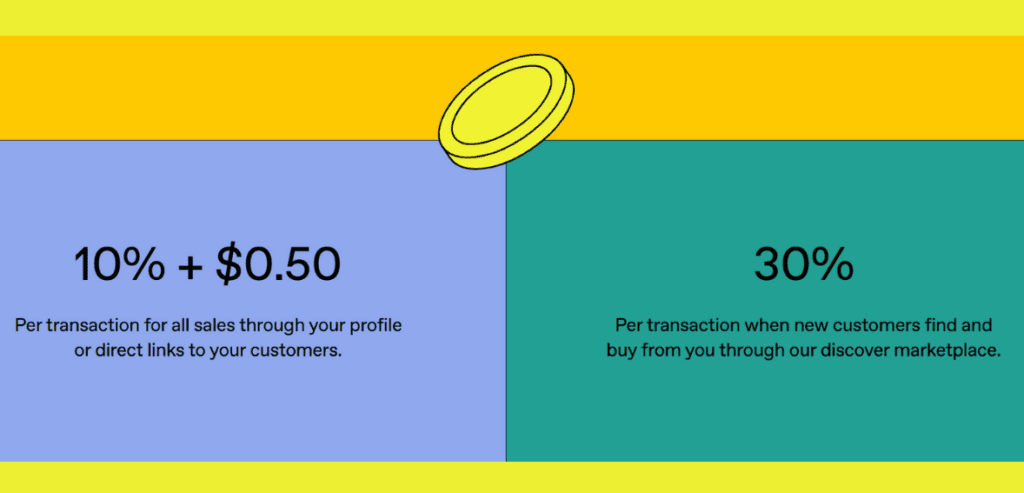
Image source
Gumroad replaced its monthly platform-fee model with a transaction fee. This fee stands at a flat 10% on each sale. The Gumroad model is relatively cost-effective, especially for low-volume sellers just starting out. In the long run, sellers may shift to other alternatives depending on sales volume.
This fee model can be understood as a two-faced coin; those changes depend on the demand a seller caters to. In terms of restrictions, Gumroad positions itself as a ‘Creator-First’ platform and thereby prohibits resale of products that don’t qualify as the respective seller’s intellectual property. Unlike other online retail platforms such as AliExpress, Gumroad threatens immediate account suspension for property and concept theft.
Additionally, a significant concern with Gumroad involves the ‘Gumroad Discover’ marketplace. When a customer finds your product through Gumroad’s internal search engine rather than your direct link, the platform takes a 30% Discovery Fee. While this marketplace helps creators by providing exposure, the high costs are a major limitation for those seeking to maximize profit margins.
Gumroad Limitations: POD and Customization Challenges
Print-on-demand (POD) has emerged as one of the most sought-after ecommerce services, owing to its relatively lower overhead costs. In addition to a few platform limitations, the lack of effective POD integration is a major concern, creating manual hurdles. Competitors such as Shopify and WooCommerce offer installation services for several custom printing businesses, including Printful, Printify, and Gooten. Not only does Gumroad fail to offer these, but it also lacks any native dashboards that sync a creator/seller’s designs directly with a printing house.
This requires sellers to manually forward their orders, shipping details, and designs to another POD provider. Third-party middleware, such as Zapier, increases costs through additional fees and technical difficulties. This is a significant drawback for sellers and creators looking to build clothing brands or other printing-based enterprises.
The Ecommerce platform also lacks advanced email marketing automation. While there is a provision for the seller to send basic broadcasts to customers, it does not support complex drip sequences or behavioral triggers. Such features are provided in alternatives such as Podia and Kajabi. Creators, therefore, cannot build automatic sales funnels directly within the platform.
Other limitations of Gumroad include technical constraints that limit users’ ability to scale their businesses. The customization options to make one’s storefront stand apart are extremely limited. Gumroad only offers the option to customize colors and add a unique header image. Additionally, users cannot change the layout, resulting in all storefronts appearing monotonous and indistinguishable. The creator’s personal voice, as well as the brand’s, can get lost in this process. The platform also lacks a good variety of marketing and SEO tools. These are essential for driving organic traffic and sales, and their absence negatively affects the business.
Why Choose Gumroad? Global Reach and MoR
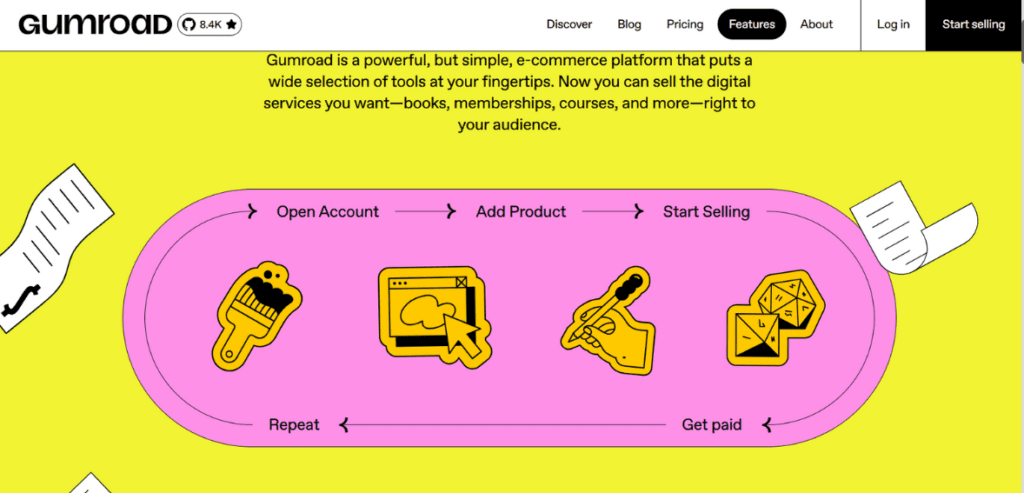
Image source
Despite the limitations mentioned above, Gumroad offers several features that make it a strong contender. The platform’s checkout supports PayPal and a wide range of credit cards. This helps build trust with customers and, in turn, leads to higher sales. Gumroad also supports transactions in a variety of global currencies, expanding the reach of users to customers in various countries.
Since 2025, Gumroad has served as the Merchant of Record (MoR) for creators, assuming full legal liability for transactions, tax compliance, and fraud monitoring. The collection and remittance of Value Added Taxes (VAT) in the EU and the UK, as well as in multiple U.S. states, are handled by the platform. This service reduces the cost of tax compliance that a small seller would otherwise incur.
Top Gumroad Alternatives in 2026
Despite the multiple incentives and ease of operation offered by Gumroad, the limitations could certainly be dealbreakers for certain sellers. In light of this, here are a few Gumroad alternatives that have gained traction over the years:
- Shopify: Shopify has emerged as an industry standard, particularly due to its scalability. From homegrown hobbies to global brands, the platform encompasses a wide range of enterprises and offers longevity and gradual support for expansion. Users rarely feel the need to switch to other platforms for the same reasons. Additionally, Shopify streamlines and automates through effective POD integration. All major POD providers, such as Printful, Printify, and Gelato, are deep-synced. With a monthly fee of $39, Shopify is best for serious entrepreneurs who plan to expand over time.
- Sellfy: Sellfy is Gumroad’s direct alternative, characterised by its massively sought-after feature designed for those selling custom merchandise. Their built-in POD feature eliminates the need to use a third-party POD service. Instead, sellers can use Sellfy’s internal POD catalog, which includes products such as mugs, apparel, and stickers that can be customized in a few simple steps. Despite a revenue cap that increases the monthly membership fee based on the seller’s annual sales, creators and artists must monitor this platform. Compared with Gumroad, Sellfy provides a more robust POD experience without requiring manual order forwarding.
- Payhip: Payhip offers the same features but with greater flexibility for sellers and a significantly lower fee structure. The pricing is Payhip’s biggest incentive, as the Free Forever Plan allows the seller to operate on a mere 5% transaction fee, which by itself is just half of Gumroad’s fee. If necessary, sellers can also upgrade their monthly plans to reduce or eliminate the transaction fee. Much like Gumroad, Payhip also acts as a Merchant of Record for EU and UK VAT. Despite the absence of native POD synchronization, it integrates efficiently with automation tools that support POD workflow management, unlike Gumroad. This is a solid choice for beginners on tight budgets and facing other constraints. It also promises a higher profit margin for creators, unlike Gumroad, which charges twice Payhip’s transaction fee.
Conclusion
Gumroad is best used as an effective, rapid monetization tool. It remains an increasingly accessible entry point and a beginner-friendly platform for creators worldwide. Gumroad is a suitable choice for writers, artists, and coders seeking to sell digital products, as well as those who want to avoid manual tax compliance.
On the other hand, it is unsuitable for those responsible for print-on-demand businesses and for those building brands with a distinct voice. Gumroad overthrew power hierarchies and is focused on frictionless entry into business, followed by a smooth entrepreneurial experience. In the long run, as creators and sellers expand their scale and vision, alternatives such as Shopify, Sellfy, and Payhip might prove more sustainable. In the current creator economy of 2026, Gumroad is a perfectly acceptable place to begin, but once your vision breaks out of existing confines and fee ceilings, look out for the listed Gumroad alternatives that are as high and wide as your expanding ambitions.
FAQs
What is Gumroad and What Can I Sell on It?
Gumroad is an ecommerce platform and a simplified digital marketplace designed to be easy and accessible for both creators and sellers. It is optimized for high-speed transactions with an easy setup process and limited duration. On Gumroad, you can sell digital products such as files (PDFs, eBooks, Software Keys, and Digital Art), Memberships, Video Content (Courses/Tutorials), and physical goods.
Can I use Gumroad for print-on-demand products?
Technically, one can, but the platform poses several limitations in the sale of POD products. Unlike Shopify, Gumroad has no native print-on-demand integration. To run a POD business on Gumroad, you will have to manually forward customer details to your product supplier/manufacturer or pay for third-party automation tools like Zapier to bridge the gap.
What fees does Gumroad charge?
Gumroad charges a 10% transaction fee on every sale. This is highly beneficial for beginners but can be costly for high-volume sellers. Moreover, If a customer finds your product through the ‘Gumroad Discover’ feature, an additional 30% Discovery Fee is applied to the particular transaction.
What are the main limitations or restrictions of Gumroad?
The platform offers very little customization; storefronts and business layouts often look identical, making it hard to foster a unique brand voice. There is also a lack of advanced SEO and email marketing tools. Gumroad strictly prohibits the resale of products that are not your own intellectual property. Violations often lead to immediate account suspension. So, if you don’t own the rights to all your products, it may be deemed a violation of the platform policy.
What are some alternatives to Gumroad?
A few Gumroad alternatives are Shopify, Sellfy, and Payhip. Shopify streamlines and automates through effective POD integration. All major POD providers, such as Printful, Printify, and Gelato, are deep-synced. With a monthly fee of $39, Shopify is best for serious entrepreneurs who plan to expand over time. Sellfy, on the other hand, largely caters to those selling custom merchandise. Finally, Payhip offers features similar to the other two but with greater flexibility for sellers and a significantly lower fee structure. Pricing is Payhip’s biggest incentive, as the Free Forever Plan lets sellers operate on a mere 5% transaction fee, which is just half of Gumroad’s fee.