Host Merchant Services – Credit Card Processing and Point of Sale for Small Business


Posted: November 18, 2025 | Updated: January 20, 2026 at 11:56 AM
Stablecoins now handle trillions in annual transactions, but the blockchains they run on weren’t built for everyday payments. Most existing networks prioritize trading and general-purpose smart contracts, leaving a gap for systems that can manage fast, low-cost, and compliant money movement.
To address this, Tempo by Stripe-Paradigm is a new “payments-first” blockchain purpose-built for stablecoin transactions. Designed to match enterprise-grade scale, Tempo aims to bring the performance of Stripe’s global payment systems to the blockchain world.
Key Takeaways
- Tempo is optimized for routine stablecoin transfers and business transactions, removing unnecessary complexity from trading-focused chains.
- The network targets 100,000+ transactions per second with sub-second finality, supporting real-time global payments.
- Users can pay transaction costs directly in stablecoins (such as USDC), providing transparent, stable pricing rather than volatile gas fees.
- Features such as batch transfers, memo fields, and compliance tools (e.g., KYC and sanctions lists) cater to banks, fintechs, and large businesses.
- Built on Paradigm’s Reth client, Tempo supports Ethereum tooling and smart contracts, making it easy for developers to adopt and integrate.
Tempo by Stripe-Paradigm: A Blockchain Purpose-Built for Stablecoin Payments
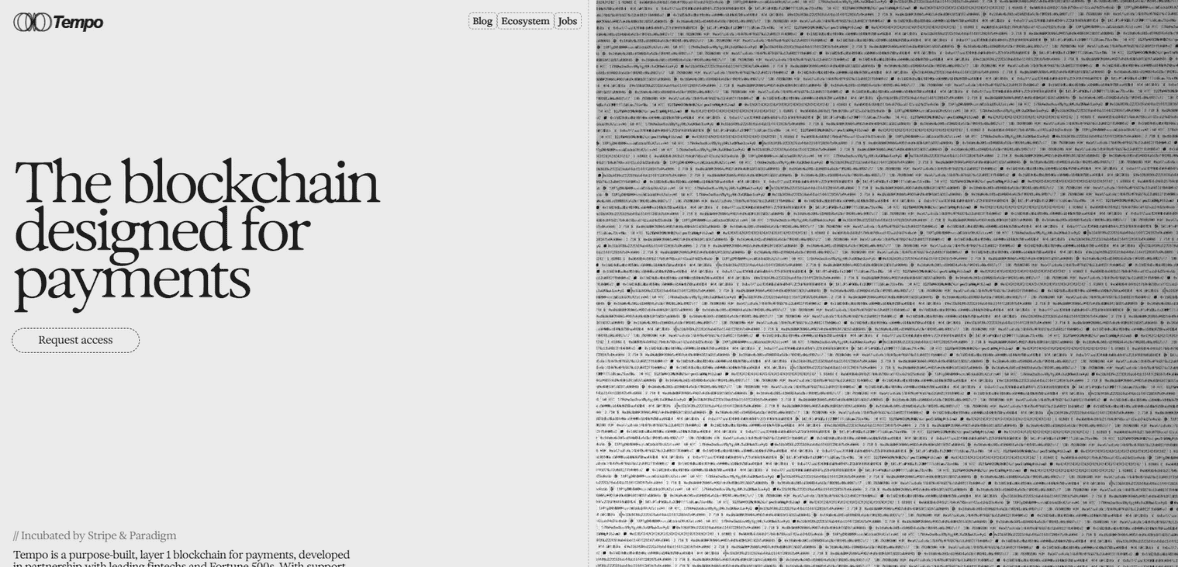
Image source
The rise of stablecoins has created a strong demand for faster, more scalable payment rails. As of mid-2025, stablecoins already accounted for roughly 30% of all on-chain crypto transactions, which is over $4 trillion in annual volume (an 83% jump from the previous year). Yet most existing blockchains were built for trading and general-purpose use, not routine money transfers. Stripe (the payments giant) and crypto VC Paradigm jointly announced Tempo, a new layer-1 blockchain explicitly designed for high-volume stablecoin payments to address this gap.
This “payments-first” network will enable businesses to move money on-chain with enterprise-grade speed and cost. Stripe’s CEO, Patrick Collison, noted that conventional chains can’t easily support such use cases. For example, Bitcoin handles ~5 transactions per second (TPS) and Ethereum ~20 TPS, whereas Stripe’s own systems peak at over 10,000 TPS.
Stripe sees Tempo as the solution—a blockchain tailored to real-world financial flows rather than crypto trading.
Stripe has already been building out stablecoin infrastructure. In May 2025, it launched Stablecoin Financial Accounts in 101 countries, powered by Bridge (a stablecoin orchestration platform Stripe acquired earlier that year). This lets businesses hold USD-pegged stablecoins and transact in traditional fiat rails globally. Even so, Stripe executives found that certain fundamental features were missing from existing networks.
As Collison explained, fees must be meaningful to users, denominated in a familiar fiat currency, but most blockchains charge gas in their native token. He also pointed out that features like batch transfers are far more critical for payments than for trading.
These insights – and Stripe’s experience handling 10,000+ TPS in peak loads – motivated Stripe and Paradigm to incubate a dedicated new blockchain. Paradigm co-founder Matt Huang wrote that “much of the existing crypto infrastructure is focused on trading,” and Tempo will be optimized for payments.
Tempo is structured as an independent startup with its own engineering team. It is an Ethereum-compatible (EVM) layer-1 built on Paradigm’s high-performance Ethereum client (“Reth”), so developers can use familiar Ethereum tools (Solidity, wallets, etc.). Tempo’s architecture isolates routine money transfers from more complex smart-contract traffic. A “dedicated payments lane” ensures that simple transactions don’t get bogged down by general-purpose activity.
Stripe and Paradigm claim that Tempo can achieve well over 100,000 TPS with sub-second finality, an order of magnitude above what any current blockchain offers. Tempo aims to deliver the latency and throughput demanded by global commerce by focusing on just the operations needed for payments.
Tempo by Stripe-Paradigm Features
- High throughput:
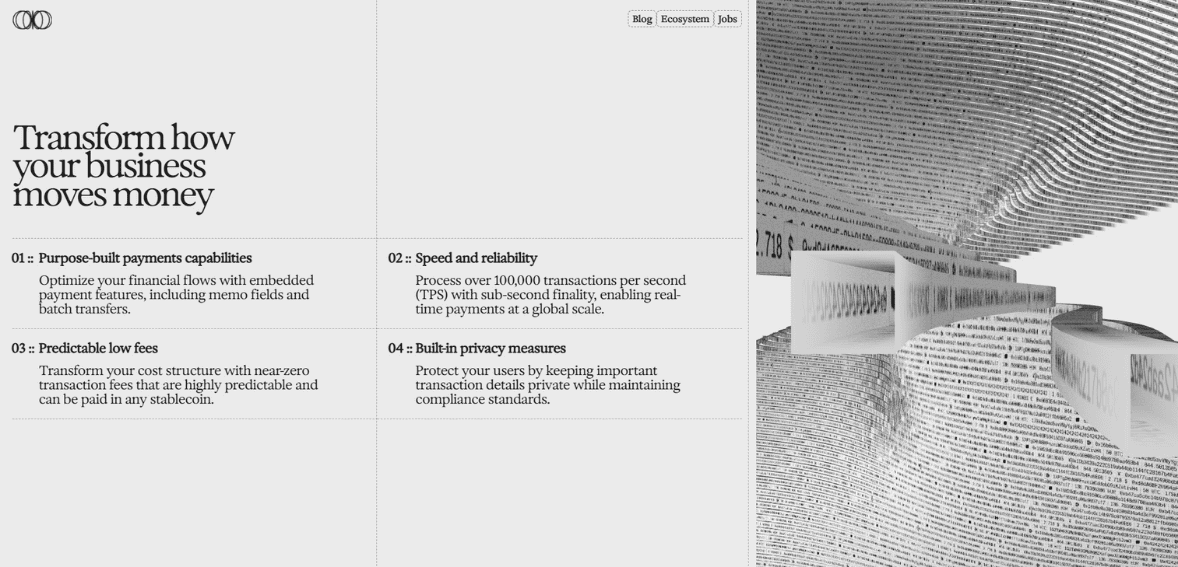
Architected for >100,000 transactions per second with near-instant final settlement. This headroom is meant to accommodate demand peaks (remember Stripe’s ~10k TPS) and keep delays negligible.
- Low, predictable fees:
Transaction fees are kept near-zero and can be paid in stablecoins rather than a volatile native token. Businesses could pay gas in USD-pegged coins (e.g. USDC) so their costs are transparent and stable, unlike on most blockchains.
- Dedicated payments lane:
Tempo allocates a portion of each block just for routine transfers. By separating everyday payments from complex smart contracts, the chain avoids congestion and keeps payment processing smooth.
- Stablecoin interoperability:
The network is stablecoin-neutral. It allows any issuer to use any stablecoin for transfers or fees. Tempo even includes a built-in automated market maker, enabling token swaps on-chain with very low friction.
- Account abstraction (memos and batch):
Tempo supports features like native memo fields and native batch transfers. Businesses can add ISO 20022–style payment references (memos) for reconciliation and bundle multiple individual transfers into a single transaction, significantly improving efficiency for payroll or recurring payouts.
- Privacy and compliance:
The chain offers optional private transactions and built-in compliance controls. User-level blocklists/allowlists let enterprises prevent sanctioned addresses or enforce KYC standards. These measures address privacy concerns while still obeying regulations – a key consideration for banks and large companies.
- EVM compatibility:
Built on the Reth client, Tempo is fully compatible with Ethereum’s ecosystem. Developers can easily port smart contracts and wallets, lowering the barrier to adoption even though Tempo is a new network.
Taken together, these capabilities make Tempo unlike any mainstream chain today. By focusing exclusively on payments (stablecoin transfers, fiat on-ramps, payroll, etc.), it omits many elements needed for crypto trading that only add cost or latency. This streamlined design is why its creators call it “purpose-built” for real-world money movement.
More About Tempo

Tempo is still in its infancy but already in trial use. A private testnet is running for select partners. These partners span fintech, commerce, and banking: design collaborators include Visa, OpenAI/Anthropic, Shopify, DoorDash, Nubank, Revolut, Standard Chartered, and others.
E-commerce and delivery companies can test cross-border payouts, while banks explore embedding blockchain payments or tokenized deposits. According to Stripe and Paradigm, use cases being tested include global payroll, intercompany remittances, embedded financial accounts, and even new AI-driven “agentic” payments.
The input from such diverse enterprises is meant to fine-tune Tempo’s features to actual business needs. (Eventually, Tempo plans to transition from its private network to a permissionless mainnet once the design is proven.)
Stripe’s rationale for all this can be summed up in two points: speed and user-friendly fees. In Collison’s words, Stripe’s payments traffic routinely outstrips what legacy blockchains can handle. And it’s not practical for a company to budget fees that fluctuate wildly with crypto markets. Tempo solves both: it delivers very high throughput and lets companies pre-purchase fee capacity in dollars (i.e., stablecoins).
Collison put it bluntly: existing blockchains “denominate their fees in blockchain-specific tokens,” whereas Stripe wanted fees “denominated in a fiat currency that makes sense to the user”. He added that features like native batch transfers (often unused in trading scenarios) are critical for payments. All these gaps led him to say, “We decided to incubate Tempo… We think of Tempo as the payments-oriented L1”.
Tempo reflects a broader shift in fintech infrastructure. It joins efforts like Circle’s new “Arc” network (announced Aug. 2025) – a multi-chain stablecoin platform for payments. These projects signal that big players see value in dedicated payment rails. If successful, Tempo could transform cross-border commerce, remittances, payroll, and more. Imagine instant, round-the-clock settlements between banks using on-chain tokenized deposits, or microtransactions for digital services priced in cents, all at minimal cost.
Companies could embed programmable payments directly into apps (for example, a ride-sharing platform issuing rides paid in stablecoins). These are the sorts of innovations Stripe cites when it talks about the next era of finance.
Of course, significant hurdles remain. Stablecoin-based systems still face uncertain regulation in many jurisdictions. Industry analysts caution that broad adoption will require clear rules and extensive testing beyond closed testnets.
Tempo’s architects are aware of this: they’ve included compliance hooks (like blocklists) and are collaborating with banks to ensure regulator comfort. In the words of crypto experts, specialized blockchains like Tempo “will likely play an even greater part in the crypto landscape” once governance catches up.
Conclusion
Stripe’s Tempo is a bold reimagining of what a blockchain can be. It’s a narrowly optimized, payments-oriented Layer-1 for the modern financial system. Stripe and Paradigm are both trying to build next-generation plumbing for cross-border transactions, embedded finance, and digital commerce by focusing exclusively on stablecoins, throughput, compliance, and UX.
If successful, Tempo could reshape how money moves globally, faster, cheaper, programmable, and finally built with business in mind.