Host Merchant Services – Credit Card Processing and Point of Sale for Small Business

Posted: September 30, 2025 | Updated: January 20, 2026 at 12:22 PM
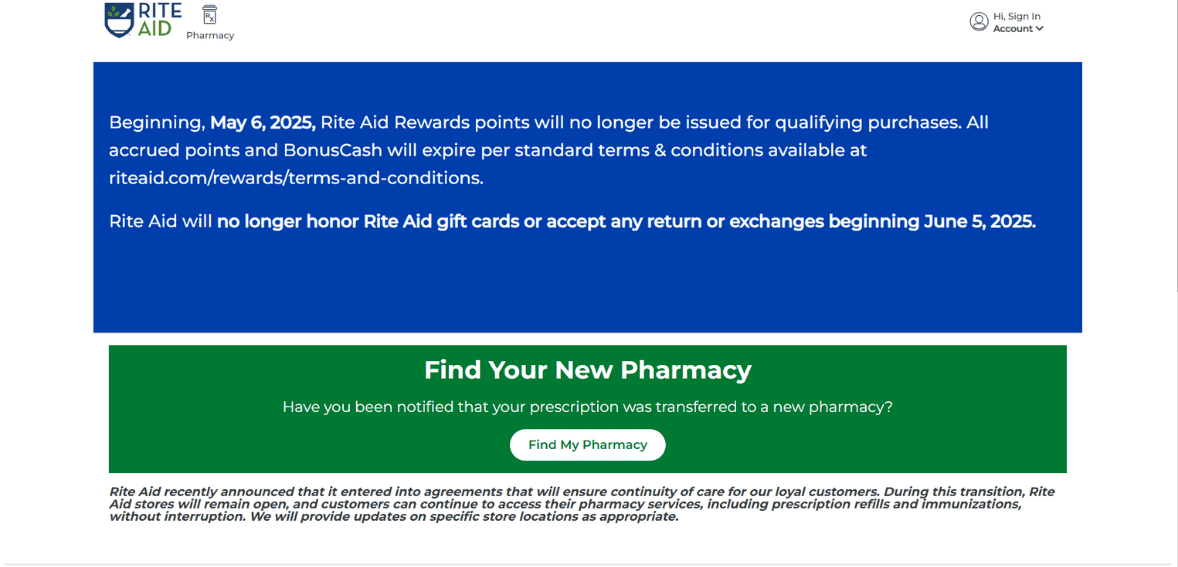
Rite Aid Corporation, once America’s third-largest drugstore chain, filed for Chapter 11 bankruptcy (again) in May 2025, barely a year after emerging from its first reorganization. The company’s woes trace back years of heavy debt, sluggish retail performance, and mounting legal liability from the opioid crisis, which have all conspired to sink the chain.
In 2023, Rite Aid (with roughly 2,000+ stores) collapsed under about $4 billion in funded debt and over a thousand opioid-related lawsuits. Its October 2023 Chapter 11 filing gave it a temporary respite, closing hundreds of unprofitable stores and cutting $2 billion of debt, but it did not cure the underlying problems. By May 2025, the company was still on life support. Rite Aid second bankruptcy filing aims to liquidate remaining assets and satisfy creditors. This will mean shrinking Rite Aid’s footprint to perhaps a thousand stores or less, as many locations are sold to or closed in favor of competitors.
Key Takeaways
- Second bankruptcy in 8 months: Rite Aid filed for bankruptcy again in May 2025 after exiting its first Chapter 11 in October 2023.
- Debt & opioid lawsuits: Massive liabilities and thousands of opioid-related suits drove the new filing.
- Aggressive store cuts: From ~2,200 stores in 2023 to about 1,000 or fewer, including 114 more closures approved for mid-2025.
- Asset sales & prescription transfers: Selling remaining assets and shifting customer prescriptions to CVS, Walgreens, and others to repay creditors
- Industry headwinds: The turmoil reflects broader pharmacy pressures, as CVS, Walgreens, and others also slim down, while Amazon, Walmart, and e-pharmacies gain ground.
Background: Rite Aid’s Rise and Long Decline
Image source
Founded in 1962, Rite Aid grew into a national pharmacy chain. At its peak in the 2010s, it operated thousands of stores across more than a dozen states. However, aggressive expansion saddled Rite Aid with heavy debt, and it never attained the economies of scale of its two main competitors.
In the mid-2010s, Rite Aid struck a deal with Walgreens Boots Alliance. Walgreens agreed to buy about half of Rite Aid’s locations (over 2,000 stores) for $5.18 billion. Walgreens acquired many Rite Aid stores (mainly in the Northeast, Mid-Atlantic, and Southeast), leaving Rite Aid a much smaller chain (roughly half its former size). Antitrust concerns had scuttled Walgreens’ original plan to acquire all of Rite Aid; they instead settled for a partial acquisition. This left Rite Aid vulnerable, unable to compete on a scale with the giants CVS and Walgreens.
In 2023, Rite Aid’s remaining store network numbered around 2,100 locations (across 17 states), making it the third-largest standalone U.S. pharmacy chain (CVS and Walgreens being far bigger). The company had been losing money: it reported roughly $750 million in losses for its fiscal year before filing (FY2023).
Its balance sheet was grim, with approximately $4 billion in debt obligations. Top executives and analysts routinely cited pressures on Rite Aid’s business. Margin pressure on prescription drugs, cutthroat competition (from CVS/Walgreens as well as big-box retailers and mail-order services), and the evolving healthcare landscape were the top reasons. In mid-2023, then-interim CEO Busy Burr acknowledged significant losses and stated that Rite Aid was closing underperforming stores to reduce costs.
Despite such belt-tightening, Rite Aid’s situation continued to worsen. Ongoing national crises hit the chain in healthcare and retail as e-commerce and mail-order pharmacies (such as Amazon’s PillPack service) were cutting into walk-in prescription business, and reimbursements from insurers were flat or falling.
With little room to grow or improve profit margins, Rite Aid leaned on debt and asset sales (including selling its pharmacy benefit manager Elixir in prior years). Nevertheless, at the end of 2023, Rite Aid could no longer service its debt or fund operations. In mid-October 2023, Rite Aid filed for Chapter 11 bankruptcy protection in New Jersey, marking its first bankruptcy in over 30 years. This restructuring brought relief in the short term. The company reduced its debt by approximately $2 billion and sold Elixir during this process. But many of Rite Aid’s underlying challenges remained.
Opioid Litigation and Debt: The Tipping Point

A major driver of Rite Aid’s downfall has been its liability in the U.S. opioid epidemic. Like other pharmacy chains, Rite Aid has been sued by hundreds of local governments and individuals who accuse it of oversupplying addictive opioid painkillers. More than 1,600 lawsuits had been filed against Rite Aid by late 2023, including a case by the U.S. Department of Justice. The core allegation is that Rite Aid turned a blind eye to “red flags” (such as suspicious prescription patterns) when filling opioid prescriptions.
Those lawsuits threatened potential liabilities in the billions of dollars. Rite Aid’s court filings explicitly cite opioid litigation as a critical factor pushing the company into bankruptcy. Rite Aid struggled due to its high debt, revenue declines, increased competition, and opioid litigation, as stated in the company’s own bankruptcy filings. The opioid lawsuits didn’t, by themselves, cause Rite Aid to become bankrupt, but they exacerbated its precarious financial situation and limited its ability to borrow or invest.
Rite Aid used the first bankruptcy to address some of this liability. Under the Chapter 11 plan, it negotiated with many creditors, including state and local governments, to resolve these claims. Its plan provided a fund of roughly $47.5 million to pay some of the minor opioid claimants. The first reorganization also consolidated opioid liabilities into the general claims process, forcing creditors and insurers to share the burden.
Nevertheless, not all lawsuits have been resolved, and litigation costs remain a significant concern. Some state attorneys general objected to Rite Aid’s initial settlement plan, arguing the company was not setting aside enough for future claims.
Store Optimization and Closures

Almost from the day Rite Aid filed in October 2023, the company began cutting back its retail footprint. Management and its financial advisors judged that many stores were unprofitable, so an aggressive store-closure plan was part of the bankruptcy strategy. As a result, Rite Aid closed 154 underperforming stores almost immediately after the initial filing.
This move to “optimize” store alone accounted for about 7% of the chain’s locations (Rite Aid reported having roughly 2,284 stores at the time). The closures affected a range of markets; dozens of locations in states such as Pennsylvania, California, New York, and Ohio were shuttered in the first wave.
The closures continued through the restructuring process. By early 2024, Rite Aid had closed “hundreds of additional stores” beyond the initial 154, cumulatively trimming its network to roughly 1,245 locations by the end of its first bankruptcy period. Before filing for bankruptcy, it had operated 2,000 pharmacies. The scale of closures was massive. Rite Aid’s store count shrank by about half in the 12 months from late 2023 to late 2024.
CFO Dive noted that Rite Aid had proactively closed more than 200 “underperforming” stores in the years preceding bankruptcy, and these efforts accelerated once Chapter 11 gave the green light to jettison leases.
Now, under Chapter 11, the chain is closing even more stores. A New Jersey bankruptcy judge approved the closure of 114 additional Rite Aid stores in July 2025 as part of the reorganization plan. These closings span multiple states – notably, Pennsylvania is seeing dozens of closures – and will take place in the weeks after approval.)
Throughout this contraction, Rite Aid has tried to maintain pharmacy services in affected markets by transferring prescriptions. Whenever a store closes, Rite Aid’s plan is typically to send those customer records to nearby competitors, allowing patients to continue getting their refills. In fact, the bankruptcy documents reveal that Rite Aid has lined up buyers for most of its prescription files. Rite Aid has arranged to sell customer prescription profiles to 13 different pharmacy chains, including CVS, Walgreens, Albertsons, and Kroger.
By mid-May 2025, the company stated that it had secured buyers for approximately 810 of its remaining stores, with competitors either purchasing the stores themselves or taking over the prescription traffic. CVS is the largest single buyer – it agreed to acquire 64 store locations and take over prescriptions at 650 more.
Many Rite Aid customers will be directed to CVS, Walgreens, Giant Eagle, Albertsons, or other chains for their future prescriptions. Rite Aid has posted official lists of closing-store pharmacies and designated transfer pharmacies on its website, so patients know where to go.
Rite Aid Second Bankruptcy Filing (May 2025)

In May 2025, just eight months after emerging from Chapter 11 in September 2024, Rite Aid filed for bankruptcy again. By then, it was evident that the first reorganization had not fully stabilized the business. The May 2025 filing (in the same U.S. Bankruptcy Court for the District of New Jersey) reaffirmed that the chain was still overwhelmed by debt and liability. The clock ran out on Rite Aid’s post-reorganization runway, forcing a new court intervention.
The second bankruptcy is intended to be more of a liquidation than a mere restructuring. According to Rite Aid and its advisors, the goal is to address all remaining debt and litigation claims by selling off assets and winding down operations. In practical terms, this means Rite Aid is requesting that the court permit it to sell or liquidate the remaining assets of the business.
In mid-2025, Rite Aid sought approval to sell its remaining pharmacy assets in a bulk transaction. The court approved a kind of “fire sale” of most remaining assets, allowing competitors to buy stores and customer files. Rite Aid’s counsel told the judge that transferring customers’ prescriptions to other pharmacies was a top priority, and the sales process was structured to serve that goal.
Additionally, Rite Aid has sought new financing to sustain the company through the sale. The company obtained commitments for about $1.94 billion in debtor-in-possession financing from its existing lenders. This is essentially new cash to keep stores open and pharmacists paid during the Chapter 11 process. Attorneys say this money, plus whatever cash Rite Aid can earn by operating a slimmed-down chain, should be enough to fund the asset sales and wind-down. The company has also stated it will “divest or monetize any assets” not sold via the court process.
Notably, the filing makes it clear that Rite Aid is actively in discussions with potential buyers. The CEO has stated that the company has received “meaningful interest” from national and regional pharmacy chains to acquire parts of Rite Aid. Walgreens, CVS, Albertsons/Kroger, and local chains like Bartell Drugs have all been reported as interested in picking up select locations and prescription customers.
The reorganization is structured as a series of piecemeal asset sales. Some buyers will acquire existing stores (often co-located in shopping centers), while others will acquire only customer accounts and patient records. Meanwhile, Rite Aid continues to negotiate with creditors (e.g. landlords and insurers) on the terms of leases and liability release. The company’s managers emphasize that pharmacy operations will continue to run during the process, and that employees handling prescription transfers will remain on payroll. But the long-term intent is clear: absent a single buyer willing to take over the whole enterprise, Rite Aid is being dismantled state by state.
Impact on Employees and Customers
Every Rite Aid closure affects real people and communities. On one side are the employees: each shuttered store results in dozens of layoffs, many of which are among part-time workers and retail associates. Union representatives and advocates have highlighted the human cost. A Philadelphia union leader noted that Rite Aid clerks are “mostly women, working part-time while raising families” – meaning that closures disproportionately affect working mothers and others who relied on these jobs.
Nationwide, local press reports say hundreds of employees have already been laid off through the first round of closures, with many more expected as the second bankruptcy proceeds. (Rite Aid has said it will try to keep pay and benefits intact during store transfer operations, but once a location shuts permanently, most staff are ultimately let go.)
On the customer side, closures raise access and continuity issues. In towns where Rite Aid was one of the only drugstores, people now must travel farther or find alternatives for medicine pickup. Observers are already warning of emerging “pharmacy deserts.” The spate of Rite Aid closures – many of which have been sold to CVS/Walgreens or have closed – has raised concerns that this could limit Americans’ access to essential medications as communities lose nearby pharmacies.
When combined with other chain closures (CVS, Walgreens, and small independents have also been closing stores), some neighborhoods – especially those in poorer or rural areas – may find themselves with limited pharmacy options.
To mitigate disruptions, Rite Aid has supplied customers with transfer instructions. On its website and in local press, the company has published lists of closing-store addresses paired with nearby alternate pharmacies. A Rite Aid in Pittsburgh, closing in June 2025, directed patients to nearby Walgreens or Giant Eagle locations for their prescription needs. Pharmacists and staff in many closing stores spend their last days helping patients sign over prescriptions. Still, the transition isn’t seamless: some customers report confusion or delays, and not every prescription (mainly controlled substances) can be easily transferred.
Beyond individual communities, the closures also carry broader consumer implications. In markets where Rite Aid shrinks or exits, competition among pharmacy chains becomes less intense. Economic studies suggest that fewer competing pharmacies can lead to higher drug prices and reduced service. (CVS and Walgreens, the big remaining players, have not always positioned stores close to each other – so losing Rite Aid locations may not spur immediate new entrants.) In the short term, some customers worry about higher costs or fewer pharmacy choices in neighborhoods affected by closures.
Restructuring Path Forward
What comes next for Rite Aid? The Chapter 11 process is designed to answer that question over the coming months. Rite Aid’s management is pursuing a sale-and-restructure strategy. The company will finalize deals with buyers for as many stores and prescription portfolios as possible, use the proceeds to pay down debt, and aim to settle the remaining obligations. Under court supervision, the goal is to emerge (if at all) as a much smaller entity with a clean balance sheet.
So far, the data suggest that Rite Aid will emerge from bankruptcy with only a slice of its former business. The company has committed to “pursue sales of substantially all of its assets.” That means every remaining store and pharmacy asset is on the market. As noted, CVS, Walgreens, Kroger/Albertsons, and Giant Eagle have already struck deals to acquire hundreds of stores and millions of prescription records. Even Bartell Drugs (a regional chain) showed interest in buying some Northwest Rite Aid stores. In markets where no buyer steps up, the store shuts and the leases are rejected (a common practice in bankruptcy).
Behind the scenes, creditors and courts are also hashing out the non-store items. This includes settling with insurers (who had funded Rite Aid’s health plans), disentangling vendor contracts, and possibly establishing an opioid litigation trust – a mechanism where Rite Aid’s remaining assets would be pooled to pay claimants over time. (In similar retail bankruptcies, companies have used 363 sales and trust structures to handle tort claims.) Rite Aid’s lenders, having already taken control of the company in the last reorganization, are motivated to recoup whatever value is left.
Analysts caution that the chain’s long-term survival as an independent pharmacy franchise is in doubt. Some observers suggest that Rite Aid may not survive in its current form – instead, it may be liquidated more fully, with only a handful of stores being transferred to competitors. As one insurer commented, this second bankruptcy “is meant to facilitate total liquidation of the company’s assets.” However, there is still a possibility that Rite Aid could re-emerge, at least in name, on a smaller scale.
If enough buyers take on branches and a settlement trust covers the central claims, what remains of Rite Aid could be relaunched under new ownership (likely the former creditors), focusing on its core markets. This slimmed-down Rite Aid might operate a few hundred stores on the West Coast and East Coast, rather than the multi-state chain it once was.
Pharmacy Industry Trends: Consolidation and Competition

Rite Aid’s collapse is not happening in a vacuum – it reflects a larger upheaval in the U.S. retail pharmacy industry. The industry has been consolidating and contracting for years. Even before Rite Aid’s troubles, its two largest peers were already retrenching. In late 2024, Walgreens announced plans to close 1,200 stores over three years (with about 500 slated for 2025). CVS Health, the market leader, also signaled large-scale closures, stating it would shutter approximately 270 stores in 2025. These cuts by CVS and Walgreens stem partly from overbuilt footprints (both had expanded rapidly in previous decades) and partly from the same margin pressures affecting Rite Aid.
Meanwhile, new competitors are reshaping the field. Amazon has aggressively expanded into pharmacy services – since acquiring PillPack in 2018, it has launched Amazon Pharmacy and even acquired the One Medical clinic network in 2023 to provide prescriptions through telehealth. Walmart, which operates a massive chain of superstore pharmacies, is upgrading its digital and delivery capabilities (opening large prescription fulfillment centers and bundling RX with grocery delivery).
This market context helps explain why a once-major chain like Rite Aid could crumble. It’s similar to how mid-sized grocery chains or regional department stores have vanished due to their inability to compete with national retailers and e-commerce. The surviving major pharmacies (Walgreens/CVS) are still under threat, so they are also cutting costs and closing stores. Every Rite Aid exit means one less competitor, in turn raising questions about drug pricing and consumer choice. In some towns, customers have already started complaining about limited options for their prescriptions.
Conclusion: Lessons for the Market and Consumers
Rite Aid’s second bankruptcy—the largest ever among U.S. retail pharmacies—highlights how volatile the pharmacy sector has become. Consumers can still fill prescriptions for now, thanks to transfers to other chains; however, fewer neighborhood pharmacies may eventually drive up prices and limit access, especially in low-income and rural communities that are already vulnerable to “pharmacy deserts.” Some relief could come as larger chains, supermarkets, and insurers move to plug gaps and guide patients toward remaining outlets.
For the industry, the case serves as a stark warning about the risks of financing, compliance, and litigation. Pharmacies must invest more in fraud detection, prescription monitoring, and risk management to avoid a similar collapse, while regulators and insurers are tightening standards after Rite Aid’s opioid-related lawsuits. Though the company aims to reorganize by mid-2025, analysts expect it will shrink drastically or be broken up, leaving only fragments of the brand—a cautionary tale of overexpansion and mounting legal liabilities in a tightly regulated market.
Frequently Asked Questions
Why did Rite Aid file for bankruptcy again?
Rite Aid still faced heavy debt, unprofitable stores, and billions in opioid lawsuit liabilities even after its 2023 Chapter 11. In May 2025, it entered bankruptcy again to cut more debt, settle lawsuits, and continue operating a smaller chain.
How have opioid lawsuits affected Rite Aid?
States and others sued Rite Aid over improper opioid prescriptions. Legal costs and potential settlements drained the company’s cash, forcing store closures and pushing it back into Chapter 11 to negotiate a global settlement.
How many Rite Aid stores are closing, and what does it mean for customers?
Since 2023, Rite Aid has closed hundreds of locations, with the store count falling from approximately 2,200 to around 1,200, and more closures are pending approval. Prescriptions from closed stores are typically transferred to nearby pharmacies, such as CVS or Walgreens.
Is Rite Aid going out of business entirely?
No. The plan is to emerge from Chapter 11 as a smaller company by selling assets and closing weak stores. Long-term survival isn’t specific, but many Rite Aid pharmacies are expected to remain open during the restructuring.
What does Rite Aid’s bankruptcy say about the pharmacy industry?
It reveals intense competition, thin margins, and legal risks in the retail pharmacy industry. Chains are cutting locations and shifting toward medical and digital services, and Rite Aid’s struggles signal the traditional drugstore model must adapt quickly.